



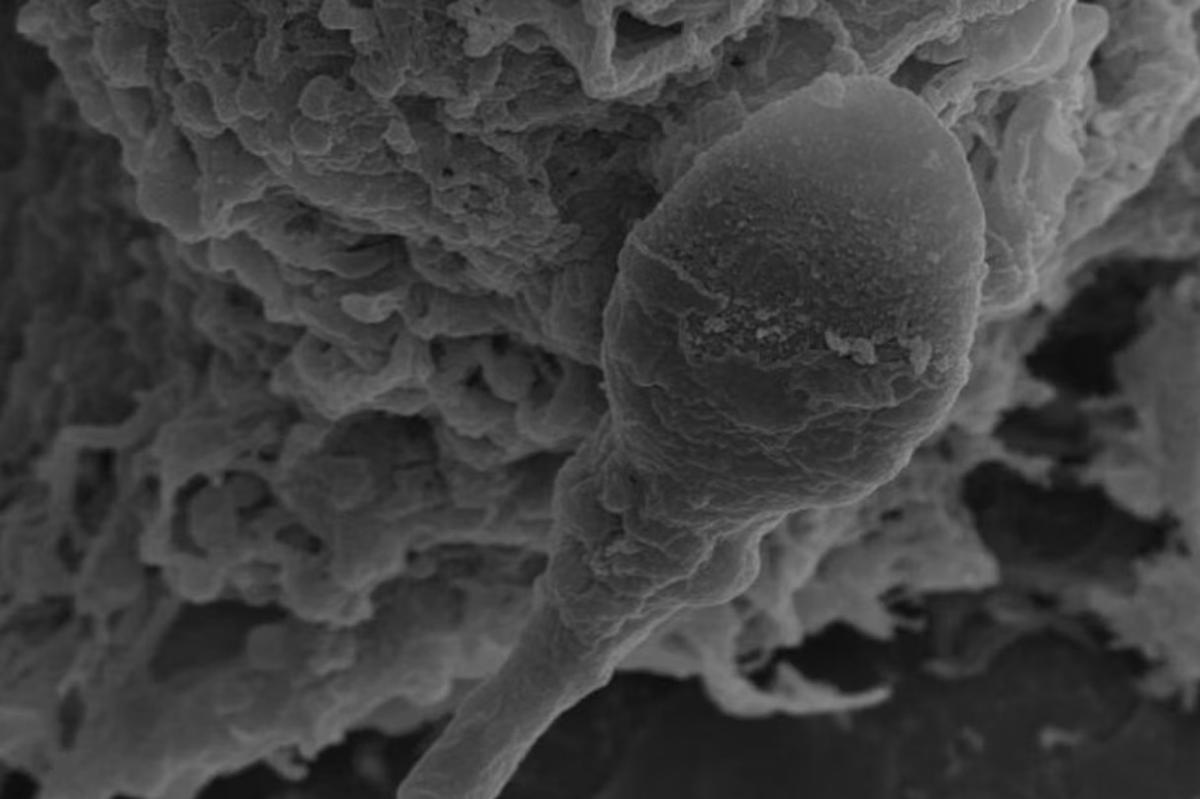
These swimmers are sure to sink.
Human sperm can get lost in space, new research shows.
Scientists put sperm to the test to determine whether a child could be conceived in space, using a tiny plastic “obstacle course.”
The findings, published in the journal Communications Biology, showed that the navigational abilities of sperm are negatively impacted by a lack of gravity, and having a baby in space may require “a bit more direction.”
While previous studies have looked at sperm’s ability to move in space, this research is the first to evaluate the sperm’s ability to navigate through a reproductive channel under the conditions of space.
“This is the first time we have been able to show that gravity is an important factor in sperm’s ability to navigate through a channel like the reproductive tract,” senior author Dr. Nicole McPherson from Adelaide University’s Robinson Research Institute said in a statement.
Sperm samples from three different mammals, including humans, were put through an obstacle course that simulates the zero-gravity conditions — called a clinostat — so the cells become disoriented.
The sperm then traveled through the maze, which was designed to resemble the female reproductive tract.
“We observed a significant reduction in the number of sperm that were able to successfully find their way through the chamber maze in microgravity conditions compared to normal gravity,” McPherson said.
“This was experienced right across all models, despite no changes to the way sperm physically move. This indicates that their loss of direction was not due to a change in motility but other elements.”
When the scientists added the sex hormone progesterone, which is vital for pregnancy establishment, more human sperm were able to conquer the negative effects that the simulated microgravity had on navigation.
McPherson noted that the researchers believe this is because progesterone is also released from the egg and can help guide the sperm to the site of fertilization, but “this warrants further exploration as a potential solution.”
The scientists also looked at the effects of exposure to microgravity had on embryo development in the animal models, and the experiments showed that sperm were roughly 50% worse at navigating under space-like conditions, though it resulted in just a 30% drop in fertilization.
They found a 30% reduction in the number of mouse eggs that were successfully fertilized after four hours of zero-gravity exposure, compared to traditional conditions on Earth.
However, the sperm that did make it through seemed to produce higher quality embryos, which could turn out to be “beneficial.”
It appeared that the stress of the microgravity worked as a “filter” that left “only the most capable sperm in the running,” McPherson explained, per Medical Xpress.
However, after the first 24 hours, “the results reversed sharply, with fewer embryos formed, and those that did were of poorer quality,” she said.
“We observed reduced fertilization rates during four-to-six hours of exposure to microgravity,” McPherson shared. “Prolonged exposure appeared to be even more detrimental, resulting in development delays and, in some cases, reduced cells that go on to form the fetus in the earliest stages of embryo formation.”
“These insights show how complex reproductive success in space is and the critical need for more research across all early stages of development.”
The findings suggest that microgravity “may not be the deal-breaker,” but protecting the embryo from weightlessness in the critical first hours “will likely be essential for reproduction in space.”
The study is in collaboration with Adelaide University’s Andy Thomas Centre for Space Resources, which focuses on challenges of long-term planetary exploration and living in environments not on Earth.
“As we progress toward becoming a spacefaring or multi-planetary species, understanding how microgravity affects the earliest stages of reproduction is critical,” Associate Professor John Culton, Director of the Andy Thomas Centre for Space Resources, noted.
“In our most recent study, many healthy embryos were still able to form even when fertilized under these conditions. This gives us hope that reproducing in space may one day be possible,” McPherson added.
She emphasized that much more research is needed to understand how reproduction would work in space, noting that fertilization is “only one small piece of a very long and complex puzzle.”
“We are still a long way from seeing the first space baby,” she said.
Read the full article here