


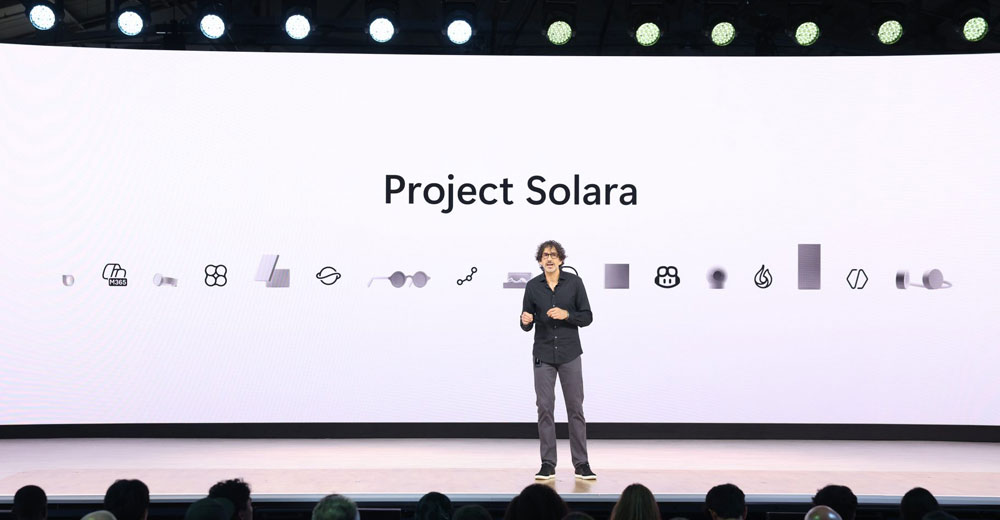
At Build 2026, Microsoft previewed a genuinely good idea: Project Solara. Solara has three important layers: an operating system built for AI agents instead of apps; a governance standard that controls what those agents can touch; and a data layer that lets an agent understand a company’s files, meetings and permissions while respecting existing access controls.
Then Microsoft showed two concepts as examples of what could be built with the Solara stack: a desk hub that sits beside a PC and can integrate with Windows 365 in the cloud, and an ID badge for frontline workers. They represent two very different directions with no clear priority.
AI wearables could become the next major extension of mobile computing. Project Solara looks like Microsoft’s attempt to make sure it does not watch another device cycle develop from the sidelines.
However, what Microsoft showed at Build raises two very different questions. Has it effectively conceded consumer mobility and chosen enterprise as its battlefield? Can it convince hardware partners to build Solara devices that customers want — and OEMs can sell profitably?
The Windows Challenge
Microsoft’s Windows OEM and Devices revenue has been essentially flat for the last several years and has consequently declined as a percentage of Microsoft’s total revenue.
However, revenue undersells what Windows does for Microsoft. It’s still the surface through which Microsoft 365, Copilot, security and identity reach a billion machines. Windows isn’t dying. It just isn’t carrying the strategic weight it used to.
Apple is pressing that weakness. In March, it put an iPhone chip in a laptop and sold it for $599. The MacBook Neo moved 1.1 million units in roughly three weeks and outsold every other Mac in its debut quarter. Mac revenue hit $10.4 billion in Apple’s June quarter, up 29%, growing about three times faster than units did.
The pressure isn’t only from a more aggressive MacBook lineup. Apple continues to pressure Windows from the sides with Continuity features spanning phones, watches, earbuds, and eventually AI-powered wearables such as glasses. That ecosystem presents a difficult challenge for Microsoft.
The Consumer Front Door Is Closed
Apple took 23% of smartwatch shipments in the first quarter and more than half of North America. Samsung managed about 7%. Smart glasses grew 167% year over year, with Meta holding somewhere between 69% and 84% depending on whose numbers you trust.
Microsoft isn’t meaningfully in that market today, and it has no obvious direct route back in. Most consumer wearables depend on a phone as the hub, and Microsoft doesn’t have one. Samsung’s bridge to Windows is Phone Link, which is Microsoft’s own product and only exists because Android does.
Agentic AI might loosen the app store’s grip on distribution. It doesn’t erase installed base, identity or default-device advantage. Microsoft would still be walking into a living room owned by Apple, Google, Samsung and Meta.
The pattern extends beyond phones. Microsoft increasingly treats Xbox as a cross-platform content and services business even while continuing to develop console hardware. That is not a retreat from devices. It is a reluctance to make proprietary hardware the center of the strategy.
Solara Gives Microsoft a Different Way In
Credit where it’s due: Microsoft made several smart architectural choices.
Solara runs on the Microsoft Device Ecosystem Platform (MDEP), an enterprise build of Android that Microsoft originally made for Teams room hardware. Microsoft chose Android on purpose for small, low-power devices, while keeping Intune, Entra ID, Defender, and over-the-air patching. The silicon comes from Qualcomm and MediaTek rather than a Microsoft-designed chip.
Governance runs through the Agent Control Specification, a portable, vendor-neutral standard rather than a lock-in play. Microsoft won’t build the hardware at all; partners take the reference designs and turn them into products.
Each of those choices reflects a lesson Microsoft learned the hard way, several of them from HoloLens specifically.
Commercial is also the right battlefield. Consumer wearables are heavily influenced by fashion, ecosystem, and phone attach. Commercial wearables live or die on workflow, management, identity, security, and measurable ROI. For a nurse’s badge or a warehouse picker’s glasses, the deciding question isn’t camera quality. It’s whether the company can control where the data goes, who can access it, and how long it is retained.
So Why a Desk Hub?
The desk device isn’t a bad idea. A trusted shared endpoint with face sign-in has real uses: hot-desking, supporting frontline shift workers, and providing a persistent agent in a room. But attach a monitor, and it becomes a Windows machine running in the cloud, which drags Windows back into a story Microsoft had correctly made Windows-free — and it does nothing to put Microsoft into the moving, hands-free environments where the more disruptive opportunity may be.
The badge is the better concept. It’s mobile, and it’s more than a credential. One press wakes an agent, one tap records and transcribes, and there’s a camera. Devices like Plaud already sell into that space, so the real question is what Solara adds. There’s a good answer Microsoft barely bothered to make. Plaud sends your audio to Plaud’s cloud. A Solara badge could keep the data under Microsoft 365 identity, access, and retention controls.
That camera, though.
A chest-mounted camera is difficult to aim without the wearer looking down, which defeats the whole eyes-up premise. It also films whoever happens to be standing in front of the wearer — patients, customers, colleagues — none of whom agreed to be recorded.
In a hospital, that immediately raises patient-privacy questions. In other workplaces, it creates consent, retention and data-protection issues that vary by jurisdiction. Those privacy concerns are also part of what helped kill Google Glass and remain a challenge for emerging smart glasses.
Microsoft has capable tools for addressing the camera challenge: recording indicators, tenant-bound capture, and retention enforced by the recently published Project Solara governance spec. Those capabilities could make governance a competitive advantage. The strange part is that it barely made that case.
The Bigger Risk: Who Builds It?
Here’s the part that should worry Redmond. Solara only works if somebody builds the hardware, and Microsoft hasn’t named a single Solara device partner. It does have a growing MDEP ecosystem, but Solara is asking those partners to do something much harder than build another Teams appliance.
A hardware company must invest in a new class of mobile AI device, determine the form factor, solve battery life and thermal constraints, build around cameras and sensors, prove a new workflow, and then convince enterprises to deploy it at scale.
The economics don’t help either. HP’s PC business runs around a 5% operating margin. Dell’s client group sits near 6%. OEMs will accept thin hardware margins if the device pulls through management revenue, support contracts, integration work, or enterprise accounts. But Microsoft hasn’t described that stack. So far, the company has said little about the business model beyond the role Azure will play.
That raises the architecture question, and it isn’t the one people usually ask. Microsoft calls Solara “chip to cloud,” suggesting that some inference will run locally and some in the cloud. Where that line falls decides two things at once: whether the badge works in a hospital basement and how much innovation is left in the device for a partner to differentiate.
Push too much value into Azure and the OEM risks becoming a low-margin, thin-client assembler. For companies already accustomed to mid-single-digit PC margins, that is hardly an obvious reason to fund a new category.
Winning Without Owning the Device
Maybe Microsoft doesn’t need to win the device. It could own identity, management, agent governance, organizational context, cloud inference, workflow integration and developer tooling — and get paid whether the hardware comes from Lenovo, Samsung, an industrial OEM or, within limits, Apple. That’s a higher-value position than assembling gadgets. It may also be exactly what Microsoft took away from losing phones.
There’s a bigger question underneath all of this, and it may matter more than the hardware. The agent that holds a worker’s identity, memory, permissions and workflow context as that worker moves between devices could own the most valuable part of this next cycle.
Microsoft is in that race with Work IQ and Entra, alongside Apple, Google, Meta, OpenAI and the vertical software companies already sitting inside hospitals, warehouses and other commercial workflows.
Microsoft could lose the device and still win the agent. It could also end up supplying the plumbing while somebody else owns the customer relationship.
Commercial isn’t consumer, either. Smartphones needed carriers, app ecosystems, brand preference, and hundreds of millions of buyers. A hospital badge needs a handful of large customers, centralized purchasing, security certification, and a productivity number somebody can defend in a budget meeting. That plays to Microsoft’s strengths rather than against them.
The real question isn’t whether Microsoft can build a great wearable. It’s whether Microsoft is deliberately playing for the control plane — or whether “platform provider” has become a comfortable way to describe a company that no longer makes category-defining hardware.
What Would Settle It
Microsoft has been here before. In 2021, it won the U.S. Army’s Integrated Visual Augmentation System (IVAS) program, worth up to $22 billion for more than 120,000 headsets. Three years later, Microsoft discontinued HoloLens 2. By February 2025, it had exited AR hardware and handed IVAS to Anduril, including future hardware and software development.
Solara’s partner model appears to reflect one lesson Microsoft took from HoloLens: don’t carry the manufacturing, inventory, and channel burden of a narrow hardware segment yourself. Build the platform and let specialists create devices for their markets. That is a reasonable strategy, but it creates the opposite risk.
Microsoft may control so little of the finished product that everyone waits for someone else to take the risk. A reference architecture isn’t enough. Microsoft needs to give partners a clear product vision, compelling economics, and enough support to invest in something beyond another meeting-room appliance.
That is what makes the hardware partner so important. Microsoft already has MDEP device partners, including Yealink, Jabra, Lenovo, Neat, Cisco and HP. However, most of that activity is centered on established categories such as meeting rooms, desk phones and collaboration devices. Solara would require those partners to venture into a new category.
Lenovo may be the most obvious candidate. Through Motorola, it has something most of Microsoft’s enterprise hardware partners lack: current Android, cellular, and compact-device engineering combined with a major enterprise sales channel.
So what would show that Solara is becoming more than an interesting architecture? Here’s what to watch for:
- A named hardware partner willing to make a multi-generation commitment
- A form factor that a nurse, warehouse worker, or field technician can wear for a full shift
- A revenue model that gives the OEM more upside than another thin-client business
- A clear explanation of which AI workloads run on the device and which require Azure
- A privacy and governance model designed into the product rather than added later
None of those requires Microsoft to build the hardware itself. But somebody must take responsibility for turning the stack into a product.
Microsoft appears to have learned some technical lessons from its previous hardware experience:
- Android instead of forcing Windows
- Off-the-shelf silicon instead of a proprietary stack
- Partners instead of another expensive hardware campaign
- An open specification instead of lock-in
The commercial lesson is still unproven. A platform doesn’t create a category by itself. Until Microsoft names committed hardware partners, shows a hands-free workflow worth deploying, explains what runs on the device versus in Azure, and gives device makers a reason to invest, Solara remains the right stack waiting for somebody else to take the risk.
Read the full article here