




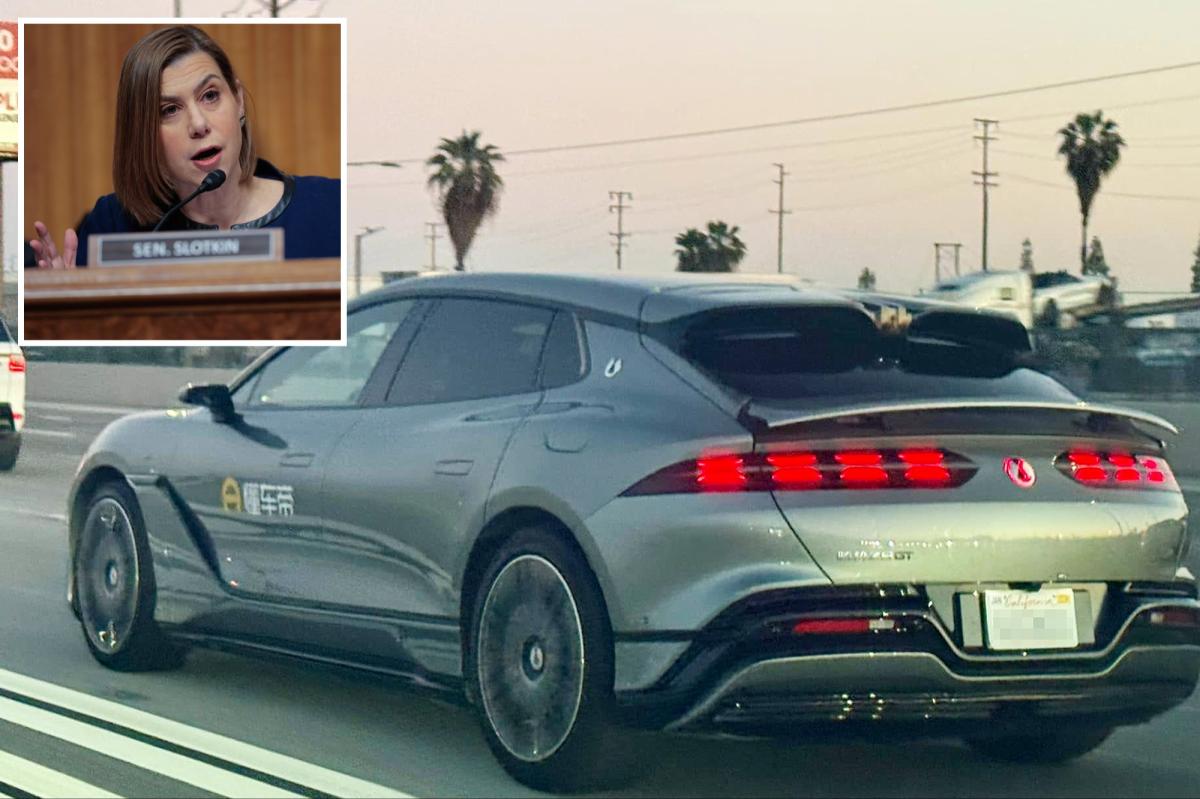
A wave of low-cost Chinese-made vehicles is slipping into California through Mexico — and the issue is now headed to Washington.
Panicked lawmakers are working to close a border loophole that allows cars that would never clear US safety or emissions standards to enter the country.
In Mexican border cities like Tijuana’s Zona Río, dealerships are packed with new electric vehicles, hybrids, and SUVs, many of them Chinese-built and priced around $20,000.
That undercuts the American market so drastically that even basic new cars cost far more in the US.
Congress is now looking at the issue more critically, with a motion to ban Chinese vehicles from US roads completely.
Chairman John Moolenaar (R-MI) of the Select Committee on China and Congresswoman Debbie Dingell (D-MI) announced Thursday they plan to introduce a bill later this month.
“Every vehicle on American roads is a rolling data collection device, capturing information on location, movement, people, and infrastructure in real time, and we cannot allow Chinese vehicles or components to be a part of that system,” the lawmakers said. “The legislation we introduce will show bipartisan support for doing what must be done to protect the manufacturing sector, jobs, and the American people from China’s predatory trade practices and manipulative attacks on American industry.”
Lawmakers and officials are sending the same message: Chinese vehicles are already here.
Online discussions and commuter reports have also pointed to the growing presence of Chinese-branded vehicles from companies like BYD, MG and Chirey appearing in Southern California traffic, with some Reddit users in communities like r/tijuana describing cross-border ownership as relatively straightforward for Mexican residents working in San Diego.
One contributor wrote, “I owned a new vehicle bought in Mexico while I lived in Tijuana and worked in San Diego. You won’t have any problems at all,” reflecting how the temporary admission framework is being interpreted in practice.
US Customs and Border Protection (CBP) allows foreign-registered vehicles to enter the country under temporary visitor rules.
The agency told The California Post that it permits “non-resident visitors to the United States to drive noncompliant vehicles across the Canadian or Mexican borders for legitimate, temporary purposes such as work or vacation,” because those vehicles are not being officially imported into US commerce.
The National Highway Traffic Safety Administration (NHTSA) also waved the white flag on the issue. In a statement to The Post, NHTSA noted that these vehicles fall under CBP’s temporary admission framework because they are not being formally imported for sale or permanent use in the United States, but instead handled as visitor vehicles under border admissibility rules.
A CBP spokesperson further clarified the scope, saying foreign drivers, including Mexican citizens, are generally allowed to cross into the United States with their own vehicles if they have “all proper and required documentation,” and that entry is permitted for “strictly personal use,” depending on purpose, duration, and paperwork.
The California Department of Motor Vehicles told The Post it does not regulate which vehicles are allowed on US roads and does not maintain records on them, directing inquiries to federal agencies.
The California Highway Patrol said it has no authority over who enters the country and does not track these vehicles once they arrive in the state.
The key detail is what comes next.
These vehicles do not have to meet US safety or emissions standards because they are not classified as imports.
That distinction has now fed into a broader debate over data security, industrial policy, and foreign vehicle technology.
“The idea that you could have a fleet of these folks driving around major infrastructures sites taking all that data, all that video, all that mapping and sending that back,” Michigan Senator Elissa Slotkin said. “As someone who’s from the Pentagon, that is the exact detailed information an adversarial loves to have in their war planning.”
Slotkin said Chinese automakers steal intellectual property and then reverse engineer it before deep subsidization by the Chinese Communist government.
She called some of the vehicles a “$11,000 to $14,000 Tesla” during a press conference Thursday.
She said European markets allowed Chinese vehicles to be sold there and warned that they have “gobbled up market share.”

She also raised concerns about the technology embedded in Chinese vehicles, warning that if a Bluetooth device is nearby it could potentially be accessed, and described scenarios where vehicles could be remotely manipulated or “piloted from Beijing.”
She added that unlike iPhones and vehicles from companies like Toyota, which operate under American laws and standards, Chinese vehicles do not follow the same regulatory frameworks, raising concerns that they could be collecting sensitive data while operating in the US, including around military bases.
Read the full article here