


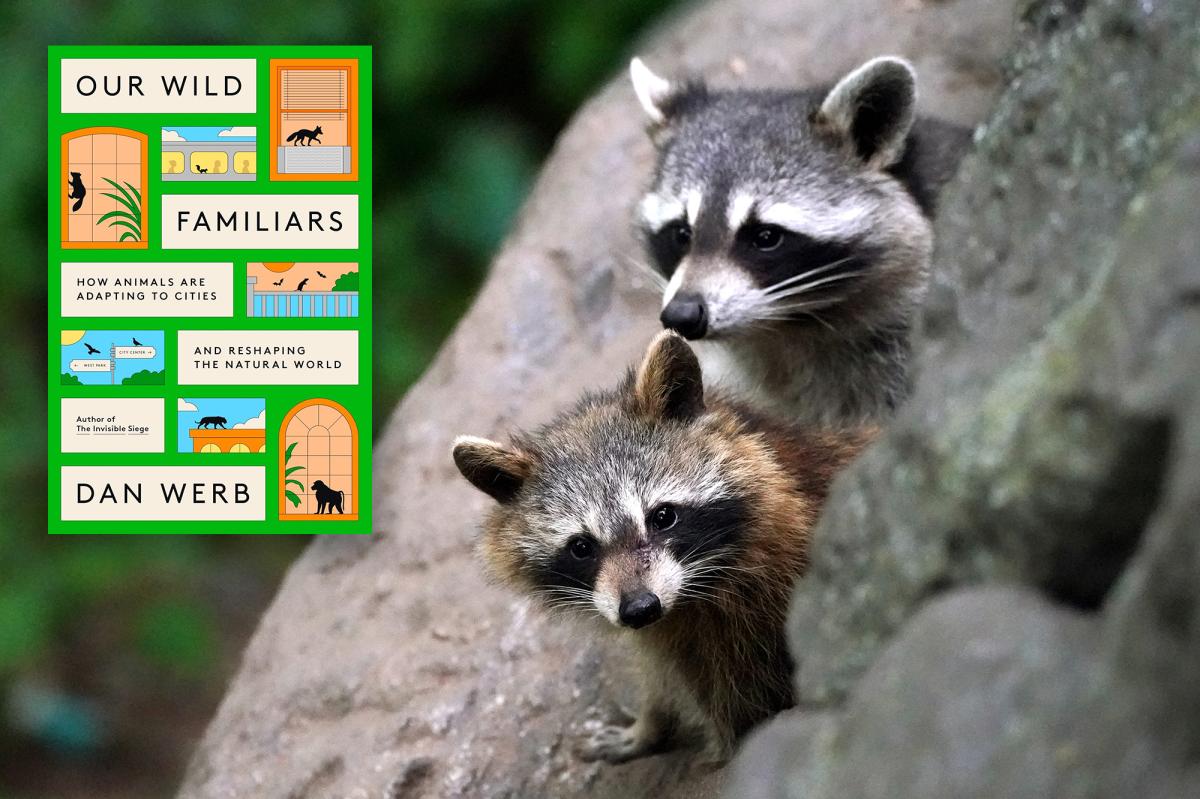
On July 9, 2015, a dead raccoon appeared on a Toronto sidewalk and, for reasons no one fully understood, four men from a nearby office decided to hold a funeral. They bought a cellophane-wrapped rose, signed a card, and placed it on the corpse, whom they named Conrad.
In “Our Wild Familiars” (Crown, out Tuesday), Dan Werb uses Conrad’s wake as the doorway into an exploration of synanthropes — a term derived from Greek that means “together with man” and is used to describe wild creatures who have found niches in human-built cities.
“I love the story of Conrad, because it’s so unlikely and revealing,” Werb told The Post. “There are hundreds of thousands of raccoons living in Toronto, and many die every day. Everyone’s first instinct is to ignore them … [but Conrad] revealed that we actually love the animals around us, precisely because they are funny, and elegant, and make us think differently about what makes a city special.”
“Our Wild Familiars” looks at other examples of synanthropes, including the creatures living in our garbage cans, roofs, alleys, sewers, parks, train stations, courthouse hallways, and polluted seafloors. Cities have become active natural systems, places where animals are adapting to human architecture, food waste, noise, heat, traffic, and danger.
Toronto spent millions on “raccoon-proof” garbage bins that require turning a circular lock, a task raccoons shouldn’t be able to manage without opposable thumbs. One raccoon figured it out anyway. Within a year, raccoons across the city had learned the trick too.
Werb calls this “reversal learning,” the cognitive ability to unlearn old strategies when circumstances change. Biologists studying the phenomenon say raccoon intelligence is evolving faster than usual in cities, where raccoons are constantly forced to learn new rules. “Where this is all eventually going to lead is anyone’s guess,” Werb said, “which is very exciting.”
Shortly after moving to Buffalo, NY, architect Joyce Hwang attended a party, and the conversation turned to local survival tips. Someone told her she needed a tennis racket because, as Werb writes, “We have a ton of bats here,” and “you can only kill them with a racket.”
Hwang responded by designing structures that function as both public art and animal habitat, including Bat Cloud, a set of tunnel-like roosts installed in trees, and Bat Tower, a wooden sculpture with a hollow interior, landing pads, and plants meant to attract insects for bats to eat.
As Werb puts it, her sculptures reveal that “the opposite of fear is intimacy,” and that cities can be made more beautiful and more biodiverse at the same time.
In Seattle, marine ecologist Eliza Heery took Werb into a strange urban frontier, the polluted water around the city. The seafloor near her research sites contains rotting boat hulls, broken concrete, garden gnomes, handguns, old refrigerators, and even a rusting van, along with arsenic, mercury, PCBs, lead, and other contamination from nearby Superfund sites.
And somehow, it’s teeming with marine life. “Amidst this grim world, Giant Pacific Octopus, one of the world’s most beautiful, enigmatic, and intelligent creatures, aren’t just surviving, but thriving, in greater numbers than pristine areas further out to sea,” Werb said.
For him, the discovery shows how stubborn ecosystems can find a foothold, even in places humans have treated like underwater junk drawers. “No matter how bad things appear, there is almost always a pathway for ecosystems to proliferate,” Werb said.
That lesson becomes more dangerous when the animal at the center of the story is a leopard. In February 2023, a leopard entered a courthouse in Ghaziabad, India, and spent four hours tearing through the hallways, injuring at least five people.
The scene was terrifying because the humans suddenly became prey. Ghaziabad sits near wilderness where leopards have long prowled, and as cities push deeper into their habitat, encounters like this become less freakish and more predictable.
“Interspecies coexistence is complicated,” Werb said. “It’s a lot easier to coexist with hundreds of thousands of urban raccoons than one or two urban leopards.”
The practical answer, he argues, begins with changing human behavior rather than animal behavior. New York has waged war on rats since the 1970s, and Werb said the result has been rats that are “invulnerable to rodenticides and far better adapted to living in the city.”
But the city’s new bin mandate, which began June 1st and requires New Yorkers to containerize trash instead of leaving it in bags on the sidewalk, reduced rat sightings by 60% during its West Harlem pilot phase.
“That basic lesson, changing human behavior to create harmony with urban animals, is pretty foolproof,” Werb said. “But when the animal is an apex predator on the brink of extinction, like a leopard or tiger, you can’t wait decades to figure out a solution, because by then the species will be lost, and some humans might be, too.”
In Werb’s telling, the city is a living habitat with more species, stranger neighbors, and deeper animal dramas than most people notice. “Cities are nature,” he writes.
Read the full article here