



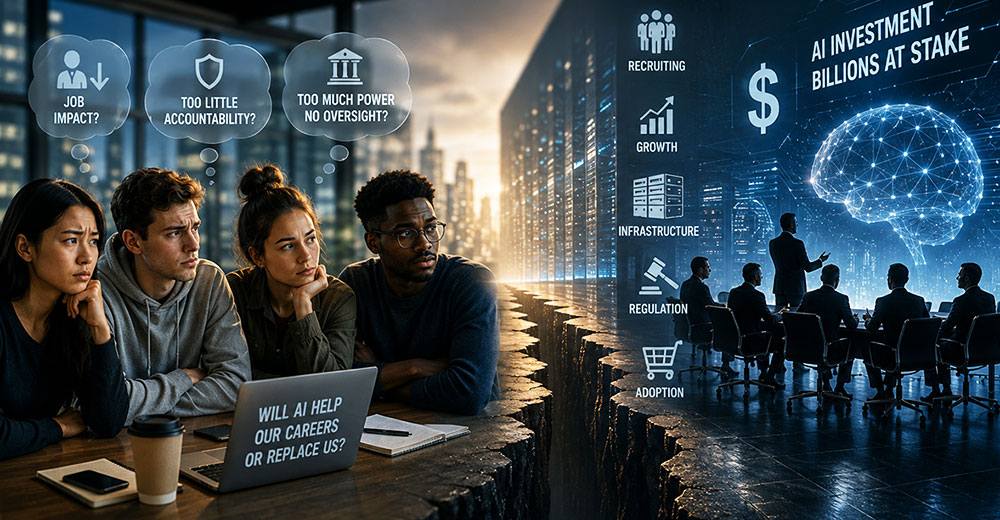
The technology industry’s enormous investment in artificial intelligence is colliding with a growing trust problem among younger adults. Recent polling suggests many Americans ages 18 to 34 distrust prominent AI executives and worry about how the technology could affect their careers.
For technology companies, that skepticism could eventually affect more than public perception. It could influence recruiting, AI adoption, data center development, regulation, and purchasing decisions.
Let’s look at why this generational trust gap could become a significant business problem for the AI industry. Then we’ll close with my Product of the Week: an electric toothbrush with an integrated air-jet flossing system.
Young Adults Distrust Tech Leadership
According to a recent CNBC/Generation Lab poll of 1,088 Americans ages 18 to 34, respondents expressed substantial distrust of several AI industry executives. Palantir CEO Alex Karp recorded an 81% distrust rating, followed by Peter Thiel at 79%, Mark Zuckerberg at 71%, Elon Musk at 70%, and Sam Altman at 69%. Microsoft CEO Satya Nadella fared better, although only 35% of respondents said they trusted him.
Concerns extend beyond individual executives. The survey found that 45% of respondents expect AI to negatively affect their careers, while 40% favor heavy government regulation of the industry. Sixty percent also want the technology industry to slow data center construction.
Taken together, those findings suggest the AI industry’s trust problem could affect recruiting, regulation, infrastructure development, and adoption.
Whatever the causes, the polling suggests technology leaders have substantial work to do rebuilding public trust.
Distrust Could Complicate AI Recruiting
Technology companies depend on a continuing pipeline of young engineers, developers, researchers, and other technical talent. If prospective employees distrust a company’s leadership or question how its technology will affect workers, recruiting that talent could become more difficult.
Compensation can overcome some resistance, but companies also compete on reputation, mission, workplace culture, and the opportunity to work on products employees consider worthwhile. AI companies that develop poor reputations among younger workers may therefore find it harder to attract talent and more likely to lose candidates to competitors.
Established technology companies have faced similar recruiting challenges when younger workers came to regard them as outdated or unattractive employers. AI companies could face a more difficult version of that problem if concerns encompass not only corporate culture but also the technology’s perceived effect on jobs and society.
That does not mean young engineers will refuse to work for major AI companies, but reputation could become another factor affecting recruitment, retention, and compensation.
Data Centers Add to the Trust Problem
AI’s expanding physical footprint adds another dimension to the industry’s trust challenge. Data centers require substantial electricity and, depending on their design and location, can place additional demands on water and other local infrastructure.
Those projects increasingly put technology companies in direct contact with communities concerned about utility capacity, environmental effects, construction, and who ultimately pays for infrastructure upgrades.
For AI companies, addressing those concerns requires more than explaining the technical benefits of additional computing capacity. It requires listening to affected communities, communicating clearly about costs and benefits, and investing appropriately in the infrastructure their facilities depend on.
The survey suggests that concerns about AI extend beyond the technology itself to the infrastructure required to support it. For AI companies, the message is clear: rapid expansion without addressing community concerns risks further eroding public trust.
Public Opinion Could Influence AI Policy
Public skepticism can eventually influence technology policy. If younger voters remain concerned about AI’s effect on employment and favor greater regulation, elected officials are likely to pay attention.
That could affect issues ranging from AI regulation to local approval of data centers and the public incentives used to attract technology infrastructure and semiconductor manufacturing.
Persistent public opposition could also make some technology incentives harder to sustain politically. The technology industry can benefit from municipal tax breaks for data center development and federal grants for semiconductor manufacturing.
Technology companies seeking public incentives for major infrastructure projects should expect increasing scrutiny over the local jobs, investment, tax revenue, and infrastructure benefits those projects provide.
How Tech Leaders Can Rebuild Trust
Technology executives need to communicate more effectively about what AI means for workers. Repeatedly emphasizing automation and job replacement may reinforce the fears reflected in the survey.
A better approach would emphasize where AI augments employees, removes tedious work, improves productivity, and creates new opportunities. Companies also need evidence that those benefits are materializing rather than relying on promises about what AI might eventually deliver.
The same principle applies to data centers. Companies building large facilities should work with communities on power, water, transportation, and other infrastructure requirements and clearly demonstrate the local economic benefits of their projects.
Rebuilding trust will require more than better messaging. Companies will need to demonstrate that AI investment can create benefits for workers, customers, and the communities supporting the infrastructure behind it.
Long-Term Business Risk
If distrust persists, it could eventually affect more than hiring and regulation. Today’s younger adults will become tomorrow’s managers, executives, technology buyers, and investors, giving their attitudes greater influence over enterprise purchasing and consumer adoption.
Buyers who distrust a company’s leadership may be more receptive to competing products, particularly when comparable alternatives are available. Brand reputation therefore could become an increasingly important competitive factor in AI.
AI growth forecasts depend in part on continued adoption by businesses and consumers. Persistent distrust does not mean adoption will stall, but it is a risk companies should not dismiss. The industry will be in a stronger position if its leaders treat public confidence as a business requirement rather than assume technological capability alone will drive acceptance.
Wrapping Up
The polling presents a warning for an AI industry investing enormous amounts of money in technology, infrastructure, and talent. Significant numbers of younger adults distrust prominent technology executives, worry about AI’s effect on their careers, favor greater regulation, and want data center development slowed.
Those attitudes may change as AI develops and its benefits become clearer, but technology companies should not assume they will.
Building trust will require executives to demonstrate that AI can create value not only for shareholders but also for employees, customers, and the communities supporting its infrastructure. For an industry whose long-term success depends on widespread adoption, public confidence is becoming a business issue in its own right.
Can technology executives rebuild trust among younger adults, and what should they do differently? Share your thoughts in the reader comments below.
Ranvoo AirJet X5 Electric Toothbrush

Image Credit: Ranvoo / AI-enhanced by TechNewsWorld
The electric toothbrush market doesn’t change much, but the Ranvoo AirJet X5 takes an interesting approach by integrating an air-jet flossing system directly into the brush head. The design is intended to clean between teeth while brushing, and I was intrigued enough to buy one.
I have been using the AirJet X5 for several months. At my recent routine dental exam, my dentist commented that I was doing noticeably better than during previous visits when I was using a Sonicare toothbrush. My teeth feel exceptionally clean after brushing, the hardware feels substantial in the hand, and the battery lasts for weeks between charges.
Another attraction is the price. The AirJet X5 currently sells for $127.49, putting it in a competitive range with other high-end electric toothbrushes. Combined with the integrated air-jet feature, long battery life, and solid build quality, the Ranvoo AirJet X5 is an easy recommendation and my Product of the Week.
Read the full article here