


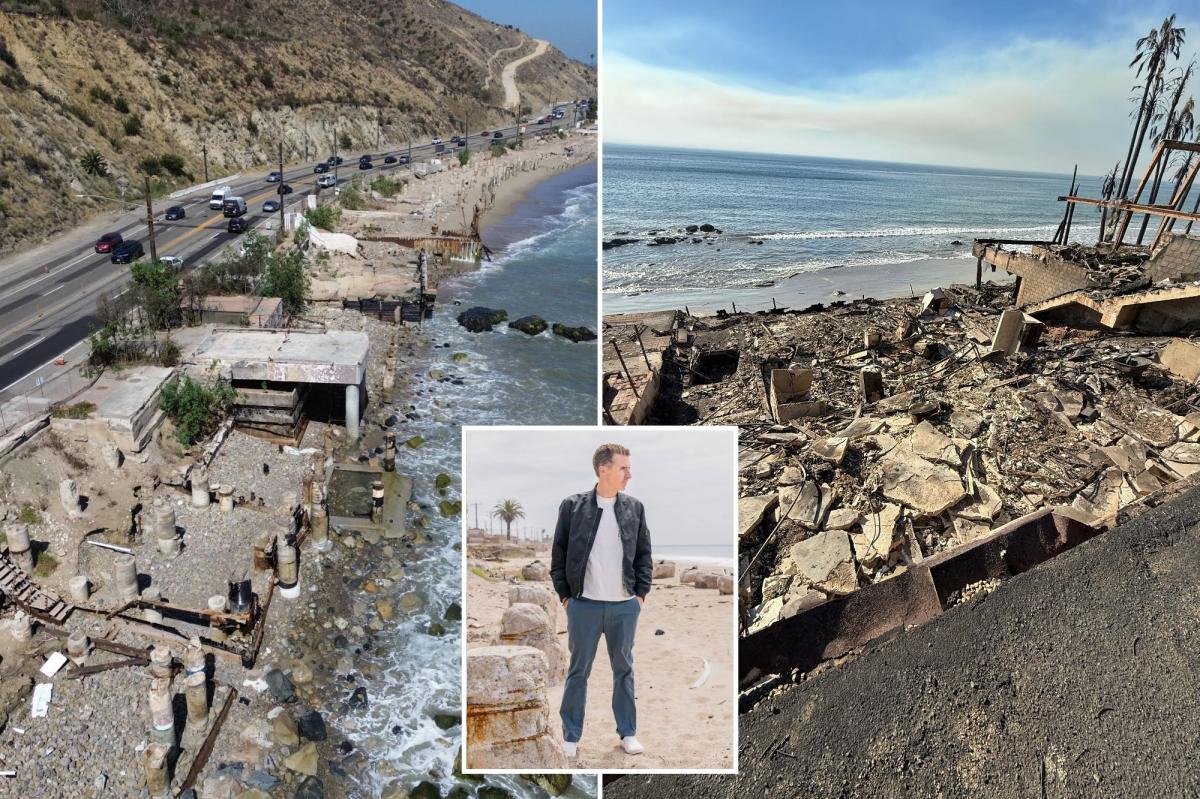
More than a year and a half after the Palisades Fire tore through Malibu, only a handful of homes along the iconic Pacific Coast Highway have begun rebuilding — leaving the famous area a ghost town of charred ruins.
Red tape and the high cost of construction has caused many homeowners to simply sell their lots, while the few that have started rebuilding say it’s taken about year of headaches to green light shovels in the ground.
“I was one of the first ones to sell on the beach,” Matt Greenberg told The California Post. “I just couldn’t imagine myself [rebuilding], and I think a lot of neighbors are kind of coming to those terms.”
Greenberg bought his slice of Malibu paradise on the water in 2023, a fixer-upper that he was ready to turn into his dream home — until he realized how long it takes to get the stamp of approval from the city, Coastal Commission, and other agencies for a simple remodel.
“The process to get anything done in the city is just an absolute nightmare,” he said. “Everything’s slow, expensive, and it takes awhile.”
Greenberg did ultimately get the permits over a year later, tragically, on the the exact same day the Palisades Fire broke out, July 7, 2025.
“It’s like burned in my brain,” Greenberg said. “We were literally going to crack some champagne and the whole thing — the morning of the fire, we got the permits and it burned down that night.”
Greenberg said he didn’t want to go through the headache of the permitting process again and the challenges of rebuilding.
“I just knew after going through this process with the city just to get a remodel, to get a rebuild was going to be ridiculous and it was just going to be so expensive,” he said. “Then on top of all that, you know, the PCH falling in and construction and just space issues with neighboring homes.”
Out of the 1,076 permits for damages, repairs, debris removal, and structures along the Pacific Coast Highway, only 88 are for new home construction, according to the City of Malibu.
Then-Mayor Marianne Riggins told Realtor.com in November that at least 700 structures were destroyed, with nearly 600 of those being single-family homes.
Currently, 61 homes that burned down are being rebuilt.
But Danny Smith, who is running for Malibu City Council and lost his beachfront home in the fire, said those numbers are “misleading.”
“I don’t think we should be spending our time marketing, the problem is obvious,” he told The Post. “It’s obvious to the public, you drive in from Malibu to the East and it looks like Pompeii and it’s going to continue to look like death for decades if we don’t speed things up.”
Smith opted to sell and purchase a home further down the beach.
“A part of me didn’t want to give up, but there were so many uncertainties and there continue to be so many uncertainties about the septics and sewers and the costs,” he said.
He gave Governor Gavin Newsom credit for his quick response streamlining the permitting process with the California Coastal Commission and waiving the California Environmental Quality Act requirements, but Smith said he feels like the homeowners have since been forgotten.
“I don’t know where his attention is these days. I think he has bigger political ambitions.” he said. “We’re still here, and we are not anywhere close to recovery. I wish the conversations with the Governor’s office that were frequent last spring, and summer, were continuing now with the same urgency, and I don’t feel that they are.”
When asked about the concerns from homeowners, the city pointed to a series of decisions it made to support faster and safer building, including disaster rebuild ordinances that streamline approvals, a dedicated online expedited rebuild submittal portal, and staff that is available to triage any questions or concerns.
Download The California Post App, follow us on social, and subscribe to our newsletters
California Post News: Facebook, Instagram, TikTok, X, YouTube, WhatsApp, LinkedIn
California Post Sports Facebook, Instagram, TikTok, YouTube, X
California Post Opinion
California Post Newsletters: Sign up here!
California Post App: Download here!
Home delivery: Sign up here!
Page Six Hollywood: Sign up here!
“The City of Malibu is committed to helping residents rebuild from the devastating Palisades Fire as quickly, safely, and efficiently as possible,” a spokesperson for the city told The Post. “Through our dedicated staff providing one-on-one assistance, streamlined processes, innovative technology, and ongoing community engagement, the City continues to remove barriers and provide personalized support throughout every step of the rebuilding process.”
But Smith argued none of those changes would’ve happened if it wasn’t for “community outrage.”
“I would say all those things they are citing were residential driven, and we’re glad that they have implemented them to one extent or another, but in the absence of community outrage none of that stuff would’ve happened, sadly,” he said.
Instead of red tape, the city said the biggest challenge for homeowners to rebuild is being underinsured and the dramatically higher cost of construction — something Carl Randall is seeing firsthand.
“I’m building for about $7 million. They can’t afford that, nobody can afford that because most everybody here had the California Fair Plan, which is a maximum $3 million insurance,” Randall said, adding that he was lucky to have had great insurance to cover the cost.
It’s a concern Greenberg believes could completely change the dynamic of the beach, as residents are forced to sell and the superrich buy up prime beachfront property for relatively cheap prices.
“Malibu’s turned into this playground for the ultra wealthy. We were a certain little enclave where over half of the stretch of the beach were full-time residents or close to it,” Greenberg said, adding that the community he fell in love with is now largely gone.
Despite the challenges and the unknown future, Randall is hoping to he can be the proof his neighbors need that rebuilding is possible — no matter how daunting the task may seem.
“There’s probably 200 people going, ‘I don’t know whether I want to rebuild, I’d like to rebuild, I don’t know if its even possible, is the city going to be impossible,’” he said. “Then there’s 20-30 of us who are idiots who are just charging full speed ahead and trying to rebuild our homes cause we want to live here.”
One of the first beachfront homeowners to secure a permit to rebuild, Randall called the process a “battle.”
“The state has a lot of regulations for us and then we live on the coast, so it’s even more,” Randall said.
He gave the city credit for helping expedite the permitting process, but highlighted the continued challenges related to all the other hurdles needed to rebuild, like septic systems, utilities, geotechnical reviews, and public works.
“All the engineers you have to hire if you’re on the beach — I have a coastal engineer, you’ve got structural, civil, septic engineer — you’ve got all these different people you have to hire and they have to run the reports, and then you have to smash all those together and fit that into the city’s plans and go through all their planners and the processes,” he said.
But the multigenerational Malibu homeowner said it could be much worse, saying that local leaders have stepped up: What would typically take five or six years to get done took him only about a year.
Randall, whose parents bought the home back in 1966, recently started the drilling process to build caissons — reinforced concrete pillars that sit deep into the earth and serve as a foundation.
And though he’s grateful to start the rebuilding process, it has brought to light a whole new set of concerns.
“Literally every day I’ve got to stand and protect the guys from getting run over as they’re working,” he said, referring to the narrow space between his construction crew and the cars zipping past on the PCH.
Randall said he asked the city for the highway to be pushed back inland 10 feet to provide construction crews the necessary space to work and bring in heavy equipment, but was granted only 5.
“We can’t be too close to the edge or the edge will collapse,” he said.
Another longtime resident, Glenn Dexter, whose father built his family’s Malibu home in 1959 for $35,000, said he’s torn whether to stay or go mainly because he’d have to pay a hefty price to rebuild his seawall.
“That was probably my number one reason I was considering selling, but now I’m starting to get closer to getting my building permit, now I’m leaning toward trying to rebuild,” he said. “But, I am worried about the City of Malibu, they really should get in there and get everybody to handle their wall. If we miss another window, it’s another year from now to work on that. ”
Seawalls are typically only built between April and May, and again from Labor Day through October due to the risk of storms and high surf during the winter months and protect the septic tanks.
Smith, the council candidate, said the solution is to build a sewer system.
“One of the things that would help get these homes back in Malibu would be a sewer line where one has never existed before,” he said, adding that affected property owners are expected to vote later this fall on whether to approve the proposed sewer assessment district.
In the meantime, Randall hopes to be in his new home within 18 months. Whether others decide to join remains to be seen.
Read the full article here