

Our Instagram feeds have changed a lot since the platform launched in 2010.
Posts used to offer a glimpse into everyday life (admittedly with a heavy filter on top); nowadays, folks tend to only share their biggest wins and, of course, their holidays.
It’s not just a case of people going to the same places, either – they’re also taking exactly the same photos.
That’s why you’ll find queues near the blue domes of Oia, Santorini, or by the Itsukushima Shrine Torii in Japan, as people wait to secure the “perfect” shot. Barcelona is even creating a dedicated selfie zone outside of the Sagrada Família to stop clashes with locals.
Yet there is a growing trend taking over the ‘gram, and it’s not what you’d typically consider aesthetically pleasing.
Enter: brutalist architecture.
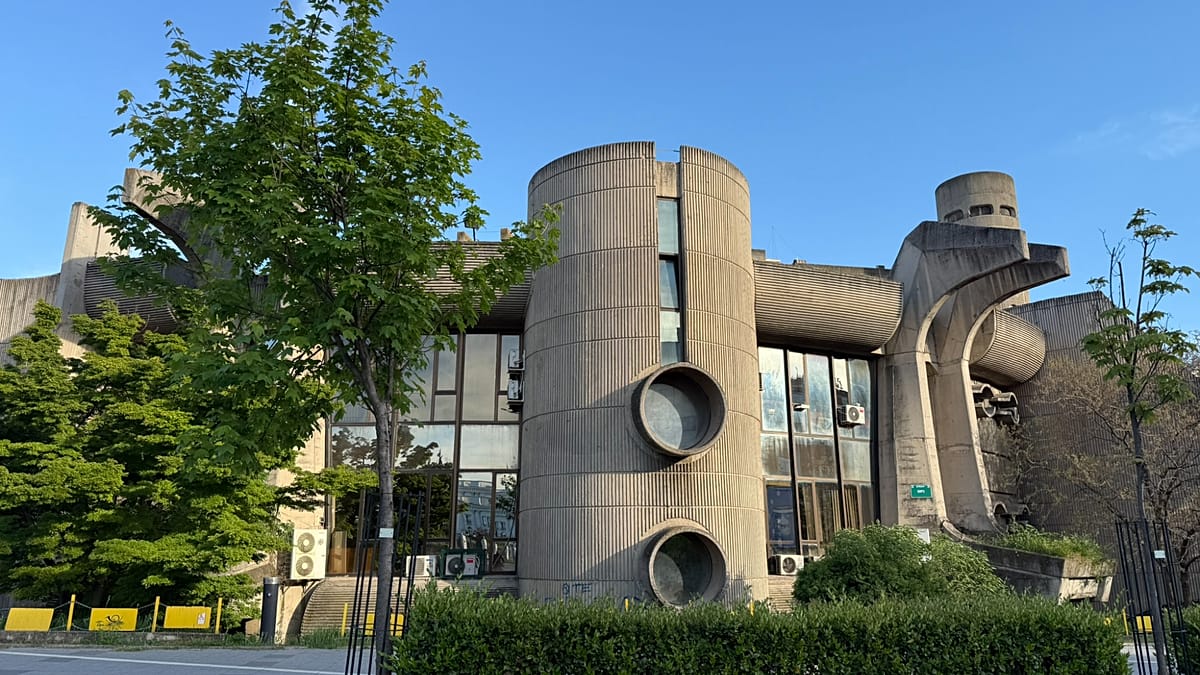
The bare-bones, concrete-dominant buildings that sprang up in the post-war period aren’t exactly social media fodder, but that hasn’t stopped tourists flocking to former socialist countries in search of them.
Skopje, a brutalist architecture fan’s dream
One place cashing in on the trend is Skopje, the capital of North Macedonia.
After a devastating earthquake in 1963, which saw 80% of the city’s buildings destroyed, architects from around the globe scrambled to help with rebuilding efforts, leading to a diverse range of brutalist styles living in harmony with each other.
Aleksandra Georgieva, a Skopje local, launched a tip-what-you-can brutalist architecture walking tour just two months ago as she wanted to share her love for the architectural style with tourists.
“In that period of time, Macedonian architects managed to make a huge contribution to the city,” she told Euronews Travel on a recent tour.
“It’s a debatable style of architecture, but whether you like it or not, the city was completely reborn after the earthquake.”
Debatable is putting it lightly. Detractors are in favour of changing the façades of these brutalist buildings to give them a neoclassical look – something that happened during Skopje 2014.
While the project was halted in 2018, buildings like the Government of the Republic of North Macedonia and the Parliament, as well as many others around the city’s main square, have already been changed at great expense.
The argument goes that changing these buildings isn’t destroying anything, but simply returning the city to what it once looked like, pre-earthquake.
Naturally, Georgieva disagrees.
“I think that we missed the chance for Skopje to renovate the city in the neoclassical style immediately after the earthquake,” she added.
“In the meantime, brutalism became one of the most important styles of architecture in the city. It might not be the favourite, but it’s very authentic and typical, and it sets Skopje apart from other cities.”
Georgieva’s tour takes in buildings like the Macedonian Academy of Sciences and Arts, which, while brutalist, draws inspiration from Japanese temples; the City Trade Centre, which is still a key part of the city’s fabric; and the Post Office’s headquarters, which is truly spectacular (assuming you are a fan of the style…).
Where else to see brutalist architecture
London’s Barbican Centre is perhaps one of the most famous examples of brutalist architecture, and you can book a 90-minute tour through the performing arts centre’s website.
Yerevan, the capital of Armenia, is another hot spot for enthusiasts, and the Cascade Complex is a real highlight. A two-hour drive out of the city will also take you to the iconic Orgov Radio-Optical Telescope.
Other top cities for embracing the trend include Belgrade and Paris.
Read the full article here