



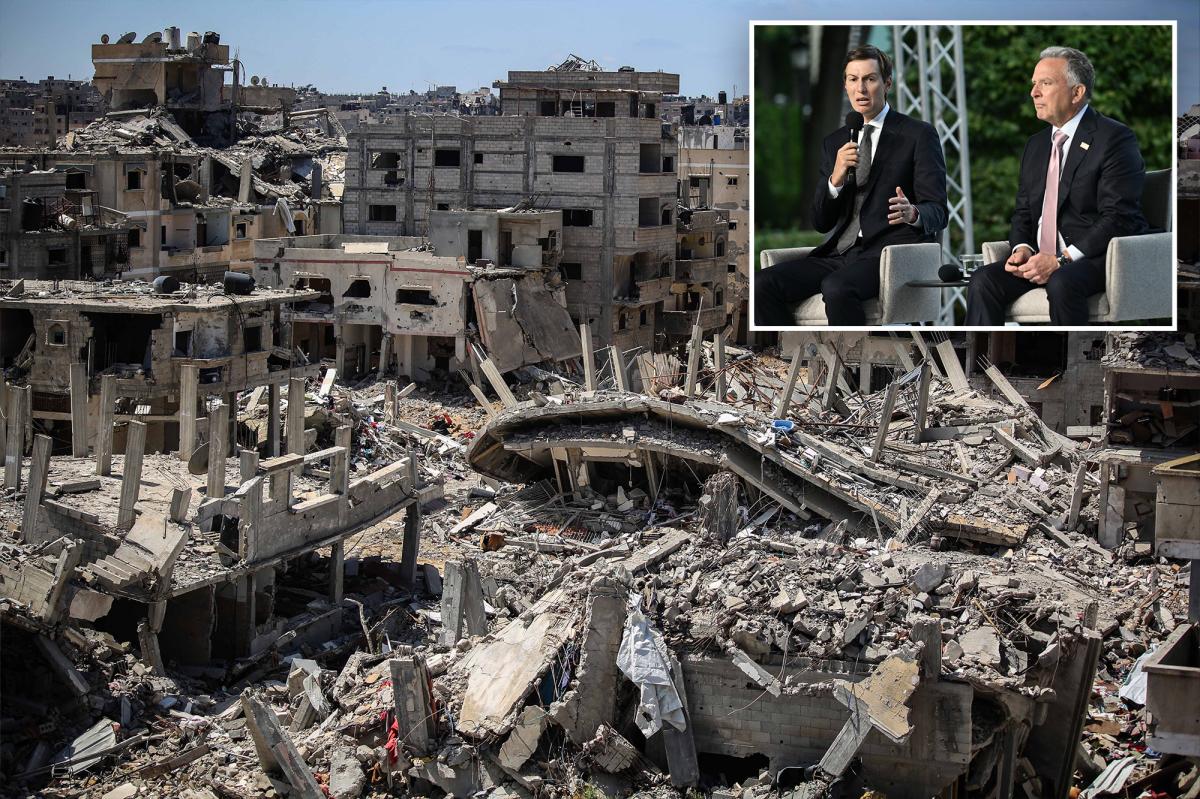
President Trump’s Board of Peace announced a multi-phase recovery plan for the Gaza Strip on Wednesday, with the first step set to cost $2.45 billion over six months.
The plan, unveilved on the sidelines of the United Nations General Assembly in midtown Manhattan, comprises 66 programs focused on infrastructure, economic growth and installing an international security force.
The final cost of the completed reconstruction is estimated to cost $71 billion.
“This recovery must be led by Palestinians, working in genuine partnership. Central and local authorities, the private sector, civil society and affected communities will work together at every stage,” wrote National Committee for the Administration of Gaza chief commissioner Ali Shaath in a one-page summary of the plan.
“What follows is not a wish list. Each program has been assessed, costed and sequenced. We ask partners for political support, for the removal of obstacles, and for resources pooled behind a single plan.”
That plan includes funding for humanitarian shelters that will replace tents, removal of debris, hospital rehabilitation, and the construction of desalination plants for water.
“A year ago none of this existed; we didn’t have the conflict solved; the Board of Peace didn’t exist,” added US special envoy and presidential son-in-law Jared Kushner. “Nobody knew what the International Stabilization Force was because it didn’t exist, and there was no national committee for Gaza because it didn’t exist.
“And what you’ve seen is almost like the building of a really, really big startup … really doing this out of the goodness of their hearts and for their passion to see peace and real progress,” Kushner continued. “They could have built a massive company with the sophistication and the effort that has gone into this, but I think we’re building something way more important than a company.
“We’re building something that is really a platform to enable the Palestinian people in Gaza to finally focus on improving their livelihoods and improving their lives.”
The almost three-year-old war by Israel against Hamas has caused an estimated $35.2 billion in damage to the Hamas-run enclave on the Mediterranean Sea, according to former British Prime Minister Tony Blair, a Board of Peace member.
“There was unanimity around a coherent architecture for Gaza’s future, one which would end the cycle of conflict and not perpetuate it,” Blair said of the UN Security Council-passed resolution that greenlit the rebuild
“First, Gaza liberated from the control of Hamas, so a new interim government in Gaza, Palestinian-led and internationally supported,” he said. “Second, full demilitarization of Gaza with the new security apparatus. Hence the International Stability Force and the new civil police force, both agreed with Israel.”
“And third, a detailed program of renewal and reconstruction. Fourth, not to resolve now, the outstanding question of Palestinian aspirations for self-government. But nonetheless to keep open the possibility they can be resolved, consistent with Israel’s security and the legitimate Palestinian desire to govern themselves.”
More than 25 countries and 75 organizations will be involved in Gaza’s reconstruction through donations and other contributions.
Up to $18 billion has already been secured in funding commitments from donations as well as private equity.
But before reconstruction can begin, as many as 250,000 members of the International Stability Force will begin moving sector by sector through Gaza to ensure phased demilitarization and decommissioning of Hamas’ weapons takes place.
“Hamas has agreed to give up the weapons, but we need to implement that,” Kushner said.
US Army Gen. Jasper Jeffers, who’s currently serving as commander of the ISF, said that 19,000 applicants for a Gazan police force have already been vetted and started initial training out of the more than 250,000 who have applied, but “the scope of the problem is immense.”
“We’re working hard on a military technical plan that can be executed sector by sector,” Jeffers explained, saying that all weapons, tunnels and other facilities will have to be “decommissioned or neutralized.”
“We will be followed by the national committee and their vetted security forces to take responsibility. And the national committee will assume full control,” he added. “Finally, that facilitates the [Israel Defense Forces] withdrawal, and in all cases, the verification is ongoing and enduring.”
“Dismantling the military infrastructure inside Gaza is unprecedented in its complexity,” Blair noted. “Underneath the cities, the towns, the villages of Gaza are literally hundreds of miles of tunnels with weapon depots and weapon manufacturing capability.
“This new government cannot govern unless that infrastructure is systematically destroyed. Hamas have agreed in principle that it should be,” he said. “And that was a landmark agreement. But our most urgent challenge now is to turn this agreement into a credible stage by stage plan, as we are doing.”
Read the full article here