

WASHINGTON — President Trump has more than doubled his press engagement numbers from the same point in his first term and blown past all recent predecessors, according to new data shared with The Post.
Trump had at least 493 exchanges with journalists — including interviews and event Q&As — during the first year of his second term, compared to 246 over the first 365 days of his first term, according to figures compiled by political scientist Martha Kumar.
The tally includes at least 153 interviews (up from 95 during 2017-18), 327 short question-and-answer sessions (up from 128) and 13 formal press conferences (down from 23) between Inauguration Day and Jan. 20 of this year.
Kumar, a professor emerita at Towson University in Maryland and director of the White House Transition Project, tracked a dramatic rise in question-answering by Trump in the newly gilded Oval Office and aboard Air Force One.
“One of the reasons that [press engagement] doubled is that he came in with a much clearer agenda to discuss than he had in his first term,” she told The Post.
“A benefit of having non-consecutive terms is that he could think not only about the agenda he wanted to have, but how to present it.”
Trump averaged more than two media sessions per work day as he overhauled foreign relations, trade, immigration, tax and healthcare policies — compared to former President Joe Biden’s first-year rate of 1.1 media event per day (266 exchanges) and the current president’s own first-term rate of one per day.
Former Presidents Barack Obama and George W. Bush averaged 0.9 daily press interactions in their first year. Bill Clinton notched 1.4 per day, while George H.W. Bush and Ronald Reagan had 0.6 and 0.5 per day, respectively
Many of Trump’s second term interviews are unscheduled chats that begin when a reporter calls his cellphone, an option no other president has provided to journalists and a sharp contrast from Biden, who gave no newspaper interviews until his final months in office — after dropping his re-election bid.
Trump took questions on Air Force One or under its wing 73 times in his first year back in power — more than quadrupling Biden’s 17 such interactions.
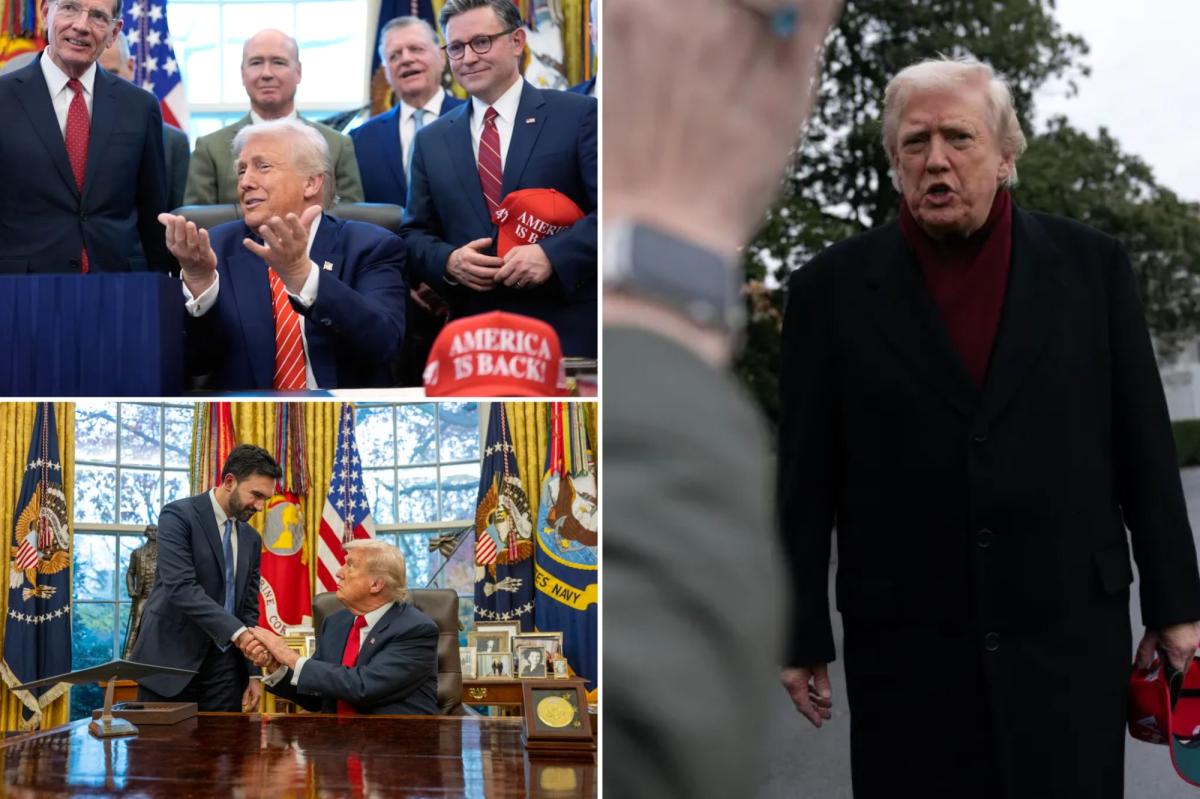
The president also has used the Oval Office heavily for media availabilities, starting on his very first day back in power when he pardoned or released from prison all Capitol riot participants.
Trump answered press questions at 95 events in the Oval Office alone — a massive increase from the 27 such events logged during both Biden’s first year and the start of Trump’s first term and more than any president since at least the early 1980s, when Kumar started tracking the data.
The Oval Office events show the former reality TV producer presiding over an revolving cast of experts, officials, businessmen and world leaders.
“When you’re signing executive orders, that’s action, and news organizations and the public are drawn to action,” Kumar said.
“By signing those orders in the Oval Office, he drew a great deal of attention from his base and from others as well. Polling showed that in his first 100 days that people had a much better idea of what it was that he was doing than was the case with Biden.”
Widely watched Oval Office events have included Trump hauling in pharmaceutical executives to pledge to lower drug prices to avoid threatened tariffs, an explosive exchange with Ukrainian President Volodymyr Zelensky over US support for his country’s defense, and a shockingly amicable meeting with socialist New York City Mayor Zohran Mamdani.
Presidents of the cable news era have had starkly different methods of communicating. Obama favored sit-downs with esteemed columnists, while Clinton preferred to pontificate at press conferences.
Biden favored extremely short — often one-word — replies to reporters, though he sought to blunt scrutiny of his age with a nearly two-hour press conference at the end of his first year. He bungled that event by saying a “minor incursion” by Russia into Ukraine would be better than a full invasion.
The prevalence of Trump’s Oval Office events has resulted in just 13 formal press conferences — the fewest by any president not named Biden (10) since Ronald Reagan.
“Under Reagan, press conferences were a national moment. They don’t draw the same kind of attention now,” said Kumar. “You can do a half hour or an hour in the Oval Office on a particular issue or series of issues and do it many times a month.”
The White House said that the data shows the extent of Trump’s availability to the public.
“President Trump is the most transparent and accessible president in American history. President Trump takes unrestricted questions from the legacy media and posts directly from his Truth Social account on the most important issues facing our nation every single day,” said White House spokeswoman Liz Huston.
“The American people have never had a more direct and authentic relationship with a president of the United States than they have with President Trump.”
Meghan Hayes, director of message planning in the Biden White House, countered that Trump’s plentiful interactions run the risk of alienating viewers when they veer into combat — as when he chided CNN’s Kaitlan Collins this week for not smiling when she asked about the Jeffrey Epstein case.
“The American people deserve a president to give honest answers and not insults,” Hayes said. “It doesn’t matter how many times you interact with press if it is all lies and hateful rhetoric.”
Read the full article here