


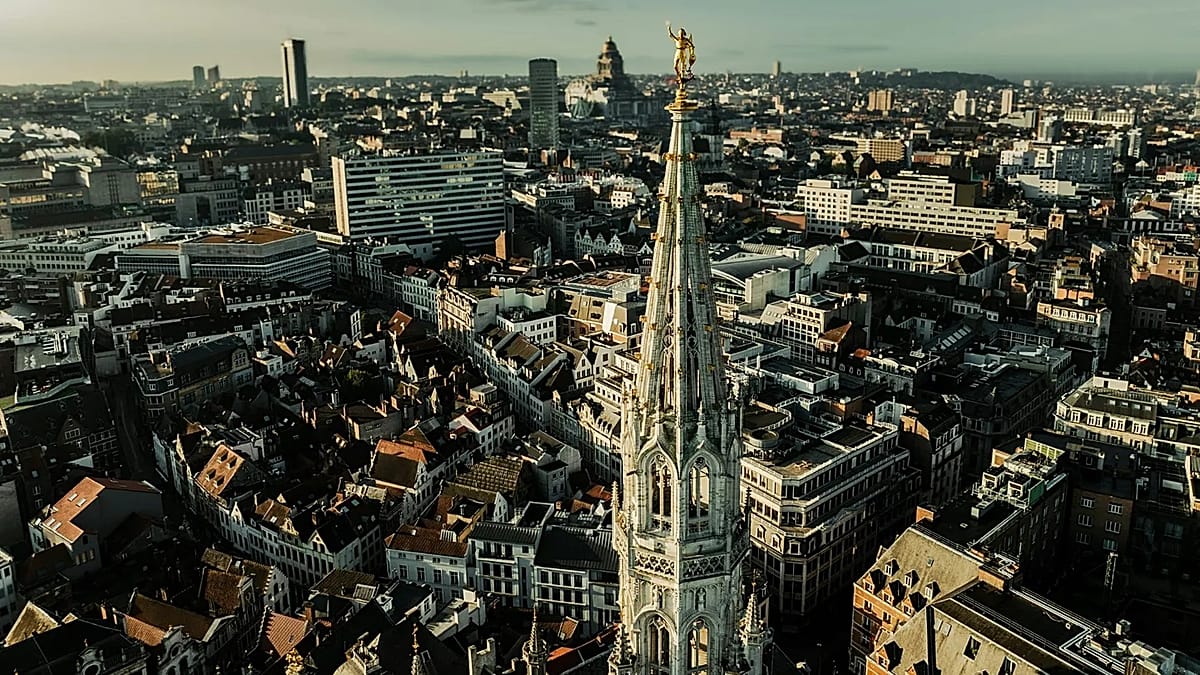
Should more of us visit Brussels? The Belgian capital’s residents certainly think so.
While tourist hotspots across Europe brace for the influx of international footfall this summer, as many as 74.6% out of 1,000 Brussels residents surveyed across 19 municipalities described their city an “underrated” destination, according to research by iVOX for Ovide-Airbnb.
With 3.7 million people having travelled to Brussels in 2025, a slight decrease from 3.71 million visitors in 2024, 79% of respondents said that tourism is “essential” for the city, in that it supports local businesses and the wider economy.
“Not enough people know that Brussels, and Belgium as a whole, are great for tourism,” Angela Dansby, author of “Best of Belgium: The Complete Travel Guide Through Expat Eyes”, told Euronews Travel.
“While I don’t think that Brussels lacks tourists, I do feel that it’s underrated as a destination. My own visitors, and I’ve had plenty, are always very pleasantly surprised by the city and echo my sentiment.”
Dansby is a lifestyle journalist who has resided in Belgium since 2015. For her latest title, which was published in April 2026, she walked hundreds of kilometres to photograph and write about 32 cities in the country with her trusty DSRL in hand.
The 200-page guide, penned by the self-described professional with “Belgitude”, journeys through nearly 100 locations, each highlighting why the multilingual destination deserves a place on every explorer’s European itinerary.
What was supposed to be a mere “one-year experiment” 15 years ago – after securing a Brussels-based client and work visa while still living and working from Chicago at her public relations firm – turned into a decades-long residency.
When asked what has kept her in the country for so long, she said: “Along the way, I became a dual citizen. I fell in love with Belgium, and a Belgian.”
Euronews Travel caught up with Dansby to hear her insights into Belgium’s best places to go, top places to eat, where to experience local arts, heritage and culture and even explore places that the average tourist may overlook.
Meet people from all over the world
The de-facto heart of Europe, Belgium is home to as many as 11.9 million people, and out of that figure, about 180 different nationalities are represented. So for Dansby, her top tip for travelling to Belgium is: “Meeting people from around the world, especially in Brussels.”
Where to go to meet the citizens of the world? She recommends adding castle hunting to your to-do list, and as Belgium is a parliamentary constitutional monarchy, the fairy tale-esque attractions aren’t hard to find.
“Belgium has the most castles per square kilometre in the world,” Dansby said, explaining that there are about 3,000 in the country. “I love discovering them. Some stunning examples are the castles of Bouillon, Beloeil and Vêves.”
All three of her recommendations are located in the French-speaking Wallonia region in southern Belgium, which has preserved its castles and fortresses. At the Bouillon Castle, which attracts 135,000 people each year, visitors are treated to a 360-degree panoramic view of the medieval town.
When it comes to where else to go for sightseeing, arts, heritage and culture, Dansby said travellers can go practically anywhere.
However, for a truly unique story to take back home, she suggests going to Oostduinkerke to see shrimp fisherman at work on horseback. Inscribed as a UNESCO Intangible Cultural Heritage facet, men on horseback head to sea about 40 times a year keeping the 500-year-old tradition alive.
Belgium’s best bites
Eating is one of Dansby’s favourite things to do in Belgium, and who could blame her – the country’s gastronomy scene includes hundreds of restaurants listed in the Michelin Guide and more than 100 starred restaurants – “the third highest density in the world”, she said.
For travellers looking to splash out on a meal, Dansby recommends dining in Brussels, Antwerp, Bruges and Knokke-Heist.
“Eupen is great for German classics,” she said, recommending dishes such as sauerbraten, a marinated pot roast, or Eupener Platz, a flat, oval-shaped brioche dish filled with raisins and finished with generous sprinkles of pearl sugar.
For coffees, meatballs and waffles, Liège is your best bet according to Dansby, while Ghent is the place for waterzooi, a creamy chicken and vegetable soup, and Ostend for seafood.
Readers may be surprised to know that it’s not just the French that acquired a taste for snails. Belgian Petit-Gris de Namur from the Namur province in Wallonia are an off-the-wall delicacy usually paired with garlic butter, herbs and served with mushrooms.
Beyond Brussels
According to Dansby, some of Belgium’s best experiences are far beyond the hum-drum tourist trail.
While a city like Brussels might be synonymous with local gastronomy, Danby said Hasselt in the country’s Flemish region also has a vibrant food scene.
Tripadvisor’s top three eats in the city include two restaurants that are listed by Michelin – Ross, which serves up Belgian and Dutch cuisine, and La Fontella, known for its Italian and French fare.
“De Haan is also a beautiful coastal town, with villas named after Albert Einstein who spent several months there,” she said.
Other locations steeped in history include Ploegsteert. Located in the country’s Wallonia region, the village is also the site of the 1914 Christmas truce where rival soldiers laid down their arms during World War I to play a football match.
Dos and don’ts
Chuckling about chips, Dansby advises against the phrase “French fries” because of the debate about the snack’s origins. She said: “Instead, just call them frîtes! And try them with mayonnaise instead of ketchup – that’s the Belgian way.”
Her other Belgium travel tips include taking advantage of the country’s public transport system to explore the country. Belgian bus routes are divided into three with De Lijn overseeing the Flanders network and TEC overseeing bus travel in Wallonia. In Brussels, the STIB covers both bus and metro transport.
The country is also perfect to explore by foot. Hiking through the country’s diverse topography is one of Dansby’s favourite things to do. “Especially in places like the Ardennes Forest, the German-speaking area of Ostbelgien or through the ‘purple carpets’ of bluebells each spring in the Hallebos forest,” she said.
While out and about, Dansby also said to add weekly outdoor markets and local festivals to travellers’ itinerary. “These events are great insights into Belgium’s past and present.”
Her last piece of advice? “Don’t hesitate to ask locals about anything,” she said.
Read the full article here