




Tick this item off your summer must-buy list.
Americans are smack dab in the throes of an apocalyptic influx of disease-harboring ticks, so checking for the bloodsuckers is crucial.
Now, an innovative product could eliminate weeks of worrying if you’re diagnosed with Lyme disease — and it’s the first of its kind.
With tick-related emergency room visits hitting a record high this year, Lyme disease remains the most common tick-borne disease in the US, with about 476,000 Americans treated each year.
But blood tests can miss Lyme disease early in an infection because it can take several weeks for the body to produce detectable antibodies — meaning some people may not test positive until several weeks after infection.
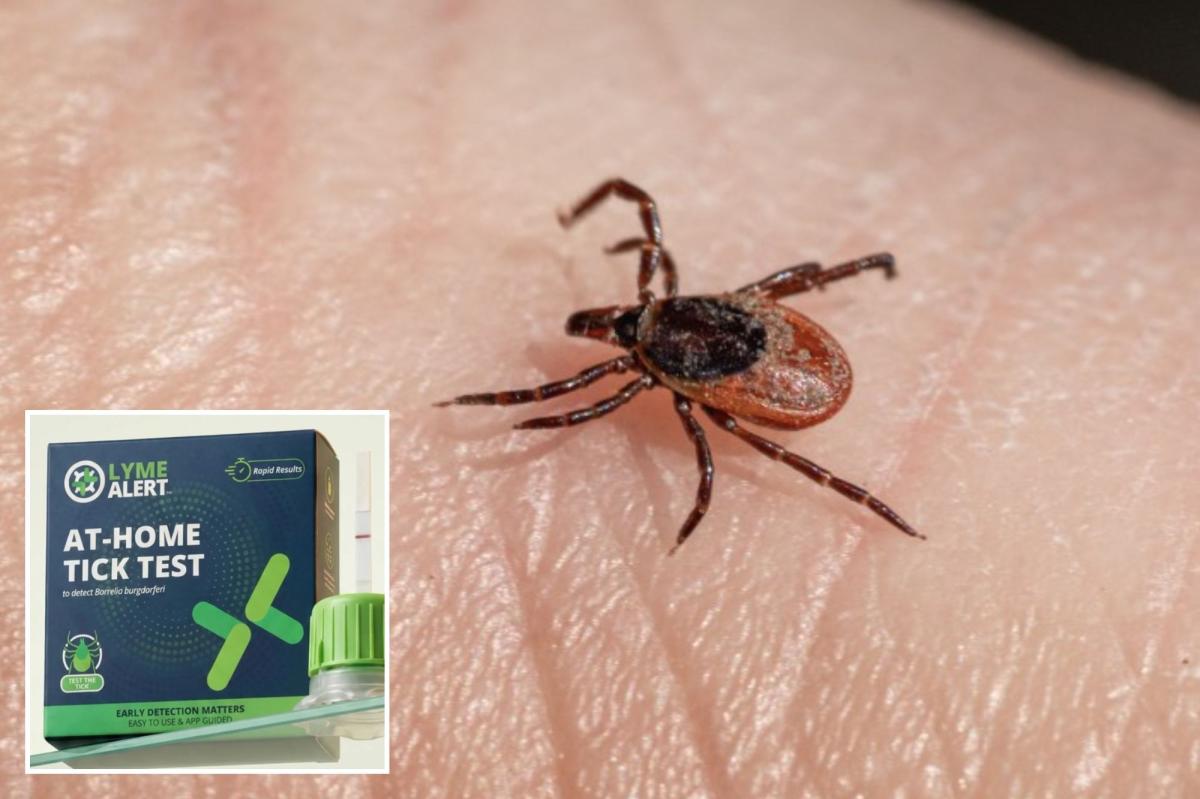
Enter the TickCrusher by LymeAlert, the first rapid at-home tick testing kit designed to detect Lyme-causing bacteria in ticks removed from people or pets in less than 30 minutes.
Created by physician assistant and MIT Sloan Fellow Erin Dawicki, TickCrusher grew out of her efforts to help patients navigate tick bites and the questions surrounding them.
“Every day, I get calls from my patients who say, ‘I found a tick on me or my child,’ and they don’t know what to do,” Dawicki, the CEO of LymeAlert, told The Post. “The reason they’re calling is that they either can’t afford to come see me or they’ve met their deductible or can’t get time off work.”
She searched for a product that could help patients “know when they need to access healthcare faster and who to properly prescribe [antibiotics] for,” and quickly realized it didn’t exist.
So, Dawicki decided to create her own product while taking a healthcare entrepreneurship class at MIT, designing a solution people could immediately access on their own time.
“You know if you’ve been exposed and then you can take appropriate measures,” she said.
She also hoped the test could give providers another piece of information when evaluating patients after a tick bite and potentially help avoid unnecessary antibiotic prescriptions.
The kit costs $50 and is currently available for pre-order, with shipments expected to go out later this month.
How to use the TickCrusher
The kit consists of four parts: a single-use patented TickCrusher base and screw-on lid — a specialized grinding component that crushes a tick’s hard exterior shell — as well as a processing solution and test strip.
After a tick is safely removed, it’s dropped into the base and the testing solution is added to further break down the tick and its internal tissues. Then, the lid is added and spun at least 10 times to pulverize the tick.
Dawicki considered people with limited hand strength or dexterity while designing the palm-sized tool, adding notches on the base making it easier to grip.
“We’re trying to make this as handicap accessible as possible,” Dawicki said. “You can literally use it with one finger, so for people with arthritis [from] Lyme, they can’t pinch or push down.”
The test strip is then inserted into lid and dipped into the processing solution. Results should show within 30 minutes, with some positive results appearing in as little as 15 minutes.
A positive result indicates that Lyme-causing bacteria were detected in the tick — but it does not mean the person or pet was necessarily infected.
And while the kit can only be used once, up to five ticks can be tested at a time, depending on size.
The biggest caveat of the kit, though, is that it doesn’t actually diagnose someone with Lyme disease. Instead, it tests the tick itself for Borrelia burgdorferi, the bacterium that causes Lyme disease.
Dawicki and her team are also building a companion app that will track bites, connect to virtual doctors or veterinarians for next steps, provide a hotspot map to track high-risk areas and confirm TickCrusher test results if the test strip color is faint or hard to see.
Users will also be able to share results with their primary doctor as a secure PDF report containing logged test results, the date of the bite and any photos of the tick or rash area.
Misconceptions around ticks and testing
The CDC currently discourages tick testing, saying it doesn’t show proof of transmission — and that a negative result could cause false security.
But Dawicki hopes the test could give doctors another piece of information when evaluating patients after a tick bite, and potentially help reduce unnecessary antibiotic use.
“You can talk about where you live, if you’re in a high-risk area, how long the tick was attached,” she explained. “All of those things influence your risk for getting Lyme disease and [the test] is just one additional data point.”
A tick check is always recommended as soon as you come indoors, as the “longer the saliva-to-skin connection exists, the higher the risk of infection,” Dr. Jason Schroder, a board-certified anesthesiologist, previously told The Post.
Dawicki also notes that ticks can crawl from a pet onto a person, “so if your dog is on flea and tick preventative medicine, [the tick] doesn’t bite your dog and jumps to you, you’ll be the one that has Lyme disease.”
Another common misunderstanding about tick exposure is where they live.
Ticks thrive not only on hiking trails, but also in backyards, playgrounds, sports fields, camps and other everyday settings where families spend the summer.
Read the full article here