



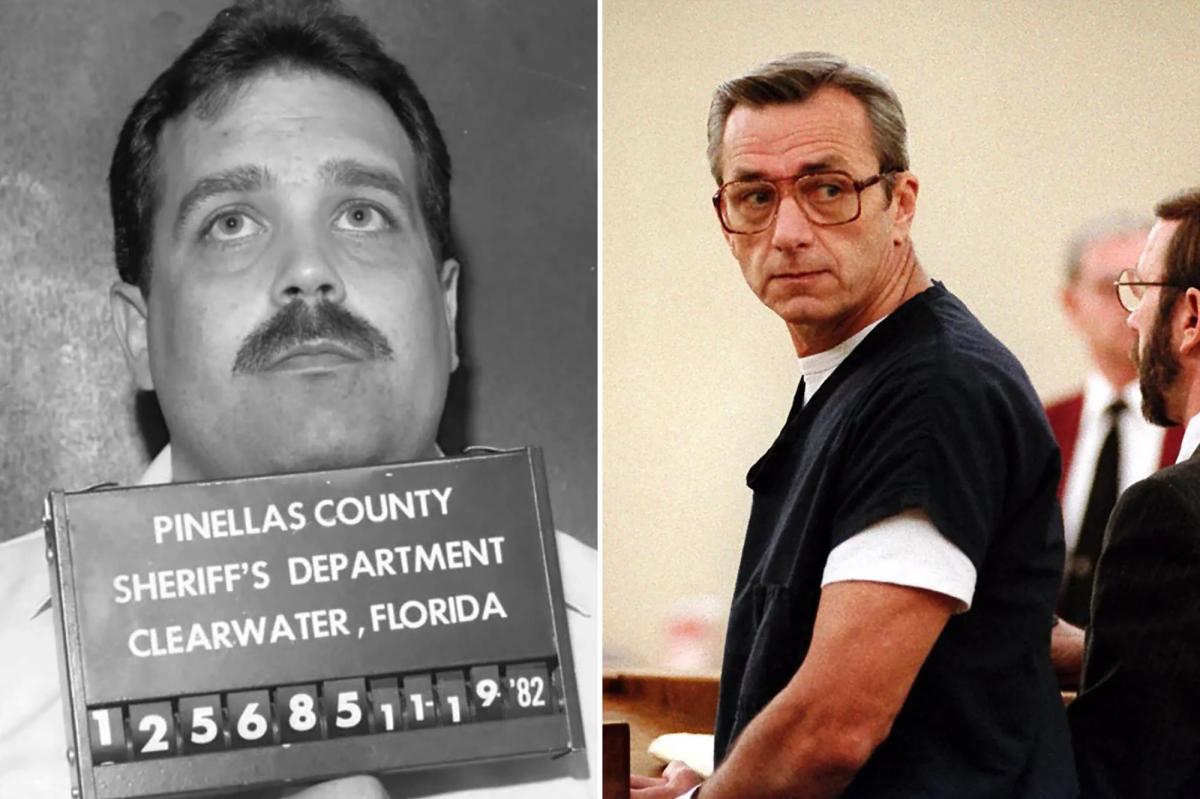
Paul Skalnik had a strange gift for being in jail when accused murderers suddenly felt the urge to spill their secrets.
Skalnik was a petty con artist with a grimly reliable routine, writes Pamela Colloff in her riveting new book, “Catch the Devil: A True Story of Murder, Deception, and Injustice on the Gulf Coast.” “Whenever his luck ran out and he ended up in jail,” Colloff writes, “men confessed their crimes to him.”
In the summer of 1981, Skalnik was sitting in the Pinellas County Jail on a grand-theft charge, staring down a possible five-year prison sentence, when he placed a collect call to the state attorney’s office in Clearwater, Florida, and told them he had information on three different men awaiting trial for murder. All three, he said, had made full or partial confessions to him.
By 1984, he had already testified against or provided information on at least 27 defendants in the Pinellas County Jail, helping send four men to death row. Prosecutors didn’t seem troubled that a man with a long record of deception was extracting confessions at a rate that would’ve impressed the most seasoned homicide detective.
Skalnik was a small-time hustler with big-time stamina. He’d been married nine times, wrote bad checks, stole from women and widows, impersonated lawyers, and reinvented himself in different cities whenever the previous version became inconvenient. He claimed to be a Southwest Airlines executive, a Stetson law student, a Marine, and a Boston attorney named Avery Harrison.
In jail, he found the role that paid best. He became a professional witness.
His first major turn as an informant came in Houston in 1978, after he landed in the Harris County Jail on bad-check charges. He spotted Thomas Hirschi, one of three activists charged with inciting a riot at a Cinco de Mayo celebration in Moody Park, in Houston’s Near Northside, and called an old friend in the district attorney’s office.
“I’ve got something to tell you,” Skalnik said. “Something that will interest you.” Soon he was out of jail for the day, sitting in the DA’s office, reading from a small spiral notebook about conversations he claimed to have had with Hirschi.
By the early 1980s, he’d taken the act to Florida. In the Pinellas County Jail, he worked in the law library, where frightened defendants kept their legal paperwork and a confident man with jailhouse jargon could pass himself off as helpful. He read the local papers, studied case details, and then called prosecutors and reported that inmates had confessed. The reward was recorded in the state attorney’s files with an exclamation point: “Probation was discussed!”
That was the basic bargain. Prosecutors got a witness who could turn messy cases into cleaner stories. Skalnik got leniency and repeated chances to resume his career as a criminal. Colloff calls him “the state’s closer, the witness whose words moved jurors to choose death.”
On the stand, Skalnik played the penitent sinner with a badge-shaped heart. “I still do have law enforcement inside of me,” he told jurors. When asked whether he had received anything for testifying, he replied, “No, ma’am. I was probably treated worse than if I hadn’t testified.”
Behind the scenes, prosecutors and investigators lobbied for him, wrote letters for him, and helped keep him in the county jail where he could remain close to defendants awaiting trial.
The case at the center of “Catch the Devil” is that of James Dailey, a Vietnam veteran from Kansas who served three tours and came home a man unrecognizable to his own family. His mother would later tell Colloff she’d sent away “two lovely young men to the Air Force and Marines,” and “they came back, and they were different boys.” By 1985, alcoholism had cost Dailey his marriage, his children, and any stable foothold in the world. He drifted to Pinellas County with Jack Pearcy, a violent drinking companion.
On May 5, 1985, a fourteen-year-old girl named Shelly Boggio crossed paths with Pearcy and Dailey at a house in Seminole. By morning, her body was under a drawbridge at Indian Rocks Beach, stabbed thirty-one times, her hands cut from trying to shield herself, water in her lungs.
During his polygraph session, Pearcy seemed to incriminate himself almost by accident. He grew so rattled that he said he might need to speak to a priest, then described a recurring nightmare in which the killer turned toward him and the face he saw was his own. But when it came time to give investigators a usable story, Pearcy blamed Dailey.
Detective John Halliday went to the Pinellas County Jail and pulled men from Dailey’s cellblock one by one. His notes recorded what each told him: “Nothing.” “Knows nothing.” “Wish I could have helped you but it’s a little outa my league.” Then Skalnik got word to Halliday that Dailey had confessed to him.
Dailey told his lawyer, “This is a damn setup,” and drew a diagram of the cellblock showing that any conversation between them would’ve required him to shout across the floor in full view of guards and other inmates. The jury never saw the diagram.
At trial, Skalnik testified that Dailey told him the girl “kept staring at him, screaming, and would not die.” It was the kind of line a jury remembers. The defense cross-examination, meanwhile, went nowhere. Colloff writes that it became so tangled and dull that it “left several jurors dozing in their seats.”
The jury deliberated for less than two hours and returned a unanimous verdict of guilty. The penalty-phase recommendation was death, also unanimous. Five days after the verdict, Skalnik walked out of jail.
Skalnik’s parole officer, reviewing his conduct after a subsequent release, was less impressed than the prosecutors had been. “This man has been, is, and always will be a danger to society,” she wrote in her official report, warning that he had “perfected the role of con man” and left behind victims who’d “never be able to recoup the financial loss or psychological well-being that they have suffered.”
Skalnik kept reinventing himself until the routine finally wore thin. When Colloff first met him in a federal prison in Texas in 2018, he pulled out a soiled rag stained with dried blood and told her he was dying of cancer, then promised to reveal everything about his years as an informant. The promised confession never came. “I refused to admit to myself, until it was much too late,” Colloff writes, “that Skalnik had been stringing me along.”
He died in a Texas nursing home on March 10, 2020, one day before COVID-19 was declared a pandemic. His ashes went unclaimed.
Dailey remains on Florida’s death row after nearly four decades. He turned 80 on June 11. He paints landscapes from his cell with commissary art supplies, small scenes of forests, streams, and a cobalt-blue swimming hole from his Kansas childhood.
A prosecutor once defended the use of such witnesses as Skalnik with the old line: “You’ve got to make a deal with a sinner to catch the devil.” Colloff’s book arrives at a harder conclusion. “What made him so dangerous,” she writes, “was not his intelligence or cunning, but rather how readily the institutions that were supposed to uphold the law and protect the most vulnerable had amplified his lies.”
In Pinellas County, prosecutors thought they’d found a sinner who could help them catch devils. What they really found was a con man who understood exactly what they wanted to hear.
Read the full article here