





If you watch how people react to new technology, you quickly realize that the most difficult component isn’t the silicon, the software, or the network infrastructure. It’s the human using it. We’ve seen this phenomenon play out on the global stage with the video assistant referee (VAR) disaster at the FIFA World Cup 2026.
What should have been a triumph of high-speed cameras, spatial computing, and precise engineering devolved into a credibility-destroying spectacle for FIFA. But if you look closely as an IT professional, a CIO, or a tech analyst, the failure of VAR isn’t a hardware or software problem.
The offside detection technology is doing exactly what it was designed to do: measuring offsides down to the millimeter and tracking the ball with mathematical precision. The failure lies entirely in human deployment, mission creep, and the catastrophic mismanagement of human perception.
This is the exact same dynamic that destroys enterprise artificial intelligence deployments. When a multimillion-dollar AI rollout fails, executives are quick to blame the algorithm. But nine times out of 10, the underlying technology performed as intended; people just screwed up the implementation and failed to manage user perceptions.
Let’s look at what FIFA did wrong, why the tech industry keeps repeating the same mistakes, and what enterprise leaders can learn from them. We’ll close with my Product of the Week, something that could make you or your kid into a far better soccer player.
How Mission Creep Undermined VAR
To understand the core issue, we have to look at what VAR was originally sold as. It was marketed to players, managers, and fans as a safety net for “clear and obvious errors.” It was supposed to stop the blatant injustices — the goal scored by a hand, or the two-meter offside trap that the linesman somehow missed.
Semi-automated offside technology delivers precise decisions, but trust depends on how officials use it.
(AI-generated image)
Instead, what we saw in 2026 was technological mission creep on a staggering scale. Referees used the system to reverse goals because a striker’s toe was three millimeters offside during a buildup phase 30 seconds before the ball went into the net. This mission creep turned one of FIFA’s biggest technological advances into one of the tournament’s biggest controversies.
The underlying offside technology wasn’t wrong. The player’s toe was, mathematically and physically, in an offside position. The cameras captured it precisely. Sports are fundamentally about flow, emotion, and entertainment. By allowing referees to pause the game for five minutes to investigate microscopic infractions, FIFA turned human error in deployment from a helpful tool into an oppressive, game-ruining microscope. This is a management failure, not a technical one.
Perception of Bias vs. Actual Bias
One of the most dangerous consequences of poorly deployed technology is the emergence of perceived bias. In the World Cup, fans and players were in an uproar, accusing VAR of being rigged to favor larger, wealthier nations. They pointed to the fact that their team had a goal disallowed for a microscopic infraction, while the opposing team seemed to get away with a rough tackle moments later.
The reality is that the VAR system does not care about the jersey colors. The cameras and sensors are entirely objective. There is no actual bias in the offside tracking technology. However, there is massive selection bias in how officials use the system — specifically, when referees decide to consult the technology and which plays VAR operators choose to flag for review.
Because the human element introduces inconsistency, the entire technological system is blamed. The perception of bias becomes reality for the end user. If users believe a system is rigged against them, the factual neutrality of the system’s backend code is completely irrelevant. The deployment is effectively dead on arrival.
Enterprise AI Parallel
This is exactly what happens in the modern enterprise, particularly with artificial intelligence. Companies are rushing to deploy AI for everything from human resources and hiring to loan approvals and workflow automation. Gartner has long reported that many AI projects fail to deliver their expected business value.
But why do they fail?
Often, it’s not because the large language model hallucinated or the machine learning algorithm broke down. It is because the employees subject to the AI perceived it as a biased, job-stealing threat. Just like soccer fans screaming at a screen, employees look at an AI evaluating their productivity and assume the machine is rigged against them.
The same deployment mistakes appear in the enterprise. Management uses AI not for its intended purpose — like augmenting human capability — but engages in mission creep, using it to micromanage employees down to their keystrokes. When morale plummets and the company loses its best talent, the CIO blames the AI vendor. The underlying technology didn’t fail. Management screwed up the use case.
When Perception Kills Good Technology
If we look back through the history of the tech sector, the graveyard of innovation is full of brilliant products that functioned as designed but were murdered by human perception and terrible launch marketing.
Look at Google Glass. From an engineering standpoint, Google Glass was a marvel. It packed a camera, a heads-up display, and processing power into a lightweight frame years before anyone else could. The engineering was impressive, but the product was perceived as a creepy, privacy-invading tool used by out-of-touch elitists.


AI-generated image
The term “glasshole” was coined because users behaved poorly with the technology in public spaces. Ultimately, the product was rejected by society, not because of its battery life or screen resolution, but because Google failed to account for human perception.
Then there’s Microsoft Tay, the early AI chatbot. Microsoft built a highly responsive, fast-learning neural net. The system behaved exactly as designed: It learned conversational patterns from its users on Twitter. The failure wasn’t in Microsoft’s core code; it was that humans on the internet are terrible, and they intentionally fed the bot toxic, racist garbage. Microsoft had to pull the plug in under 24 hours.
The perception was that Microsoft had built a racist AI. The reality was that Microsoft built a perfectly functioning mirror, and humans didn’t like the reflection.
Even something as physical as the Segway suffered this fate. It was an absolute triumph of gyroscopic engineering. You literally could not knock it over. It was supposed to revolutionize urban transport. Instead, it was adopted by mall cops and tourists in matching helmets. It became a cultural punchline despite its engineering excellence. The technology was flawless; the perception was fatal.
Technology Alone Isn’t Enough
What the FIFA VAR disaster and these tech industry failures demonstrate is that successful technology deployments require both operational competency and effective communication.
In IT, we have a terrible habit of believing that a good product will sell itself. We assume that if software improves a workflow by 15%, employees will naturally embrace it. This is a naive view of human psychology. If you drop a highly disruptive technology onto a user base without aggressively marketing its benefits, their default reaction will be fear, suspicion, and resistance.
To avoid these perception-driven failures, organizations must do two things. First, they must train for operational competency. The World Cup referees clearly lacked a consistent standard for when to use VAR, resulting in chaotic deployment. In an enterprise, if you don’t train your managers on how to properly interpret AI outputs, they will use them to unfairly penalize staff.
Second, you have to market the deployment internally. Harvard Business Review has long documented that successful digital transformation relies on culture and change management far more than the actual software. You have to sell users on how AI, a new CRM, or an automated workflow will make their lives easier. You have to shape the narrative before it shapes user acceptance.
If FIFA had spent the last two years aggressively marketing VAR as a tool exclusively for fixing undeniable, game-breaking errors and had held its referees strictly to that mandate, it would be hailed as a success today. Instead, they let the tool run wild, and the resulting perception has caused a catastrophic failure of trust.
Wrapping Up: The Real Lesson for Tech Leaders
The FIFA World Cup 2026 VAR debacle is not a story about broken cameras or faulty offside software. It is ultimately a story about what happens when you introduce a hyper-precise technology into an emotional, fluid environment without a clear, constrained mandate.
When humans misuse a tool, and the public perceives it as biased or oppressive, the technology is dead, no matter how brilliantly the engineers wrote the code.
Whether you are deploying tracking cameras at the World Cup, rolling out generative AI to a Fortune 500 workforce, or launching the next generation of wearable computing, the lesson is exactly the same. You cannot just engineer the product; you have to engineer the human perception of the product. If you fail to market the change, establish strict competency rules, and prevent mission creep, your users will gladly burn your brilliant technology to the ground.


DribbleUp Smart Soccer Ball
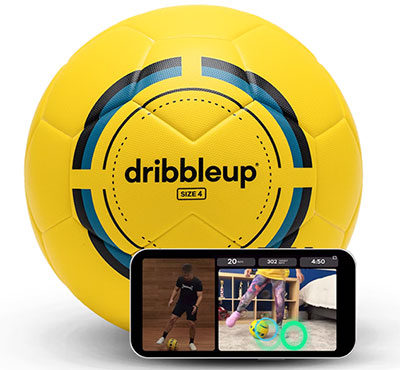

Image Credit: DribbleUp
DribbleUp illustrates how behavioral technology can improve athletic training. The system uses a specialized, brightly marked soccer ball paired with a smartphone or tablet camera. Its proprietary app tracks the ball in real time, projecting digital cones and targets onto the screen. It translates standard, often-boring repetition drills into a high-score chase.
By providing immediate visual and audio feedback, the app changes how users perceive repetitive training — transforming rigorous athletic training from a mandatory chore into a highly engaging video game.
How DribbleUp Compares
Comparing consumer soccer training systems highlights the differences between optical tracking and physical training aids. Here is a direct comparison between DribbleUp and the popular physical trainer, SenseBall:
| DribbleUp Smart Soccer Ball | SenseBall Blue Soccer Kick Trainer | |
|---|---|---|
| Price | $59.99 | $44.95 |
| Technology | Optical camera tracking via smartphone or tablet | Physical tether and pendulum mechanics |
| Core Benefit | Gamified real-time visual feedback | Bilateral muscle memory and rhythm |
| Device Requirements | Smartphone/tablet with companion app | Completely independent hardware |
| Training Environment | Highly optimized for small indoor spaces | Requires outdoor or open clearance |
While tools like the SenseBall focus entirely on physical repetition without screens, and wearables like Playermaker track GPS metrics directly via a boot sensor, DribbleUp uniquely targets player motivation and engagement. However, it is fundamentally limited by the field of view of a standard front-facing camera, restricting the drills to close-quarters ball control rather than long-range striking or sprinting.
Pricing and User Feedback
You can purchase the DribbleUp Smart Soccer Ball directly for around $59.99 for the starter pack, though the true cost involves an ongoing monthly app subscription required to unlock live classes and advanced drills.
Public perception is generally positive but varies depending on the user’s goals. Parents rave that their children are eagerly achieving hundreds of touches a day without being nagged. However, coaches have warned of a different kind of mission creep: young players often begin focusing entirely on “beating the app’s screen” rather than keeping their heads up and scanning a real pitch. The tech works flawlessly, but human use dictates its real-world success.
The DribbleUp Smart Soccer Ball perfectly encapsulates the core theme of this column: technology lives or dies based entirely on human perception. By masking the grueling repetition of athletic training behind the engaging interface of a digital game, DribbleUp solves the human-error problem of motivation.
It demonstrates that even a simple analog product such as a soccer ball can become a successful digital platform when user perception is engineered as carefully as the technology itself. That’s why DribbleUp is my Product of the Week.
Read the full article here