



Some of the biggest names in telecommunications are joining forces to bolster cybersecurity across the industry.
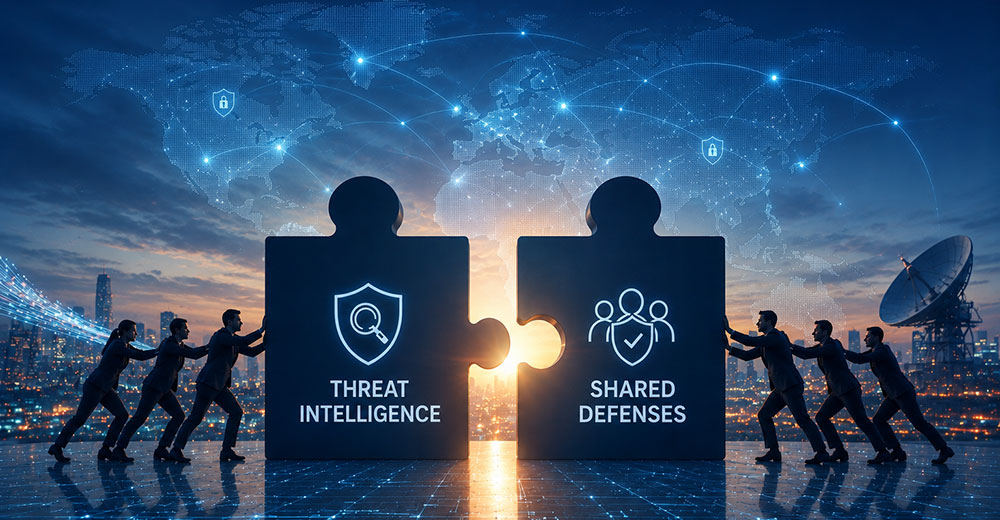
The companies — AT&T, Charter, Comcast, Cox, Lumen Technologies, T-Mobile, Verizon, and Zayo — are establishing the Communications Cybersecurity Information Sharing and Analysis Center (C2 ISAC) to provide a trusted setting where technical experts can exchange intelligence and coordinate defense strategies.
“The formation of C2 ISAC marks a critical step forward in our mission to protect the nation’s communications infrastructure against increasingly sophisticated threats,” said Nasrin Rezai, chief information security officer of Verizon.
“By formalizing real-time intelligence sharing among industry leaders, we are building a unified defense that no single company could achieve alone,” she told TechNewsWorld.
AT&T spokesperson Dan Feldstein explained that the cybersecurity threat landscape has evolved rapidly over the past 18 months, with threats becoming more sophisticated, frequent, and impactful.
“This increased complexity highlights the urgent need for industry partners to continually strengthen and adapt the frameworks we use for rapid information sharing and collective defense,” he told TechNewsWorld.
“Establishing a new ISAC allows us to address emerging challenges with fresh perspectives, innovative tools, and modernized processes,” he added.
Fostering Candid Information Exchange
“The companies that Salt Typhoon compromised are now building the sharing infrastructure they needed before the compromise happened,” declared Jacob Krell, senior director for secure AI solutions and cybersecurity at Suzu Labs, a provider of AI-powered cybersecurity services in Las Vegas.
Salt Typhoon is a cyber espionage group linked to China. It’s been accused of infiltrating telecom and other critical infrastructure networks to steal data and monitor communications.
Krell explained that telecom was the only major critical infrastructure sector whose information-sharing body sat inside the federal government rather than being industry-run.
“That arrangement discouraged candid exchange at exactly the moments it mattered most,” he told TechNewsWorld. T-Mobile’s own CSO publicly acknowledged that carriers withheld threat data that later turned out to be connected to larger campaigns.
“Financial services and energy solved this problem years ago,” he said. The telecom sector is arriving late to a model that the rest of the critical infrastructure already depends on.
Krell added that the telecom industry’s decision to form an ISAC outside the federal government at this time isn’t incidental. He pointed out that the federal Cybersecurity and Infrastructure Security Agency has lost nearly a third of its workforce and faces a $495 million budget cut, and that the CIPAC coordination framework — founded in 2006 to facilitate public-private collaboration on critical infrastructure protection — has been shuttered.
“C2 ISAC joins the Alliance for Critical Infrastructure as another case of industry organizing its own defense because federal capacity is no longer guaranteed,” he maintained.
Creating Safe Harbor
Jacob Warner, director of IT at Xcape, a managed IT solutions company in Los Angeles, asserted that C2 ISAC signals that the private sector is seizing control of its own operational defense grid to bypass a slow, risk-averse federal bureaucracy.
“By establishing a private-sector-only consortium separate from the legacy, government-managed COMM-ISAC, these hyper-competitive carriers are creating a safe harbor for sharing highly sensitive, early-stage telemetry without the chill of immediate regulatory scrutiny or Freedom of Information Act exposure,” he told TechNewsWorld.
Moving information sharing outside the federal government has both advantages and tradeoffs, argued Ensar Seker, chief information security officer of SOCRadar, a threat intelligence company in Newark, Del.
The biggest advantage is agility, he told TechNewsWorld. Industry-led groups can often move faster, share more operationally actionable intelligence, and foster stronger peer trust without some of the bureaucratic constraints associated with government structures. It can also encourage broader participation from private-sector organizations.
However, government involvement still remains critical, especially for nation-state attribution, classified intelligence, and coordinated response during major incidents, he warned.
“The ideal model is not separation,” he continued, “but close public-private collaboration where industry-led sharing complements government visibility and resources.”
Why Telecoms See Collective Defense as Essential
Adversaries have collaborated for years, defenders less so, explained Dave Gerry, CEO of Bugcrowd, a crowdsourced bug bounty platform based in San Francisco. The creation of C2 ISAC narrows that gap, he told TechNewsWorld.
“The communications sector has watched adversaries shift from opportunistic attacks to coordinated campaigns against critical infrastructure, and no single carrier can see the whole picture on its own,” he said. “I think C2 ISAC reflects a maturing view that threat intelligence is more valuable when it’s shared across the industry in something close to real time. That kind of collective defense is where the industry has to go.”
“For enterprise risk leaders, the creation of C2 ISAC serves as a stark warning that core communication foundations, specifically 5G orchestration, signaling protocols, and transit backbones, are under such aggressive nation-state and AI-driven bombardment that the primary gatekeepers can no longer defend them in silos,” Warner added.
The creation of the C2 ISAC is a sign of how dire the threat landscape has become for communications companies. When eight companies that compete fiercely for the same customers agree to share threat intelligence, that’s not a goodwill gesture — it’s an economic signal, observed Bugcrowd’s Chief Strategy and Trust Officer, Trey Ford.
No single carrier’s security budget can buy visibility into threats that span the entire sector, and the cost of getting that wrong is now clearly higher than the cost of collaboration, he told TechNewsWorld.
He maintained that three developments converged to produce C2 ISAC: AI’s dramatic acceleration of offensive campaigns against telecom providers, nation-state actors explicitly targeting communications as a force multiplier against other sectors, and the inability of any single organization to achieve full-spectrum visibility into how threats move. The math on collective defense finally became undeniable, he said.
Turning Shared Intelligence Into Defense
With C2 ISAC, the industry can have its own force multiplier, asserted Shawn Edwards, chief security officer with Zayo, a global telecommunications and communications infrastructure company.
When providers can share indicators, vulnerabilities, tactics, and operational lessons in a trusted environment, the entire sector becomes better at anticipating, detecting, and responding to threats, he told TechNewsWorld. Ultimately, that strengthens the resilience of the networks that consumers, enterprises, and government agencies rely on every day.
The formation of C2 ISAC reflects these telecom actors’ desire to increase dialogue among themselves, added John Strand of Strand Consulting, a Denmark-based consulting firm focused on telecom. “This model allows for the exchange of information and experience in a world in which telecommunications infrastructure is under attack on a daily basis,” he told TechNewsWorld.
“They have a great responsibility when it comes to ensuring that the platform their customers use to send and receive data is secure,” he said. “They have the same responsibility for the safety of their customers as an airline has for you and me when we fly.”
Read the full article here