



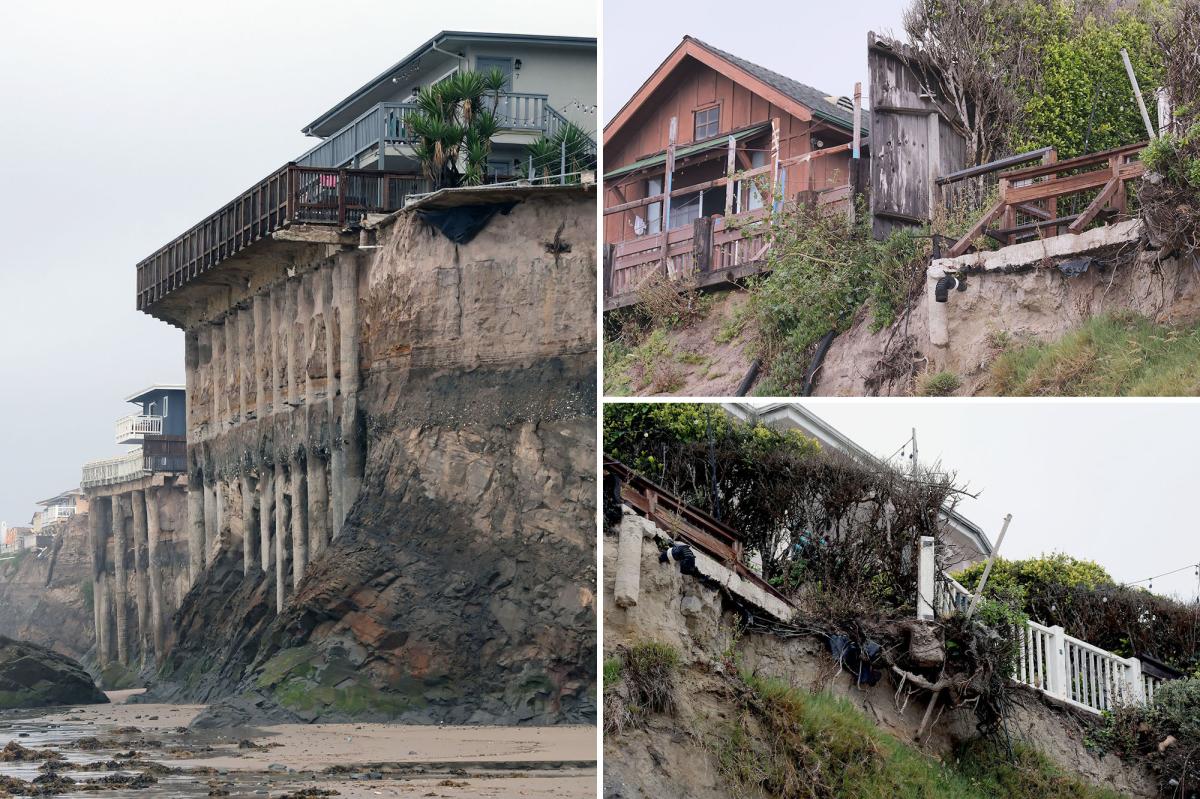
Luxury blufftop homes near the University of California, Santa Barbara are teetering on the edge — quite literally — as California’s coastline rapidly erodes into what locals are calling a dangerous “pinch point.”
The stretch of coast between campus and Isla Vista is being squeezed from both sides: rising seas on one end and hardened infrastructure on the other, leaving beaches — and the cliffs above them — with nowhere to go but down.
That’s bad news for the multimillion-dollar homes perched along the bluff, where erosion has already begun eating away at the land beneath them.
Scientists say warming oceans are expanding and driving stronger storms, pushing higher tides further inland, and accelerating the collapse of fragile coastal bluffs.
Man-made barriers like seawalls and inland development block the natural retreat of the shoreline, creating a bottleneck where the coast is effectively pinched out of existence.
The issue is not just the bluff, says Charles Lester, director of UCSB’s Ocean and Coastal Policy Center.
It’s the road, utilities, bike paths, pedestrian access, and nearby buildings—all competing for space that is disappearing over time, according to Lester.
“The erosion trend is not expected to change,” he told The Santa Barbara Independent. “That’s going to continue for decades.”
The phenomenon, called “coastal squeeze” by scientists, is playing out in real time along this shoreline, where the margin between ocean and development is steadily shrinking. Beaches that once provided a buffer are narrowing, leaving cliffs more exposed to waves and storm surges.
As that buffer disappears, the impacts ripple outward, affecting not just the coastline but also the infrastructure and communities alongside it. Public access points, walkways, and essential services face increasing pressure as the land supporting them continues to shrink.
Despite the growing danger, the California Coastal Commission has resisted calls for major protective measures, such as expanded seawalls, citing long-term environmental concerns and the importance of allowing natural coastal processes to unfold.
The commission’s approach reflects a broader tension across California’s coast–balancing immediate efforts to protect property and infrastructure with the long-term reality of a shifting shoreline.
Hard armoring solutions like seawalls offer short-term protection but come with trade-offs, including beach loss over time. By preventing the coast from naturally moving inland, these structures can intensify the squeeze they aim to address, further narrowing the space between ocean and land.
Communities like Isla Vista face a difficult position, caught between the advancing ocean and policies limiting large-scale intervention. Homeowners, students, and local officials must grapple with what comes next as erosion continues and options remain limited.
For now, the cliffs continue to wear away bringing the ocean closer to everything built above it.
And with sea levels projected to keep rising and storms expected to grow more intense, experts warn the squeeze is only going to get tighter—putting more of California’s coastline, and the homes perched along it, at risk of being slowly swallowed by the sea.
Read the full article here