


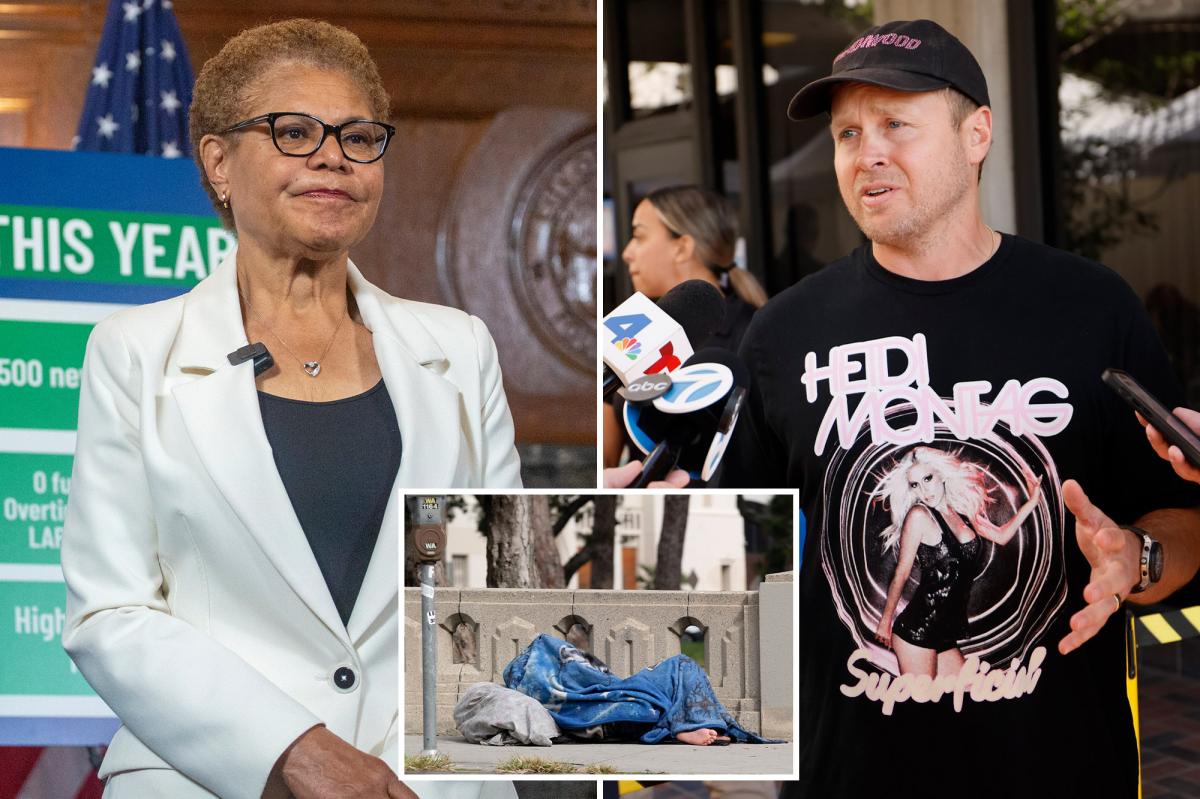
Spencer Pratt has blasted Mayor Karen Bass’ proposed $14.85 billion budget, accusing her of pouring money into a homelessness system he says is failing while neglecting basic city services.
“Despite record revenues, I see no real plan for the streets, sidewalks, parks, and streetlights,” said Pratt, who is running for mayor, told The Post.
“There is no plan to repay Los Angeles Department of Water and Power’s $129 million in past due payables.”
The budget sets aside roughly $778 million for homelessness programs, including about $104 million for Inside Safe, Bass’ signature initiative to move people from encampments into hotel and motel rooms.
“She is continuing her wasteful spending on the failed ‘Inside Safe’ program,” Pratt said.
“More of the same is a death sentence for L.A.”
The remaining roughly $670 million funds a broader system that includes interim housing such as tiny home villages, Bridge Home shelters and leased motels, along with outreach contracts, case management and sanitation response tied to encampments.
Bass has defended the approach, arguing it reduces pressure on emergency services.
“When you get people off the street, you reduce fire calls, you reduce medical calls, you reduce police calls,” she said.
But Pratt has rejected that argument, tying the spending to what he describes as a broader failure of leadership at City Hall.
“I’m not a politician,” Pratt has said in campaign messaging. “I’m a husband and father who watched my home burn because the system failed us.”
In previous reporting and recent interviews, Pratt has framed his campaign as a direct response to what he sees as government failure, particularly following the Palisades fire that destroyed his home.
“It came to the point where I got so sick of just being a yapper,” Pratt said in a recent interview with Joe Rogan. “I was like, OK, well, game on… Now I’m going to go into your headquarters and just take your job.”
He has built his message around accountability, public safety and restoring basic quality of life, repeatedly criticizing the city’s handling of homelessness, infrastructure and emergency preparedness.
Pratt has pointed to the fire response as a turning point, calling the lack of preparation “criminal mismanagement.” “The fact that the reservoir was empty was criminal mismanagement… it was just insanity,” he told Rogan.
He has also used conditions across the city to argue the system is failing, saying the homelessness crisis has spread far beyond traditional areas.
Pratt said Skid Row has grown so large it could be “called Los Angeles,” and described conditions near his family’s neighborhood as increasingly unstable.
His criticism extends to public safety.
The budget includes funding to hire 510 police officers, though city officials say those hires are largely intended to replace officers who leave, not expand the force. Even with the hiring plan, LAPD staffing is projected to fall to about 8,555 officers by 2027, down from roughly 10,000 in 2020.
The Los Angeles Police Protective League backed the mayor’s proposal.
“The mayor’s balanced budget protects public safety and funds the hiring of 510 police officers to keep Angelenos safe and maintain the LAPD’s ability to respond to 911 calls in a timely manner,” the union said.
But Pratt argues the numbers show a system under strain.
The budget holds the Los Angeles Fire Department largely flat, with only 40 new positions planned until at least November, when voters will weigh a potential funding measure.
Last year, the city invested $898 million in LAFD. This year’s budget comes in at $940 million, a bump on paper but one that still falls short of a meaningful staffing expansion.
The issue was not addressed during most of the mayor’s budget rollout and only surfaced at the end of the press conference, when a reporter raised concerns in the wake of the Palisades fire.
Bass insisted the department is adequately funded.
“I know one thing, the fire department is adequately funded for any emergency that would happen similar to what happened before,” she said.
Beyond public safety, the budget largely maintains existing city services, adding about 170 street repair workers and roughly $36 million for sidewalk improvements, while avoiding layoffs after last year’s budget crisis.
City Administrative Officer Matt Szabo described the proposal as a step toward stability, though he acknowledged the city has not fully restored services that were cut.
“We are making steady steps toward stability,” Szabo said.
The budget now heads to the City Council for weeks of hearings and potential revisions.
For Pratt, the bottom line is unchanged. The city is spending more, he argues, without solving its biggest problems. “More of the same is a death sentence for L.A.,” he said.
Read the full article here