




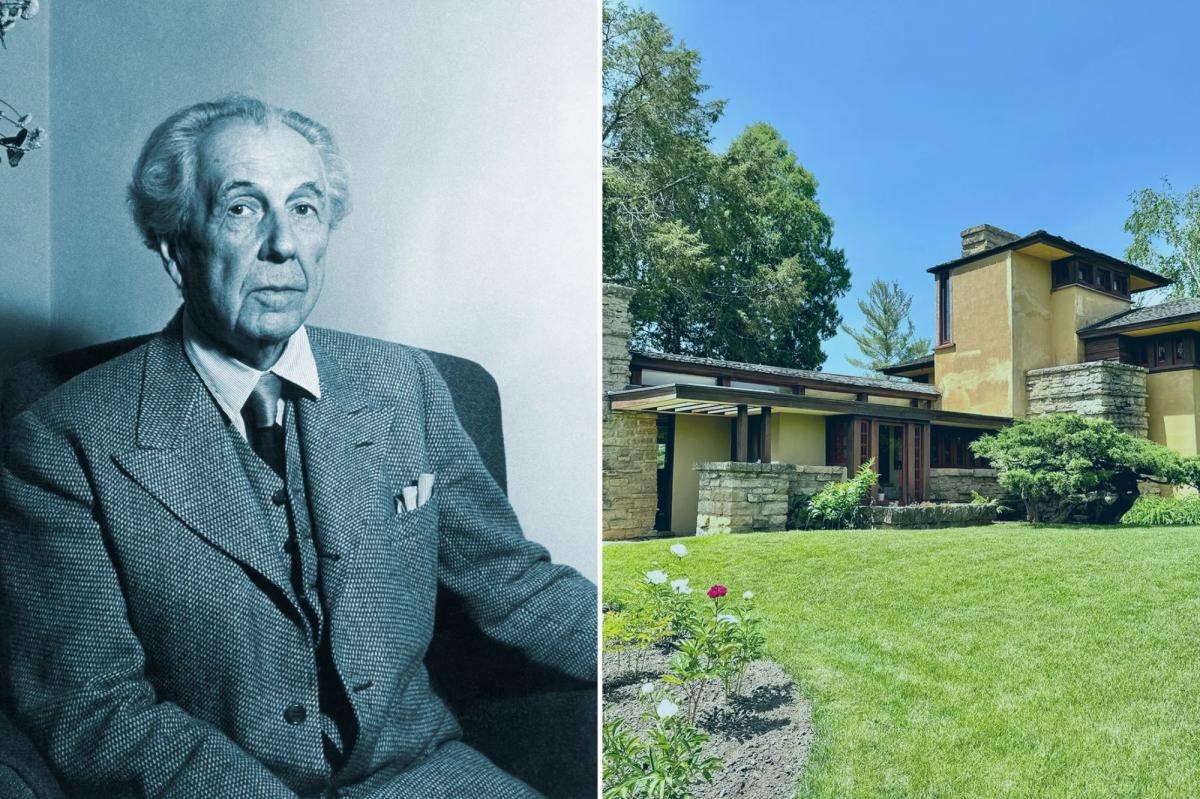
Frank Lloyd Wright was never a modest man.
Praised frequently as the greatest architect in American history, he would parry “Why limit it to America?”
During his long life — he died in 1959 at the age of 91 — he married three times, sired seven children, infuriated clients, ran up debts he couldn’t pay. Yet he remained steadfast in his self-belief.
Perhaps Wright’s greatest feat of strength, a new book argues, was to recover from a shattering personal tragedy which would have broken a weaker man.
“The Killer and Frank Lloyd Wright: The True Story of Mass Murder in Paradise,” by Casey Sherman, describes an atrocity committed in 1914 at Taliesin, the Wisconsin residence Wright designed for the great love of his life, Martha “Mamah” Borthwick.
“I call it ‘Romeo and Juliet’ meets ‘The Shining,’ ” author Sherman told The Post. “A crime like no other which — strangely — has been almost totally forgotten.”
Frank first encountered Mamah (pronounced May-ma) in Oak Park, Ill., where, in the early 1900s, he spearheaded the innovative Prairie School of design. A typical Wright home had a low-pitched roof, overhanging eaves, an open-floor plan and a horizontal ribbon of windows — very different from the Victorian-style houses previously popular in that prosperous Chicago suburb.
Mamah — a “carefree, vivacious and intellectually curious” woman, as Sherman describes her — was married to one of Wright’s clients, a stolid businessman named Edwin Cheney with whom she shared a son and daughter.
Wright, meanwhile, felt trapped in his own marriage to Catherine “Kitty” Tobin Wright whom he married when he was 22.
He claimed Kitty was too absorbed raising their six children to provide him with stimulating and attentive companionship. When she refused to grant him a divorce, Wright left Illinois in autumn 1909, and persuaded the tall and elegant Mamah, now his lover, to accompany him to Europe. Sherman describes the ensuing furor as “the earliest celebrity sex scandal in America.”
In Berlin the couple moved into the Hotel Adlon, confident of privacy 4,000 miles from home. But an enterprising foreign correspondent for the Chicago Tribune — tipped off most likely by Kitty Wright — persuaded a hotel clerk to show him the Adlon guest registry, wherein he spotted the entry “Frank Lloyd
Wright and wife, Chicago.” The subsequent headline on the front page of the Tribune read: “Leave Families: Elope to Europe — Architect Frank Lloyd Wright and Mrs. Edwin Cheney of Oak Park Startle Friends.”
Denounced as vile adulterers by preachers, politicians and editorial writers across America, Wright and Mamah moved again, this time to a secluded villa in the hilltop town of Fiesole, near Florence, Italy. There, the architect immersed himself in the study of the city’s classic buildings, while Mamah embarked on a new career as a translator, producing English versions of the writings of the Swedish feminist Ellen Key.
The couple’s Italian idyll lasted barely a year, as Wright needed to return to the US and earn money to support his large family. Mamah stayed behind for some months, resolving to live separately from Edwin Cheney for two years so as to qualify for a divorce.
Miserable back in Oak Park and sharing a house with Kitty, who insisted they remain married, Wright began dreaming of recreating life in Italy by building a home for Mamah and himself on a hill in Spring Green, Wis., near where he was born.
Taliesin — the Welsh word for “shining brow,” as he called the 800-acre estate — was a stone and wood residence designed to blend into its natural surroundings. It became not only a sanctuary for the couple, but a training center for young architects and craftsmen to study and work on the property.
Mamah encouraged Wright to expand his practice and take on the daunting job of designing a vast new entertainment venue in Chicago, Midway Gardens, even as she based herself at Taliesin doing her translation work.
On Aug. 15, 1914, a sultry Saturday, Wright was in Chicago racing to meet his Midway Gardens deadlines. Mamah sat down to eat lunch on the screened-in porch at Taliesin with her two children John, 12, and Martha, 8, who were visiting for the weekend. In a nearby dining room, six carpenters and draftsmen were also eating.
Julian Carlton, whom Wright had hired earlier in the summer to work as a handyman and butler at Taliesin, served cold soup and then — without warning — used a small hatchet he’d hidden in his jacket to strike Mamah from behind, splitting her skull in two. Next he killed young John with a single hatchet blow to the head, and pursued a screaming Martha as she ran outside. In the courtyard, he snatched the girl by the hair and hacked her to death.
Grabbing a can of gasoline, Carlton poured the liquid under the door of the dining room, which he had locked earlier, and set it afire. The men inside were faced with a terrible choice: Burn to death, or jump out of the window to face the hatchet-wielding Carlton. Only two survived.
What triggered Carlton’s murderous rampage? “Most certainly he had an undiagnosed mental illness,” Sherman explained to The Post. His wife, Gertrude, employed as the estate’s cook, reported afterwards that her husband had behaved erratically for months — exploding with anger, waking in the night to announce that enemies were approaching. He began carrying a hatchet to defend himself.
A few days before the massacre, Emil Brodelle, a draftsman, demanded Carlton, who was black, saddle his horse. When Carlton refused, Brodelle called him a racial epithet. After that, Carlton told his wife he wanted to quit Taliesin. Mamah was unhappy the couple planned to leave, and they agreed to stay on until replacements could be found.
After Carlton snapped — with Brodelle among the men killed — neighbors put out the fire and eventually found the butler hiding in a furnace, having swallowed acid. He died seven weeks later, of starvation due to his damaged throat, before he could be brought to trial.
For Wright, the events were incomprehensible. “Thirty-six hours earlier I had left Taliesin leaving all living, friendly and happy,” he later wrote in his memoir. “Now the blow has fallen like a lightening stroke.”
Wright chose to bury Mamah near the chapel at Taliesin. After the simple pine box containing her body had been lowered into a freshly dug grave, he asked to be left alone. He filled the grave himself and sat beside it for hours, reflecting on the cruel end to their five-year struggle to live together in freedom and peace.
Sherman reports how, even in death, Wright’s mistress could not escape the salacious attitudes of strangers. The headline in Utah’s Ogden Standard read, “The Terrible Fate of Mamah Borthwick in Her Bungalow of Love; Woman who with Frank Lloyd Wright Dared to Live Contrary to Accepted Rules of Conduct Meets Disaster in a Few Short Years.”
“Society went after them but they did not shrink from explaining to those who would listen how they supported and respected each other as individuals,” Sherman explained. “Frank and Mamah were intellectual soulmates.”
In his loneliness, Wright rushed into an ill-advised relationship with an unstable woman, sculptress Miriam Noel, who became his second wife. Only 10 years after the atrocity, in 1924, when he met his third and final wife, the Montenegro-born dancer Olgivanna Lazović, did America’s most renowned architect again experience the kind of happiness he’d discovered first with Mamah Borthwick.
Read the full article here