




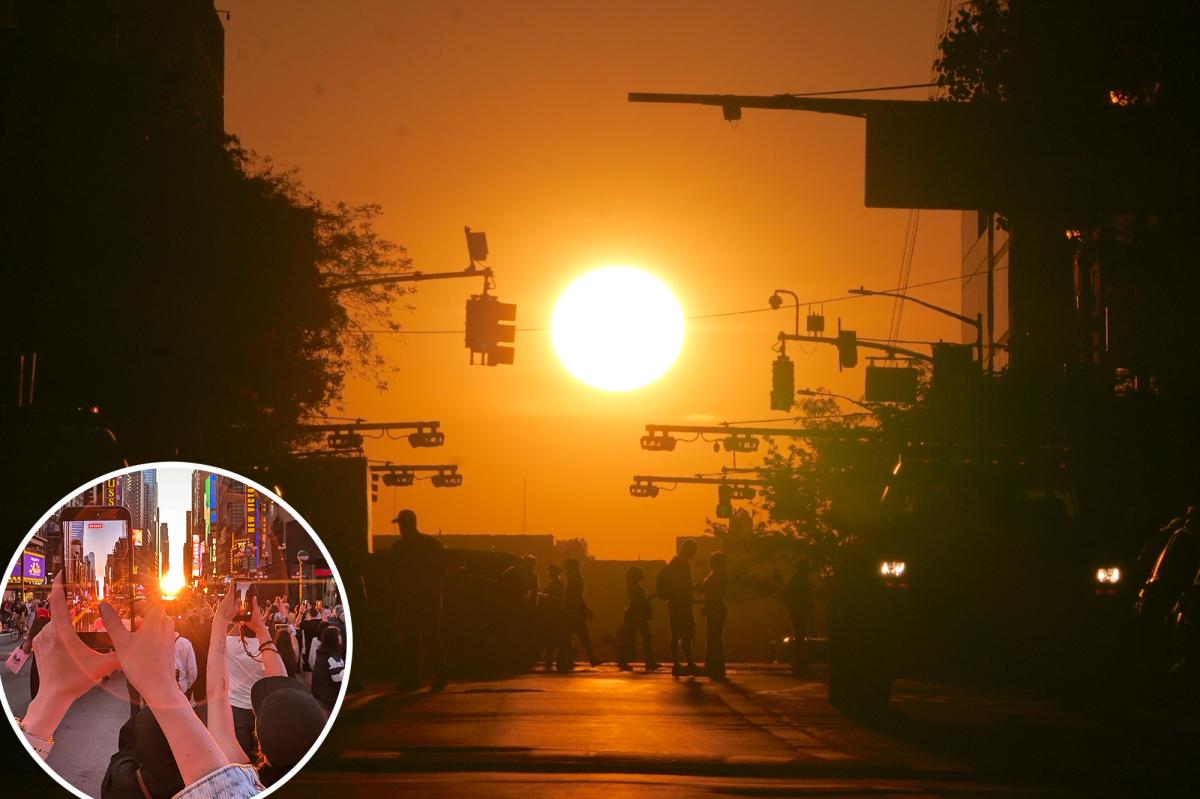
Get out your phones and head down to street level, because this year’s final Manhattanhenge — the coincidental phenomenon where the sun aligns perfectly with Manhattan’s rectangular street grid — is taking place this weekend, Sat. July 11 through Sun. July 12.
And while the point of the naturally occuring event is that you don’t have to work very hard to find the best viewing locations, not all east-west blocks are created equal. Some clouds may interrupt tonight’s show, according to Accuweather, but there’s no rain in the forecast around sunset (8:28pm) on either day.
Here’s everything you know are a few tips on the best viewing locations and happenings around town this weekend.
First up, on Saturday, American Museum of Natural History is hosting a free block party from 3-10 p.m. on W. 79th Street between Amsterdam and Columbus — there will be World Cup viewing options indoors, and chess matches, double dutch-jump rope and board games in the street.
The prime viewing time is expected to be around 8:20 p.m. — the Williamsburg Salsa Orchestra will play as the sun sets. The museum will also host a lecture at 7 p.m. about Manhattanhenge; you can get tickets for that event here.
What is Manhattanhenge?
Manhattanhenge only happens twice a year — in 2026, the first occurrence was May 28-29. The term was coined by astrophysicist Neil deGrasse Tyson, referencing England’s Stonehenge monument.
Tyson went outside and did a measurement of the grid of Manhattan and calculated the chosen azimuth — which is a point along the horizon — and altitude where the sun would line up directly with the horizon.
If you take your finger and point it down the middle of 42nd Street, a line would extend all the way out 93 million miles to the exact position that the sun is in.
While we learn that the Sun always rises in the east and sets in the west, this actually only happens twice per year on the equinoxes: the first day of spring and of autumn. On every other day, the Sun rises and sets elsewhere on the horizon, since the Earth is constantly spinning.
If Manhattan’s grid was aligned with the north-south line, Manhattanhenge would fall on the equinoxes. But the street grid is evidently rotated 30 degrees east from the geographic north, which shifts the days of alignment on the calendar to the late-May and mid-July dates.
Manhattan has the ability to have this clear sunset view because of its rectangular grid and the clear view to the horizon, which Manhattan has across the Hudson River to New Jersey. The tall buildings create a vertical channel that frames the Sun, which creates those perfect windows.
You can also view the sunset from Manhattan’s main east/west thoroughfares, where you should find a spot as far east as possible, that still has views of New Jersey across the Hudson River. Some prime viewing locations are:
- 14th Street
- 23rd Street
- 34th Street
- 42nd Street
- 57th Street
The sunset can also be viewed from Tudor City Overpass, Manhattan and Hunter’s Point South Park in Long Island City, Queens.
Jackie Fahorty works in the Astrophysics Department of the American Museum of Natural History (AMNH) and looks at the position of the sun and the exact coordinates of the Manhattan grid to identify a place in the sky where there would be a direct Manhattanhenge.
According to the AMNH website, Fahorty always does her altitude and azimuth calculations at 42nd Street and Fifth Avenue, a spot that enables full Manhattanhenge, when the very bottom of the sun kisses the grid right before it goes below the horizon.
The second is when the midpoint of the sun kisses the grid, calling it a half sun Manhattanhenge. May 28 is the half sun and May 29 is the full sun. The second Manhattanhenge is reversed — July 11 is the full sun and 12 is the half sun.
It is a combination of the azimuth — the point along the horizon — and the altitude that analysts look at to determine where the sun exactly will be.
While most people assume Uptown Manhattan is north and Downtown Manhattan is south, Tyson explained on the AMNH website that the borough of Manhattan is actually rotated so you can’t use that as your “azimuth” direction.
“New Yorkers hardly look up,” Tyson continued. “To the extent that we do not look up, we are losing something fundamental to what it is to be alive on planet Earth and to have the mental capability to contemplate the cosmos itself.”
Read the full article here