




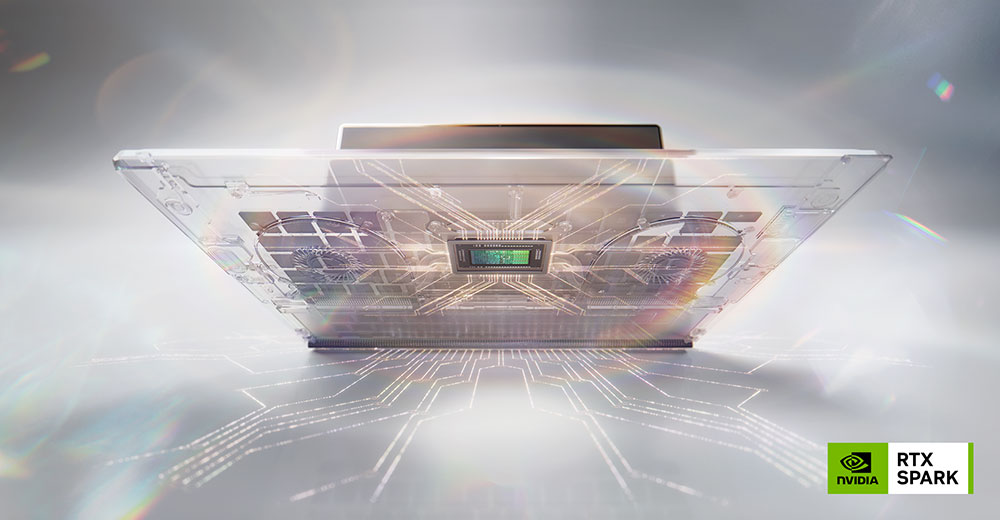
Since their market launch in 2024, AI PCs have received a tepid consumer response. Microsoft hopes to change that, with a helping hand from Nvidia.
The two companies announced Monday that they will introduce this fall some 30 laptops and 10 PCs built around Nvidia’s new RTX Spark “superchip,” which can deliver one petaflop of AI performance and address 128 gigabytes of unified memory.
“Nvidia and Microsoft share a vision that agents are the future of personal computing,” Jeff Fisher, senior vice president of personal computing at Nvidia, said in a statement. “RTX Spark combines Nvidia’s full technology stack with Microsoft Windows and is purpose-built for creators, gamers, and AI developers in the personal AI era.”
Nvidia’s founder and CEO Jensen Huang, in another statement, added: “The PC is being reinvented. For 40 years, you launched apps. Click. Type. With RTX Spark and Microsoft Windows, you ask — and the PC does the work.”
The new Arm-based laptops and PCs appear to be aimed at developers and creators and not the computing hoi polloi.
“Builders and creators today are reimagining how things get done, and they need reimagined hardware, silicon and platform capabilities to support them,” Microsoft Executive Vice President for Windows and Devices Pavan Davuluri wrote in the Windows Experience blog.
“They need PCs capable of running graphically intensive tasks efficiently, highly capable AI models, and a platform that simply and securely runs agents locally,” he noted.
“It’s the combination of Windows’ platform and ecosystem leadership, with Nvidia’s silicon innovation and industry-leading graphics and AI leadership,” he continued, “that has resulted in a collection of powerhouse laptops that will redefine how developers and creators interact with their PCs.”
‘Won’t Be Cheap’
Although no pricing information has been released for the new line of AI super laptops, they’re expected to be substantially more than an Apple MacBook Neo.
Michael Kan, writing for PC Magazine, observed that the RTX Spark family resembles Nvidia’s DGX Spark platform, a line of mini-PCs designed for AI researchers and developers. The key difference is that RTX Spark is specifically designed for consumers and Windows 11, whereas DGX Spark runs a custom version of Ubuntu Linux.
“For perspective, Nvidia’s DGX Spark features 128GB of RAM, and can be priced from $3,499 to $4,699, depending on the model,” he wrote. “Microsoft also told us its own RTX Spark product, the Surface Laptop Ultra, will be the company’s most powerful model yet, a sign it won’t be cheap.”
“Undoubtedly, the early buyers will be developers, creators, AI researchers, prosumers, and enterprises that want local AI power without buying full data-center gear,” said Mark N. Vena, president and principal analyst at SmartTech Research, a technology advisory firm in Las Vegas.
“These will not be mainstream family laptops on day one,” he told TechNewsWorld. “They will appeal first to people who already understand why running AI locally matters.”
Nvidia is now set to take on traditional PC processors from x86 leaders Intel and AMD, Brian Colello, a senior equity analyst at Morningstar Research Services in Chicago, maintained in a research note dated June 1.
“We remain impressed with Nvidia’s ability to elbow out into adjacent opportunities, and PCs are no exception,” he wrote. “Nvidia still has its GPU partnership within upcoming Intel PC processors, but we suspect Nvidia’s RTX Spark lineup will be compelling to power users.”
Nvidia Pushes AI Into PCs
Analysts said the announcement marks an important strategic move for Nvidia.
“RTX Spark is a big deal because Nvidia is trying to move AI from the data center into the personal computer in a serious way,” Vena said.
“This is not just another chip launch,” he declared. “It is Nvidia saying the next PC battleground is local AI, not just faster spreadsheets, browsers, and games.”
Nvidia is entering the laptop game, when previously they had been primarily focused on the desktop and data center markets, added Jeremy Roberts, senior director for research and content at Info-Tech Research Group, a global research and advisory firm.
“This is Nvidia’s first Arm chip,” he told TechNewsWorld. “The Arm architecture is generally more efficient than traditional x86 chips made by Intel and AMD. This matters when you’ve got very power-hungry workloads or are trying to extend battery life in laptops.”
“It’s also a further indication that the laptop market is heading in an Arm direction going forward,” he added. “Microsoft has already released some Arm Surface devices. Apple has been Arm-exclusive for a few years now.”
‘Competitive Protection’
Wading into Arm territory, however, could be risky for Nvidia, which is teaming up with MediaTek, an Arm-based system-on-a-chip designer. “A processor designed to compete with the AI PC configurations from AMD, Intel, and Qualcomm could be beneficial to consumers, if there aren’t compatibility problems,” said Rob Enderle, president and principal analyst with the Enderle Group, an advisory services firm in Bend, Ore.
“With a new technology, we can run into a series of compatibility problems that have to be overcome, particularly when we’re talking about Arm architecture,” he told TechNewsWorld.
“While Qualcomm seems to have been able to get around those compatibility issues,” he continued, “MediaTek hasn’t been at this quite as long. Neither has Nvidia on the CPU side, so there’s likely to be some teething problems with the initial generation.”
Having a front-end AI product is important for Nvidia because AMD, Intel, and Qualcomm have both front-end and back-end offerings, he added.
“Having the back-end and not having the front-end of a product is very risky for Nvidia,” he explained. “Call it competitive protection. If they didn’t do this, they would probably lose their dominant position.”
Nvidia’s Next Expansion
RTX Spark is a progressive development for Nvidia, Jack E. Gold, founder and principal analyst of J.Gold Associates, an IT advisory company in Northborough, Mass., noted in a LinkedIn post.
“Nvidia sees an opening to expand into this market as it leverages its work on Arm-based CPUs that it has created for its data center products (e.g., Vera [and] Rubin) and scales them to complement its already substantial GPUs targeted at PCs for gaming and creative work (RTX family),” he wrote.
“This is a natural evolution for Nvidia [which] sees this as a significant new market opportunity,” he explained.
“This will put pressure on the incumbents (Intel, AMD) as they too are pursuing this market,” he continued. “But they still command the vast majority of the AI PC market, and Arm-based PCs (e.g., Qualcomm) still have a small portion of the overall market.”
He predicted Nvidia will likely see slower growth in the space relative to the significant AI PC market expansion, as enterprises will likely be cautious about deploying new hardware until it’s fully qualified for their computing requirements.
Nevertheless, he pointed out that it creates an interesting niche that Nvidia can exploit and enables Nvidia to deploy to the emerging AI Edge market, which offers more flexibility in processor families.
“But,” he added, “even if successful, this AI PC short-term market opportunity is relatively small compared to the massive revenues Nvidia is generating from its cloud hyperscaler and enterprise datacenter businesses. I’d expect it to be a very small component on its financials for at least the next 1-2 years.”
Read the full article here