



The Met Gala hasn’t even hit the red carpet — and it’s already soaked in controversy.
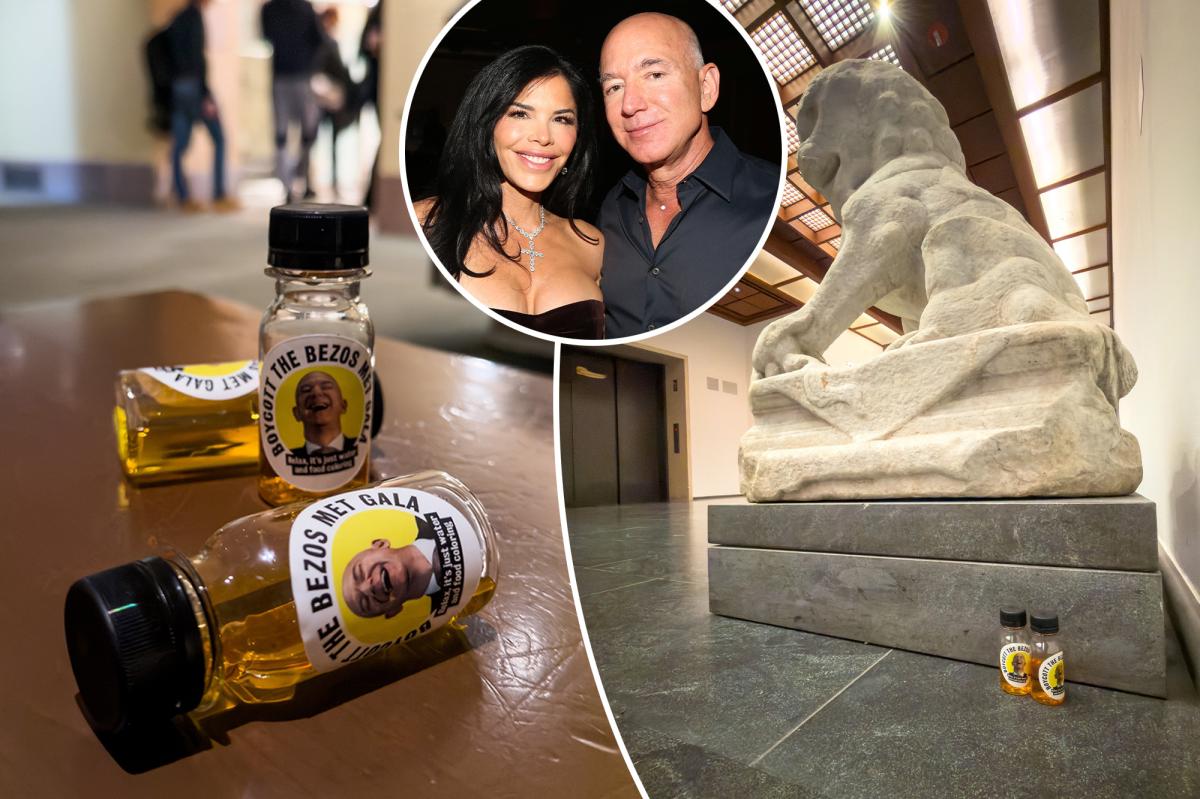
Staff at the Metropolitan Museum of Art discovered hundreds of bottles filled with what appeared to be urine hidden inside the venue ahead of fashion’s biggest night, in a grotesque protest aimed at this year’s high-profile co-chair, Amazon founder Jeff Bezos.
The shocking stunt — tied to allegations that Amazon warehouse workers feel forced to pee in bottles, rather than take bathroom breaks — comes as backlash over the billionaire’s involvement in the glitzy fundraiser has reached a fever pitch across New York City.
At the center of the outrage is activist collective Everyone Hates Elon, a self-described anti-billionaire group funded by roughly 1,000 donors worldwide, which has spent days escalating its campaign against Bezos and the Met Gala’s corporate ties.
In a statement accompanying its latest stunt, the group said: “Amazon founder and oligarch Jeff Bezos just finished his Met Gala pre-party at his penthouse and is getting ready for the big night.”
They added, “We couldn’t let him get away with using celebrity and fashion to hide his crimes. We’re exposing them instead.”
According to the group, “hundreds of piss bottles” were placed throughout the museum — alongside signs and installations designed to mock conditions faced by Amazon workers.
One particularly inflammatory display labeled a cluster of plastic bottles as a “Met Gala VIP toilet,” with signage reading: “Installed in honor of Met Gala chair Jeff Bezos. Go ahead, it’s good enough for his staff.”
Baskets of empty bottles were also reportedly left outside the museum, encouraging passersby to use them — a jarring visual meant to underscore claims about warehouse labor conditions.
The group has repeatedly alleged that Amazon workers are sometimes forced to urinate in bottles due to punishing schedules and limited bathroom access — accusations the company has previously acknowledged as part of broader logistical challenges, while disputing the framing.
Amazon has said restroom access issues are an “industry-wide problem” tied to delivery routes and traffic conditions, adding that it has “worked to address” the concerns.
Still, the optics of Bezos — worth an estimated fortune that routinely puts him at the center of billionaires-and-bad-behavior debates — co-chairing fashion’s most exclusive night has proven too much for critics to ignore.
In the days leading up to the gala, protest messaging has been splashed across the city, including posters outside a boarded-up deli showing what appears to be a urine-filled bottle staged on a red carpet under flashing cameras.
One message read: “Boycott the Bezos Met Gala. Brought to you by worker exploitation.”
Activists also projected messages onto Bezos’ Fifth Avenue residence and some of New York’s most iconic landmarks, including the Chrysler Building and the Empire State Building, urging a boycott of what they called “billionaire-backed fashion theater.”
Fashion insiders, meanwhile, have been quietly split over the growing backlash — with critics questioning the optics of philanthropy-heavy galas bankrolled by ultra-wealthy corporate figures.
Bezos and his wife, Lauren Sánchez Bezos, were named honorary co-chairs and lead sponsors of this year’s event in February, reportedly contributing millions to secure their involvement.
As previously reported by The Post, fashion’s most gilded night comes with a less glamorous reality: bathroom logistics.
At a soiree where guests are zipped, stitched, sculpted and suctioned into couture, using the bathroom becomes a full-scale operation — requiring planning, assistance and, often, dehydration.
For many attendees, it’s not a quick trip to the stall but a production: gowns are fully removed, sometimes left pooled on the floor, while assistants manage fabric, timing and damage control.
Celebrity PA Network founder Brian Daniel told the Washington Post that many stars rely on personal assistants for exactly this reason, with some even assigning trusted staff specifically for wardrobe and bathroom logistics.
While event “freebie assistants” may help in public, the more intimate work is usually reserved for people in a celebrity’s inner circle.
Some designers try to get ahead of the issue with hidden “trap doors” or discreet openings built into gowns, allowing for quick relief without a full costume teardown — though even that only goes so far once beading, latex or layered construction enters the equation.
Celebrities, in short, improvise. Katy Perry has spoken about relying on serious “self-control” and a standing-urination device called GoGirl, while Winnie Harlow recalled Perry once helping her in a bathroom stall.
Others have taken more extreme measures: Kim Kardashian has admitted she’s considered “peeing her pants” under restrictive looks, while Kendall Jenner once used an ice bucket in a sprinter van en route to the event.
For many guests, the safest strategy is avoidance — skipping liquids entirely in the hours before the carpet, trading comfort for couture integrity.
So while the Met Gala debates couture and controversy, the most universal challenge remains unchanged: What to do when nature calls in a $10,000 dress.
Read the full article here