


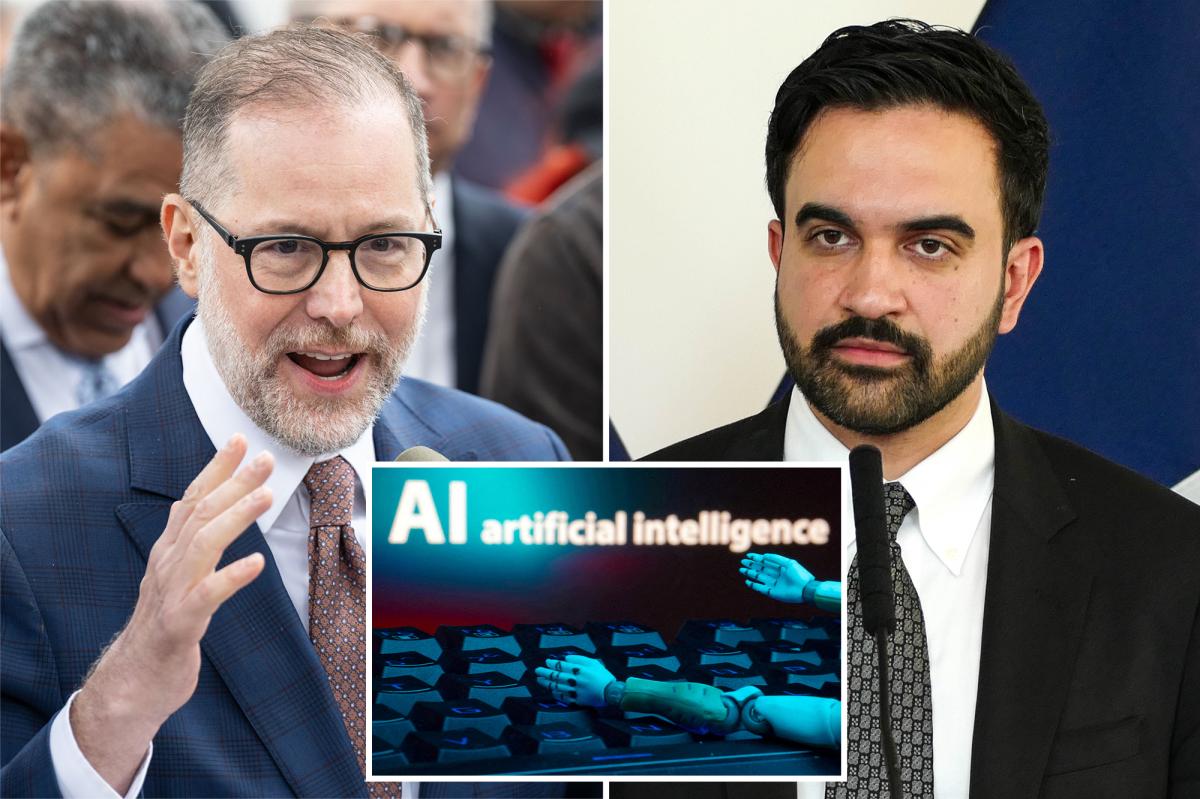
New York City’s chief auditor is calling on Mayor Zohran Mamdani to make big-time budget cuts — warning about the potential hit artificial intelligence could deliver to the economy of the world’s financial capital.
City Comptroller Mark Levine sounded the alarm about the impact AI could have on the Big Apple’s tax revenue, saying there was a 50-50 shot the emerging tech sparks a recession in the five boroughs.
Meanwhile, city coffers remain far from full enough to cover the possible economic downturn, Levine said.
“We are entering into the most dramatic technological revolution of our lifetime and this will change New York City in ways that are difficult to even imagine,” he told reporters Wednesday.
“New York City, uniquely — more than any other place in America and maybe the world — is exposed to the potential promises and perils of this technology, because our economy is deeply intertwined with the financing of AI,” he said, “because we are the nation’s capital of white collar work, with a million people who go into offices every day during jobs that are very exposed to AI.”
The fiscal watchdog urged Mamdani to squirrel away another $6.5 billion in anticipation of the AI financial hit — by continuing to chip away at the city’s budget, specifically housing vouchers, the Department of Education and other spending.
Hizzoner last week unveiled his latest budget plan, bringing spending down to $124.7 billion from his over $127 billion proposal earlier this year, while reversing course on drawing down the city’s reserves and raising taxes.
But the comptroller said the $7.2 billion in savings, spread out through multiple accounts, including the Retirees Health Benefit Fund and Rainy Day fund, still falls far short of cash needed to offset a recession.
Levine said his team estimated that $13.5 billion would be needed to at least prepare the city for the various financial situations AI could create as economists remain split on what effect the tech will have as it integrates into the workplace.
The comptroller’s office, in a new report, spelled out five scenarios showing how the tech could affect employment numbers and tax revenue:
Three of the possibilities, based on a localized Moody’s report, provided a dire projection of city finances from 2027 through 2030:
- If the AI bubble bursts and the investments fizzle, which has 25% chances of playing out, the city would lose 135,000 jobs in the private sector, costing $8.8 billion in taxes.
- The second model, which has a 20% probabilty, projects AI development moves much faster than expected, leading to the tech replacing jobs quicker than companies can replace them. That would lead to a loss of 94,000 jobs, with the biggest hit in office-space gigs, and $5.5 billion in tax revenue.
- The doomsday scenario, which had a 5% chance, where AI fully disrupts the Big Apple economy, the city stands to lose 259,000 jobs and $14.4 billion in taxes.
The most likely outcome, with a 35% shot of happening, is that the city benefits from the technological shift to artificial intelligence, boosting tax revenue by around $7 billion by 2030 and a 1.2% increase in private sector jobs.
There’s also a 15% chance for a big boost in the economy, similar to the late-1990s internet boom, which the comptroller’s office notes is the “most optimistic” outcome.
That scenario would lead to higher wages across-the-board, nearly 30,000 more private sector jobs, and $8 billion in revenue between 2027-30.
Levine said the uncertainty surrounding the potential impacts requires the mayor to act, and called on Mamdani to create a formula moving forward that would keep reserve levels at 16% of tax revenue each year.
“We do not currently today have the resources in city government… so we are doubling down on our push to finally, once and for all, have fully-funded reserves given the uncertainty,” he said.
“That is the amount of revenue we would expect to be down in a global recession.”
Read the full article here