


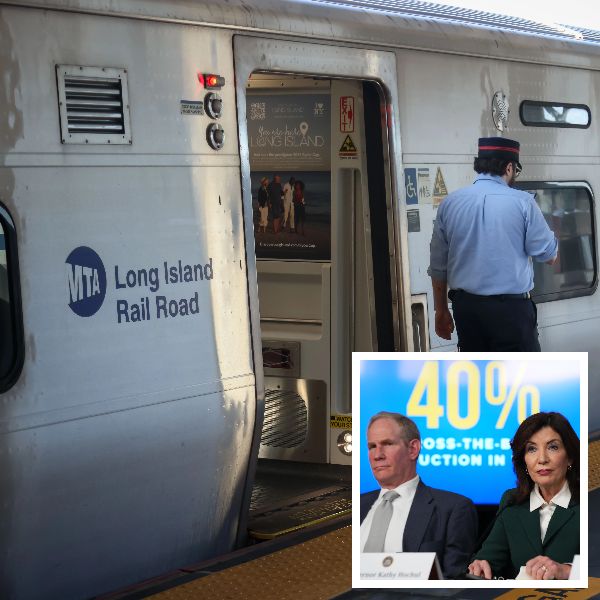
Long Island Rail Road workers went on strike early Saturday after Metropolitan Transportation Authority leaders failed to reach a deal on wage hikes with five labor unions.
More than 3,500 LIRR workers across five unions, including engineers, signalmen and trainman, walked off the job at 12:01 a.m. Saturday after a heated drawn-out battle over pay raises, with union leaders arguing higher wages are needed to keep up with inflation.
The work stoppage is expected to strand nearly 300,000 commuters, with limited shuttle buses available for essential workers and those who can’t telecommute on weekdays. MTA chief Janno Lieber and Gov. Kathy Hochul told other riders to simply work from home.
LIRR trains continued running between New York City and Long Island late Friday night, but Mayor Zohran Mamdani warned riders to expect “heavier-than-usual traffic,” crowded transit and longer travel times as the strike continues.
“City Hall and agencies across the administration are actively coordinating preparedness and contingency efforts to maintain continuity for commuters and support New Yorkers as conditions evolve,” Mamdani said in a Friday night post on X.
“The MTA has announced that limited weekday bus service will be available for essential workers and others who cannot telecommute. We encourage New Yorkers to stay informed, plan ahead and check for updates and travel guidance as more information becomes available.”
The dispute between the MTA and the coalition of labor groups involves contracts that became amenable in 2023 and centers on pay and work rules for train workers.
The sides have agreed on retroactive raises of 3% in 2023, 3% in 2024 and 3.5% in 2025, but remain at odds on the unions’ request for a 5% pay raise in 2026.
Union leaders say they need higher wages to keep up with inflation.
“We’re not asking for the moon and stars. We’re asking for an agreement that keeps pace with inflation,” a source at one of the unions involved in the negotiations told The Post Wednesday.
“They’re coming up with lump-sum payments rather than putting the money in our wages.”
Gary Dellaverson, the MTA’s lead labor negotiator, said Wednesday that in recent meetings, the authority has offered individual lump-sum payments over the remaining 12 months of the contract rather than the wage increases the unions are seeking.
But union officials argue that lump-sum payments do not raise base pay and would leave workers effectively stuck at 2025 wage levels when the next round of bargaining begins.
Negotiations reportedly continued late into Friday night as the strike deadline loomed, with riders rushing to return to Long Island before service was disrupted.
“At this point, we have no idea what’s going to happen, and we’re just kind of waiting to figure it out,” commuter Jordan Rund told ABC 7 News Friday night, noting how working from home isn’t an option for him.
“I work in the West Village, so for me to drive all day from Long Island to the west side, it would take me like over two hours to be able to get there. So, it’s kind of a hassle.”
Commuter Dana Camera told the outlet working from home is out of the question for her.
“I do ultrasounds for pregnant women and gynecology and so on and I have to be there,” she said. “I can’t do that remotely.”
Options will be slim for the LIRR’s daily riders who can’t work from home during the strike.
The MTA has planned rush‑hour shuttle buses for essential workers from five Long Island stations into Queens, at a projected cost of roughly $325,000 to $550,000 per day.
State Comptroller Thomas DiNapoli estimated the strike could cost up to $61 million in lost economic activity per day, based on prior analysis, inflation and rider trends.
“A LIRR strike will be felt far beyond the tracks, triggering the loss of millions of dollars per day in lost economic activity, disrupting thousands of riders and throwing the region’s transit service into chaos and gridlock,” DiNapoli said in a statement Friday.
“I urge the Metropolitan Transportation Authority and its union partners to expedite reaching a reasonable settlement so we can avoid the widespread disruption of a strike.”
Read the full article here