




Everything old is new again — and while the 1990s don’t seem that long ago, the style of the era has made a comeback in both ready-to-wear and bridal fashion.
“The ’90s remains an iconic era, one that’s experiencing a powerful resurgence,” said Dorothy Silver, director of merchandising at Kleinfeld Bridal.
The ’90s look is defined by a range of minimalist details.
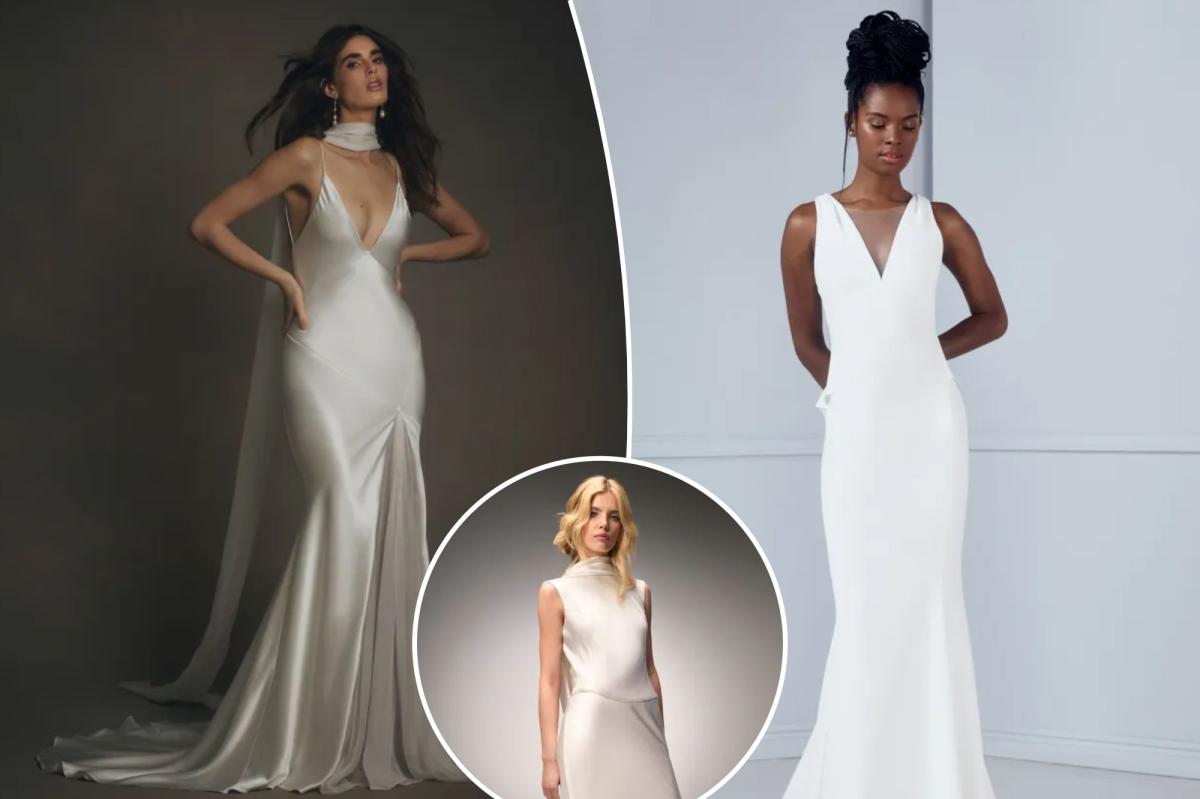
A silk charmeuse drop-waist bias gown, “Astrid” by Elizabeth Fillmore, has a high neck and a low back with plunging drape.
A mikado strapless mermaid gown with a chapel-length train, “Alison” by Mark Ingram Bride has a draped midriff and an attached overskirt.
Mark Ingram, owner of the Mark Ingram Atelier and designer behind Mark Ingram Bride, explained that off-the-shoulder necklines, Basque and dropped waists, ballgowns, bias-cut silhouettes, slip dresses, and draping are all hallmarks.
“We’re definitely seeing more minimalist designs as the popularity of all-over, three-dimensional applications are waning for brides who are opting for more simplistic or textured fabrics, such as crisp Mikados, faille, and taffeta,” he said.
“A minimalist gown can certainly vary across the board,” said Kennedy Schmidt, founder and stylist at the Bisou Bride, “but the main focus is on clean lines, high-quality fabric and a lack of heavy embellishment. A ballgown can absolutely be minimal if the focus remains on the silhouette and architectural draping rather than lace or beadwork.”
“Bea” by Katherine Tash is a bias-cut satin face silk crepe dress with silk crink chiffon insets.
Demi by Amsale Archive is an ivory fit-to-flare gown featuring a peplum over the crepe skirt and a sheer illusion back, with covered buttons down the middle.
Designer Elizabeth Fillmore said that the ’90s marked something new and fresh with the Calvin Klein and Armani way of dressing.
“Clean, gentle lines, were a real change from the frenetic ’80s vibe,” she said. “The return to ’90s minimalism also reflects how weddings themselves have changed, from micro-ceremonies to intimate restaurant receptions.”
The update to the minimalism trend focuses on texture and artistic details.
“Distressed-looking pleated fabrics in simple silhouettes — it is very much textural what brides are asking for,” said Ingram. “It could be a brocade or lace, or it can be a deliberate embellishment. Dresses that feel like something new and more artisanal.”
“Verdant” by Ines Di Santo is a strapless drop-waist hand-pleated ballgown in a broomstick pleat with fresh water pearl beading and a Chantilly lace underlay.
An ivory satin A-line gown from the Edit by DB Studio (Style No. EDS711004; features a square neckline and open back.
Dramatic floral embroidery adorns “the Ervay” by Lela Rose, a strapless weighted satin crepe sheath.
Esther Lee, editorial director for the Knot Worldwide, noted a few designers who are consistently leading in minimalist bridal design. “KYHA, and some designs by Sareh Nouri and Monique Lhuillier, are standout choices for fashion-forward minimalism with sculptural tailoring and modern draping,” she said. “Vivienne Westwood has become incredibly influential for structured corsetry and draped minimalist gowns.”
Amsale Aberra is one of a handful of designers who influenced the minimalist trend in the 1990s, and the brand currently offers older designs through the Amsale Archive.
These dresses, some of which were designed decades ago, still feel modern.
“Bridal [in the ’80s] tended to be highly ornate, theatrical and overbuilt,” said Neil Brown, her husband and co-founder of Amsale. “Amsale [who died in 2018] believed elegance came from restraint, proportion and extraordinary craftsmanship rather than embellishment for its own sake. She used to say that simplicity is actually harder to execute because there is nowhere to hide.”
Read the full article here