


The brighter the sun, the sharper the shadows, and nowhere more so than in Los Angeles.
From mob ties to the Manson murders, the history of LA is stitched through with tragedy and violence.
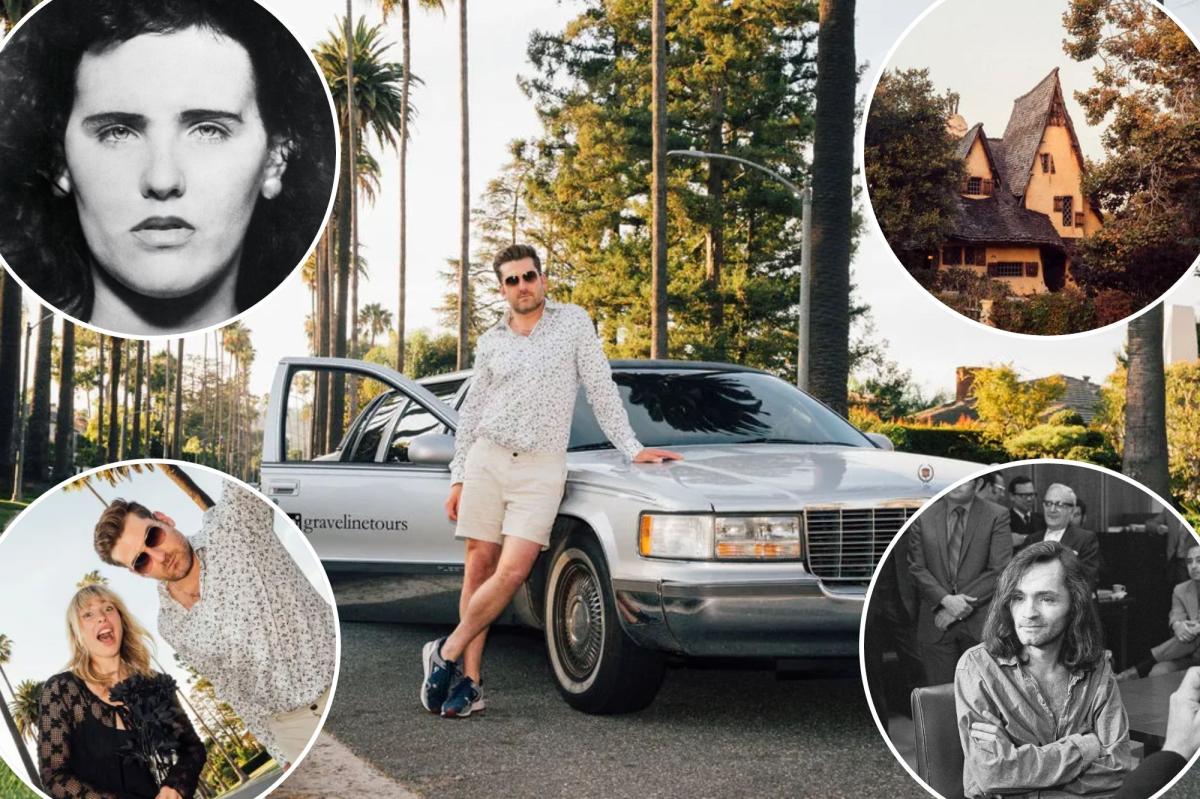
In recognition of that sordid tapestry, Grave Line Tours takes the criminally curious on a ride though the city’s dark side in a funeral limousine. One tour reveals a chilling link between the OJ Simpson and Menendez brother’s high-profile cases.
“LA is the best city in the world for true crime,” Grave Line founder Adam Paul Levine told The Post.
According to Levine, that reputation is born from LA’s association with the entertainment industry and the “ungodly amounts of wealth” that spring from it.
“That’s the main source of the immorality that has driven most of these crimes,” said Levine.
“When somebody comes into more money than most people can conceive of, it really enables them to get away with some of the worst stuff imaginable.”
Levine considers the infamous case of Elizabeth Short AKA the Black Dahlia, the quintessential Hollywood story.
In 1947, Short, an aspiring 22-year-old actress, was found brutally murdered, her bisected body left in a parking lot in the city’s Leimert Park neighborhood.
The shocking, unsolved crime remains a source of enduring fascination and speculation.
“We know less about Elizabeth than we know about the circumstances of her death, and I think that that’s the reason that people are so drawn to her,” he said.
Levine shared that in Short’s hometown of Medford, Mass, the historical society has placed a memorial plaque, but there is no such observation of her life in Los Angeles.
“How can it be that Hollywood doesn’t acknowledge her?” he asked.
In a bid to remedy that oversight, Grave Line’s Black Dahlia tour aims to expand the understanding of Short’s lived experience, not just her violent end.
“When you have somebody whose death is larger than life, it’s very easy to forget that she was a human being with dreams and insecurities and a Boston accent,” he said.
In addition, Levine recently founded the Elizabeth Short Memorial Society to restore her humanity through meetings and guest speakers.
Meetings are held monthly in LA in locations frequented by Short, including the storied Formosa Cafe.
“It is like stepping into Hollywood in the 1930s,” said Levine.
The Formosa is also a key stop on Graveline’s Gangsters Paradise Tour, as Bugsy Siegel was known to hold court in the restaurant’s arterial dining room.
“If you think that Al Capone is interesting, then you should learn about Bugsy,” said Levine, whose grandfather was once held up at gunpoint by Bugsy’s right-hand Mickey Cohen.
While the crimes profiled on Grave Line’s tours lean into the lurid, Levine is committed to humanizing the headlines.
He notes that the victims of high-profile crimes like Short, Ron Goldman and Jay Sebring face a kind of double erasure, losing not just their lives but their identities.
“Jay Sebring revolutionized men’s hair styling, and Ron Goldman had dreams of opening a restaurant, but no one remembers them for that,” said Levine.
“We want to use the tours as an opportunity to revive their legacies and give them a voice. We try very hard to minimize the glamor and the glory of the people that killed them,” he added.
To that end, Levine refers to his tour guests as “mourners” and transports them, literally and figuratively, in funeral limousines which are outfitted with front-facing rows rather than the cushy L-shape typically associated with limos.
“They are not made for fun; they’re made for crying,” he said, explaining that the objective of the tour is to create the feeling of a memorial service that “honors the victims while talking about the crimes,” anchoring the experience in the loss of life versus the sensationalization of death.
Levine’s own interest in true crime dates back to a teenage trip to London and the abiding lure of Jack the Ripper.
“I’m so enraptured with that case, and I came back here, and I learned that America does really screwed up stuff too, and we do it more often and with more creative MOs.”
Back home in Los Angeles, Levine began taking the original Grave Line tours.
Founded in late 1987 by Ray Savage, the OG Grave Line took travelers to various crime sites throughout the city in retrofitted Cadillac hearses.
“It was the most amazing thing in the world, and it was my favorite thing to do as a teenager,” recalls Levine.
“I was very much the outsider in my family, and being in a Grave Line hearse was the only thing that made me feel like I wasn’t more screwed up than everybody else.”
In homage to the original tour, which ceased operations in the early 1990s, Levine decided to revive the name and the ethos, launching his iteration of Grave Line in January of 2023 with the tagline “we put death on the map.”
To distinguish Grave Line from competitors and to ensure his mourners are given accurate information, Levine is a relentless fact-checker.
“I try to think like a journalist or a lawyer. If it can’t be verified by an independent source, then I will state that,” he told The Post, noting that it’s essential that he is “armed with the truth” as guests routinely get into spirited debates about the crimes in question.
“We know these are very emotionally-loaded cases. I want to make sure any information I give can be taken to the bank.”
While the aforementioned mechanisms of fame and finances may be directing the glut of LA true crime, Levine notes that some areas of the city seem to be hotbeds for horror, citing the infamous Hotel Cecil in DTLA and the fabled neighborhood of Laurel Canyon, which played host to the Wonderland Murders as two prime examples.
“It’s never-ending in terms of the layers of darkness that you can explore,” he said.
One such stratum is the Manson murders, the subject of Grave Line’s most popular tour.
Blaze, one of Grave Line’s guides, curated a playlist for the tour that immerses guests in the sonics of the late 1960s.
“We play you the Beatles, we play you the Beach Boys, we play you a song that Manson plagiarized from The Beach Boys,” he shared.
At three and a half hours, the Manson tour is the longest of Grave Line’s offerings and features a visit to Spahn Ranch and a pit stop at a roadside stand called the Munchbox where Charles Manson routinely ate hot dogs.
“Manson used to go in 1969; it’s still there, and it’s exactly the same. You will have the best hot dog on our side of Mulholland.”
According to Levine, the diminutive cult leader was also fond of the Munchbox’s root beer floats.
In other dynamic combinations, Grave Line’s West Side Gory tour blends two of the most infamous cases in LA history: the double murders of José and Kitty Menendez and Nicole Brown Simpson and Ron Goldman.
Levine shared that the tragedies have more common ground, or grave dirt, than people might suspect.
“The Simpson and Menendez families were actually friends. Jose Menendez was the CFO of Hertz and hired OJ to be the company spokesperson,” said Levine, noting that because of the business connection, OJ became a frequent visitor to the Menendez mansion.
“OJ used to throw the football with Eric and Lyle.”
Moreover, he notes that following his infamous car chase, OJ was placed next to Eric at the Los Angeles County Men’s Central Jail, where both awaited trial.
“It was Eric who told O.J. to call Bob Shapiro,” said Levine.
While crimes and criminals are the bedrock of Grave Line’s offerings, Levine ultimately sees the tours as historical expeditions in and into his beloved albeit bloody hometown.
“I want people to leave the tour knowing and appreciating a little more about the rich history and culture of this city,” he said.
Download The California Post App, follow us on social, and subscribe to our newsletters
California Post News: Facebook, Instagram, TikTok, X, YouTube, WhatsApp, LinkedIn
California Post Sports Facebook, Instagram, TikTok, YouTube, X
California Post Opinion
California Post Newsletters: Sign up here!
California Post App: Download here!
Home delivery: Sign up here!
Page Six Hollywood: Sign up here!
Read the full article here