


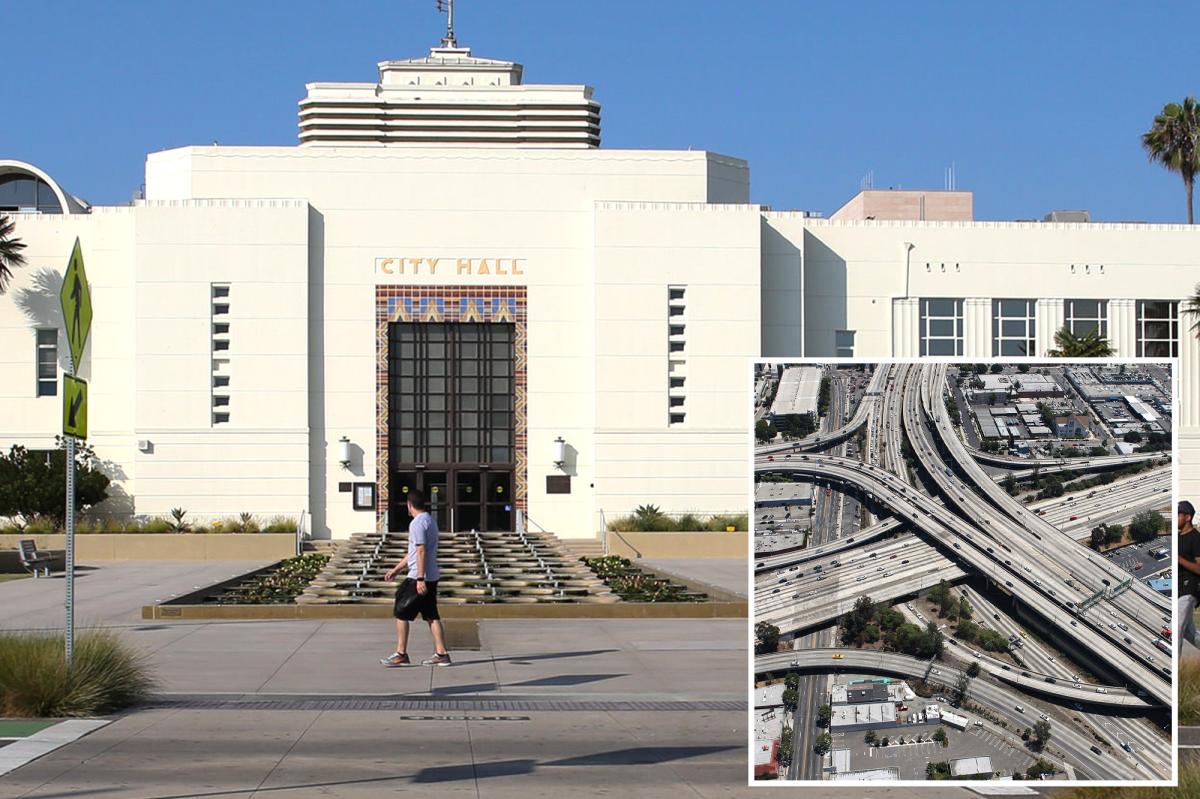
A Southern California city is facing backlash after it accepted a $2 million grant to study whether a major stretch of the 10 should be covered with a giant park — or eventually ripped out altogether.
The Santa Monica City Council recently approved a resolution allowing officials to study ways to reconnect neighborhoods divided by the 10 freeway, citing the need to address “historical harm” and “environmental hazards,” according to the Santa Monica Daily Press.
The study will focus on the freeway’s impact on the city’s historically Black Pico Neighborhood and residents whose homes were displaced when the roadway was built.
But critics say the proposal sounds more like a taxpayer-funded fantasy than a serious transportation plan.
Under the resolution, city officials agreed to examine the “trade-offs between capping and alternatives such as freeway removal” while also seeking to “reaffirm the City’s commitment to closing the freeway and follow models of municipalities that restored and healed cities by removing freeways.”
One option being studied would place a massive land bridge over the 10 Freeway between 11th and 20th streets, effectively creating a park above the roadway.
“It’s basically a park on top of a highway,” Senior Park Planner Antonio Lopez told the council.
Lopez also acknowledged the proposal remains highly conceptual, describing the study as “basically a design project without … a design.”
Councilmember Ellis Raskin argued the freeway’s construction came at the expense of minority communities.
“It was black and Latino families” whose homes were demolished to make way for the freeway in the 1950s, Raskin said.
But he suggested even the park concept may not go far enough.
“Capping the freeway, in my opinion, would be a partial improvement, but it doesn’t solve the underlying problems,” Raskin told the council.
“We need to stay focused on the long-term goal of removing the freeway and replacing it with parks, a grand boulevard, or other neighborhood-serving uses.”
“And we want to look at opportunities to rebuild this neighborhood,” Raskin told CBSLA.
The proposal quickly ignited backlash online, with many residents calling the study a colossal waste of money.
“Creating problems where there are none. I have lived on both sides and never felt in any way impacted nor ever met anyone that mentioned that,” one person commented on the report.
“Complete waste of money: the grant and city council salaries. Nonsense. Go do something actually useful for the community like reducing crime or lowering taxes.”
“Nothing is going to happen. It’s just a way for the local government to waste tax payer money by doing pointless research. Probably someone’s family member who owns the firm doing the study and they are just funneling the money,” another person added on an Instagram post.
“So destroy residential neighborhoods and make them unsafe with reckless commuters driving like maniacs to get to work by rerouting traffic off the freeways and into residential streets. These people get paid to create more problems, not solve them,” a third shared.
One Op-Ed writer for the Santa Monica Mirror seemed to sum up many people’s frustration about the city’s move.
“Council Member Ellis Raskin recently directed staff to study capping our portion of the 10 Freeway for park areas, and… eliminating the 10 completely,” Charles Andrews wrote.
“Can’t make this up. And Council Member Barry Snell seconded it. With a straight face? I don’t know.”
“Folks, this is who you voted for to lead this city. Please don’t make the same mistakes this fall,” Andrews added.
The move follows an earlier one by the city in 2022, when officials issued an apology, admitting the city in the 1950s had “targeted neighborhoods of color for condemnation.”
“Santa Monica African Americans who were thriving in the Belmar Triangle had homes and businesses condemned and taken away by eminent domain to make way for the city’s new Civic Auditorium and Santa Monica High School expansion,” the statement read.
“And some structures that had been owned or occupied by African Americans were burned down on site.”
“In the 1960s the new Santa Monica Freeway cut through the heart of the city predominantly occupied by African Americans and people of Mexican descent, depriving 550 families of long-time investments in homes and businesses,” it added.
For now, however, the plan is little more than a study. No final recommendations are expected until July 2029, and the grant funding remains available through 2030.
Still, skeptics note that removing or reducing the freeway near 20th Street would force much of the traffic headed toward Santa Monica and its beaches onto local streets — a prospect that has many residents already seeing red.
Read the full article here