


On July 31, 1790, President George Washington affixed his elegant signature to a single piece of parchment. The short document credited Samuel Hopkins of Philadelphia with having “discovered an Improvement, not known or used before,” in the production of potash, a chemical useful in making fertilizer and other products. The statement granted Mr. Hopkins “the sole and exclusive Right and Liberty of using, and vending to others the said Discovery” for a period of 14 years.
Thus was issued the first US patent. Attorney General Edmund Randolph and Secretary of State Thomas Jefferson were also on hand to sign the document. Among all the weighty duties facing Washington and his cabinet, protecting the interests of a little-known inventor might strike us today as rather mundane. But America’s founders believed that guarding the rights of innovators was a crucial role of government.
Ratified just two years earlier, the US Constitution directed Congress to “promote the progress of Science and Useful Arts” by securing such rights for inventors and writers. It was “the first time in history that a country’s founding document expressly authorize[d] the government to protect patents and copyrights,” writes Antonin Scalia Law School professor Adam Mossof.
The idea of protecting inventors’ rights wasn’t new. It had been part of English law for centuries. There, however, patents were granted at the pleasure of the king. In contrast, the newly united former colonies awarded patents based on the originality of the invention, not the whims of royalty.
The United States’ uniquely democratic approach to intellectual property set off a chain reaction that drives innovation to this day. By 1836, nearly 10,000 inventions had received patent protection; that number passed the 1 million mark in 1911. Today, more than 12 million US patents are on the books.
America is the land of invention. Not surprisingly, many early patents involved agriculture. Cyrus McCormick’s mechanical grain reaper (1834) helped mechanize farming; John Deere’s steel plow (1837) helped pioneers bust through thick prairie sod. Eli Whitney’s even earlier invention of the cotton gin (1794) showed how technical breakthroughs can have unexpected consequences.
By making it easier to process raw cotton, Whitney’s machine made cotton farming fabulously profitable. That, in turn, increased the demand for slaves to work the booming plantations. So, as northern states agitated to end slavery, the South tightened its grip on the “peculiar institution,” helping push the nation toward the Civil War.
At the same time, America’s culture of invention also opened doors for free black Americans. In 1821, Thomas Jennings, a New York tailor’s apprentice, became the first African American to secure a patent for his pioneering method of dry cleaning. Other black patent holders included Sarah Boon, who designed the modern ironing board (1892); Garret Morgan, who, after witnessing a car accident, developed the green-yellow-red traffic light we still use today (1923); and Elijah McCoy, who earned dozens of patents, including one for an automatic steam engine lubricator (1872). McCoy’s precise, reliable lubricators are said to be the origin of the term, “the real McCoy.”
As America’s innovation juggernaut gathered steam, inventors came to be seen in a heroic light. Painter-turned-entrepreneur Robert Fulton developed the world’s first commercially viable steamboat, which began plying New York’s Hudson River in 1807. Able to motor against the current — even on the mighty Mississippi — Fulton’s steamboats revolutionized transportation. Suddenly, America’s vast interior was open for business.
In Europe, status was still largely determined by hereditary class. In democratic America, technological innovators like Fulton formed a new kind of aristocracy, one representing the future rather than the musty past. Even today, dozens of streets, counties and towns carry Fulton’s name.
Fulton wasn’t the only inventor focused on moving people and goods. After all, America is a big country. In 1862, George Westinghouse patented an automatic railroad brake that allowed longer, faster trains to operate safely. Elisha Otis applied a similar insight to vertical travel: His fail-safe elevator brake (1852) reshaped city skylines by making skyscrapers feasible. The transportation revolution literally took off when the Wright Brothers’ hand-crafted airplane first flew in 1903. Humble bicycle mechanics, the Wrights had no formal training. But they applied a scientific mindset to their project, including building one of the world’s first wind tunnels to test their designs.
Henry Ford’s genius did not lie in trying to build the world’s best car. Rolls-Royce and others already made finely crafted automobiles for wealthy buyers. Ford instead created a revolutionary factory, one in which moderately skilled workers could build a sturdy, reliable car at a price most Americans could afford. Introduced in 1908, Ford’s Model T offered mobility to the masses, which, in turn, transformed the American lifestyle. For better or worse, the car-centric suburb was born.
US inventors also led the way in what today we call information technology. In 1840, Samuel Morse improved a process to send small jolts of electricity down a wire and invented a code to turn those blips into words. Telegraph lines — or what Morse called “lightning wires” — soon crisscrossed the country. Control over such a vital invention could be enormously profitable. Morse’s long legal battle to defend his patent rights led all the way to the Supreme Court, where he lost in a still-controversial 1854 decision.
Alexander Graham Bell’s 1875 patent for his invention of the first practical telephone also faced legal challenges. Almost unbelievably, another inventor had submitted his similar telephone design to the patent office on the same day. The battle raged for years, but Bell ultimately prevailed.
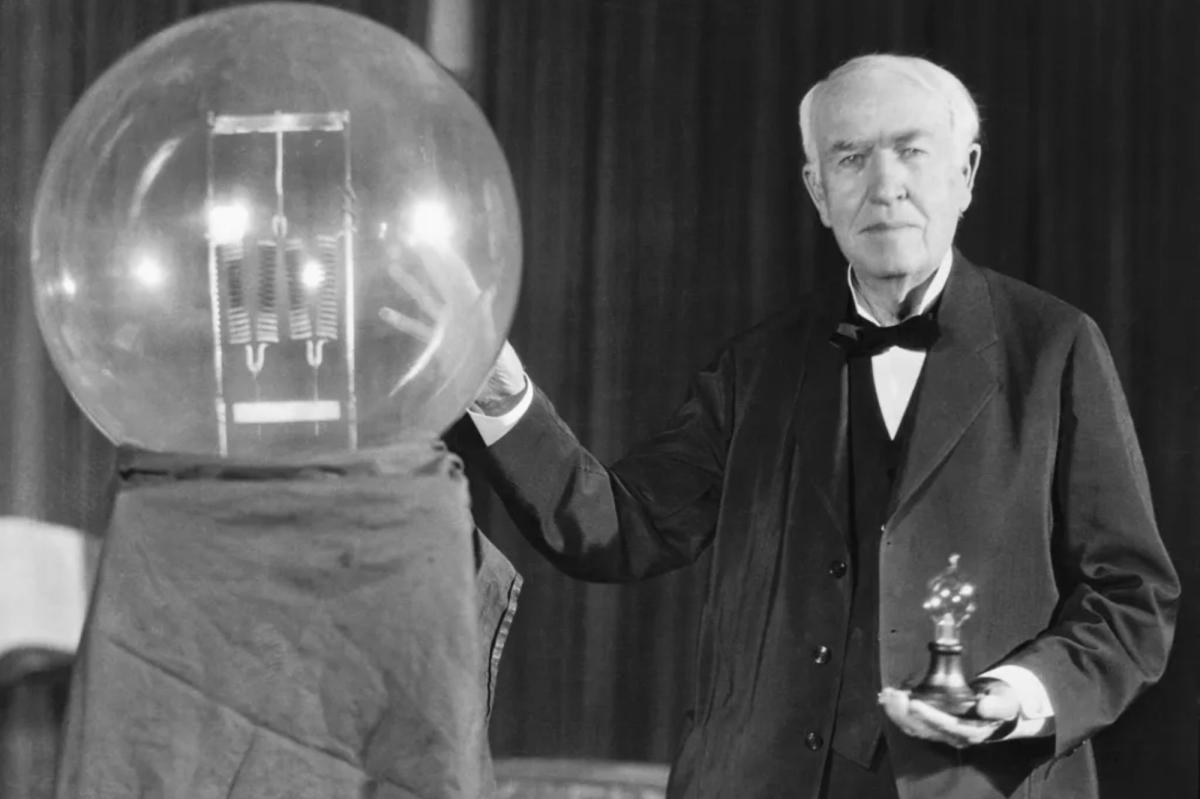
Inventor Thomas Edison was lionized for his many inventions, including the lightbulb, the phonograph and motion-picture camera. But the “Wizard of Menlo Park” was also notoriously litigious, launching endless legal battles against rival electricity innovator George Westinghouse and other competitors. As the age of invention marched into the 20th century, it sometimes seemed that patent lawyers were getting most of the spoils.
By the end of World War II, America’s culture of innovation had changed. Most breakthroughs were no longer the work of lone tinkerers like Whitney. Now, big inventions required teamwork, often supported by the military or large corporations. In 1947, a group of Bell Labs engineers found a way to manipulate electrical currents using tiny crystals. The transistor was born, and the Electronics Age was off and running.
The breakthroughs started coming like clockwork: The integrated circuit (1959) allowed multiple transistors to be placed on a single chip. Those microchips became the building blocks of vastly more powerful computers. In 1976, Steve Wozniak and Steve Jobs showed they could use off-the-shelf components to build the home computer they named Apple I. Before long, we had the Worldwide Web, the dot.com era and all the rest.
In 2007, Apple changed the world again by combining over a century’s worth of breakthroughs in a single device, the iPhone. It’s been estimated that a single smartphone relies on some 250,000 patents. Experts now worry innovation might be stymied by litigation-choked “patent thickets.”
Today, we are entering another era of technological disruption as artificial intelligence gallops forward. Like the cotton gin, the automobile or the internet, AI will bring unimaginable advances, and no doubt, unanticipated challenges. But, if history is any guide, America’s spirit of innovation will carry us through.
James B. Meigs is the former editor of Popular Mechanics magazine and columnist for the Wall Street Journal’s Free Expression newsletter.
Read the full article here