


William Rodriguez never took a sick day in his nearly 20 years as a custodian at the North Tower of the World Trade Center. But he seriously considered it on the morning of Sept. 11, 2001.
“It was so beautiful outside, I thought, ‘I’m just gonna stay home and hang out,’” he told The Post. “I called my supervisor and said I wasn’t going to work.”
But his boss begged him to come in — a decision that would change the course of his life.
Rodriguez arrived at 8:30 that morning, too late for the free breakfast his friends working at Windows on the World on the 106th floor usually gave him on the sly. Instead, he went directly to the B1 basement.
Sixteen minutes later, American Airlines Flight 11 crashed into the top of the building, all the way up on floors 93-99.
“We heard an explosion so powerful, so big the walls cracked,” Rodriguez recalled. “The building shook, the sprinkler system activated. It was horrible.”
He first assumed a generator had blown on a floor even deeper underground. But then he heard another explosion from high above — and a chorus of people screaming.
Suddenly, a badly burned man came running into the basement office, covered in blood and with skin hanging off his hands “like he was wearing gloves,” Rodriguez remembered.
It was only once he led the shell-shocked man out to a loading dock area near Vesey Street that he found out what happened.
“I saw everybody on the streets looking up with their mouth open. That’s when I saw the hole,” he said. “I saw the fire and the smoke, which was so dense it covered the antenna of the North Tower.”
Rodriguez immediately thought of his friends stranded inside Windows on the World, and started screaming, “We gotta go back!”
Trapped by plane wreckage and fire, no one at the restaurant survived that day. But Rodriguez held an important key to saving lives — literally: a master key that opened any door in either tower, something just five other people in the world possessed.
He led police and firefighters up to the 39th floor, unlocking emergency doors along the way so that countless workers and visitors could escape.
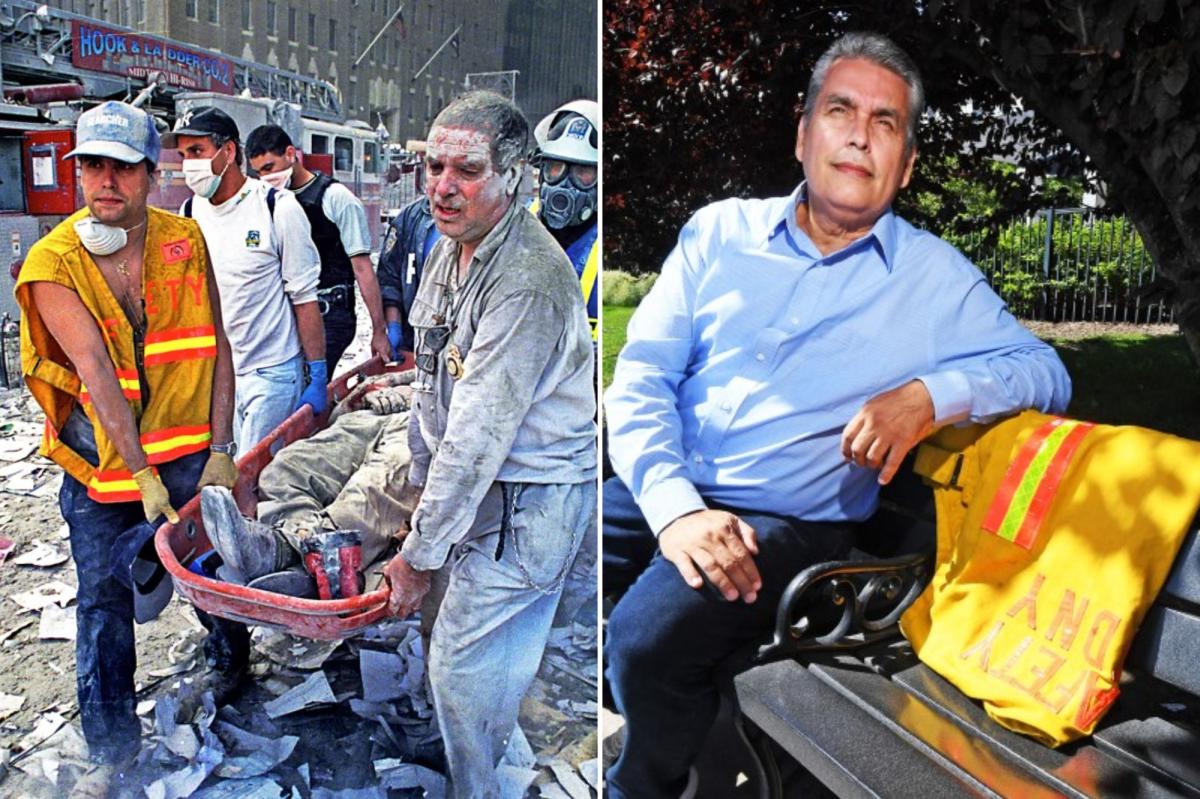
In a now well-known photo from that day, shot by The Post’s Matthew McDermott, Rodriguez — wearing a bright orange safety vest — can be seen helping carry an injured person out of the building.
He was outside when the first tower collapsed and dove for cover underneath a fire truck. Rescued four and a half hours later, Rodriguez is widely considered the last survivor out of the North Tower.
Even 25 years later, he says the experience is never far from his mind. He still has his orange vest, as well as the master key.
“I relive 9/11 every single day. There’s not a day I don’t think about it. Mostly because I lost 200 friends, and the emotional inventory losing so many friends is devastating,” he said.
“New York during that time was so innocent about terrorism, and the outpouring of love we got from the city was just amazing,” Rodriguez added. But he worries “that’s all gone now. It’s like people forgot how they felt during that time.”
So he has dedicated himself to keeping alive the memories of his friends and of that shocking day.
“I got boxes and boxes of recognition, but I just survived,” he said. “I’m going around the world doing interviews, doing documentaries because it’s the only way people won’t forget. It’s the only way I can glorify the friends and the people we lost on 9/11.”
He spends much of his time talking to Americans who weren’t yet born or were too young to remember the day firsthand; today, there are approximately 100 million adults in this country with no living memory of the attacks.
“I try to tell them that it wasn’t about the towers, it was about the people that we lost. I’m alive because of a miracle that happened on that day, I believe,” Rodriguez said. “So I try to tell the story around the world so people won’t forget.”
He estimates his cumulative efforts have raised some $122 million and counting for survivors and families of those killed.
He especially wants to help survivors who have slipped through the cracks, who, for whatever reason, haven’t benefited from programs created to help victims.
That terrible day, and losing so many friends, helped Rodriguez find a renewed purpose in his own life — realizing how precious and short it all can be.
“I was thinking about having a good time — 40 years old and single,” he said of 2001. “But after 9/11 my life made a whole metamorphosis. I became a person that was more spiritual, that has a sense that compassion is more powerful than violence and has a continuing desire to help others.
“I became more in tune with the community, what their needs are and how to fight for them. I became addicted to helping.”
Read the full article here