




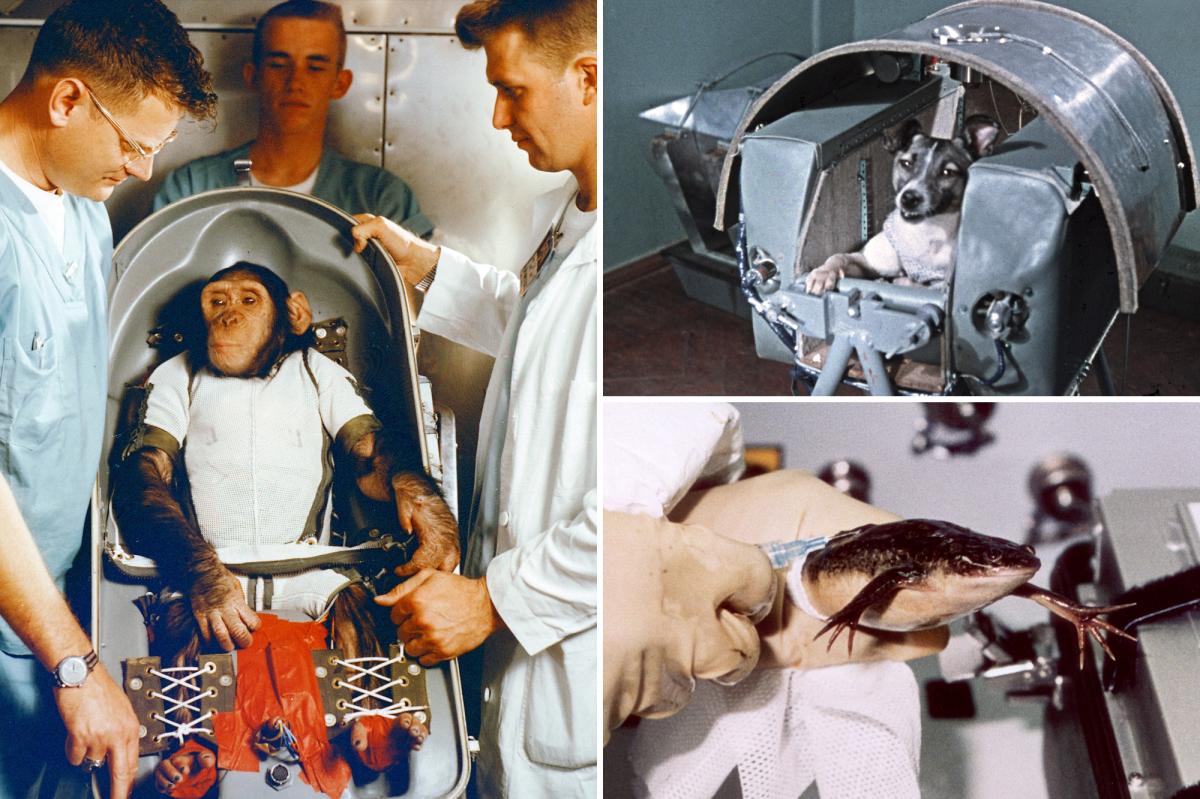
For nearly 80 years, some very unlikely astronauts have boldly gone where no fruit fly, dog, monkey or tortoise had gone before.
Long before humans hit the heavens, animals were the original space pioneers, helping scientists figure out whether living creatures could survive radiation, weightlessness and other hazards waiting beyond our atmosphere.
And they’re still at it. Rats, mice, insects and sea creatures are living at the International Space Station now.
The first buzz-worthy critters to get their wings were fruit flies.
In 1947, America launched them aboard a V-2 rocket 68 miles above Earth to study the effects of radiation. Their capsule parachuted home, and ever fly survived.
In 1949, Albert II, a rhesus monkey, became the first mammal in space. He survived the flight but died when his parachute failed.
Then the Soviets unleashed the space dogs.
Tsygan and Dezik became the first canines to reach space and return safely in 1951. Six years later, Moscow stray Laika became the first animal to orbit Earth aboard Sputnik 2.
Sadly, it was a one-way trip. The technology to bring her home did not exist, and she died within hours.
America fired back in 1958 with Gordo, a squirrel monkey who survived launch, weightlessness and reentry — only for his parachute to fail. His capsule vanished into the Atlantic.
The following year, Miss Able and Miss Baker became the first monkeys to survive spaceflight.
Able died four days later, but Baker lived until 1984 and became a beloved celebrity at Alabama’s US Space and Rocket Center, where visitors still leave bananas on her grave.
In 1960, Soviet dogs Belka and Strelka became the first animals to orbit Earth and make it back safely. Strelka later had puppies, including Pushinka, who Soviet leader Nikita Khrushchev gave to President John F. Kennedy’s daughter Caroline.
Next came Ham, an American chimpanzee trained to operate levers during flight. His 1961 mission proved a passenger could think and perform tasks in space, helping clear the launchpad for Alan Shepard to become the first American in space months later. That same year, Enos became the first — and only — chimp to orbit Earth.
France joined the menagerie in 1963, launching Félicette, a black-and-white Paris street cat who became the first and only feline to reach space. She survived but was euthanized two months later for scientific study.
In 1968, two Soviet tortoises aboard Zond 5 became the first Earth creatures to circle the Moon and return alive.
Apparently, the Russians figured slow and steady would win the space race.
After humans reached the moon in 1969, larger animal astronauts were mostly grounded, but the cosmic zoo kept growing. Apollo 17 carried five mice — Fee, Fi, Fo, Fum and Phooey — around the Moon in 1972, while spiders Arabella and Anita showed Skylab in 1973 that webs could be spun in weightlessness.
Then, in 2007, microscopic tardigrades — nicknamed “water bears” — pulled off the ultimate survival trick: enduring direct exposure to the vacuum of space.
Today, most animals sent to the International Space Station, helping researchers study bone loss, muscle wasting, are part of large-scale biomedical studies. They are housed in specialized, drawer-like habitats and tracked by numbers, barcodes or experimental groups rather than personal names
NASA calls these pioneering creatures the “unsung heroes of animal astronauts.”
Read the full article here