




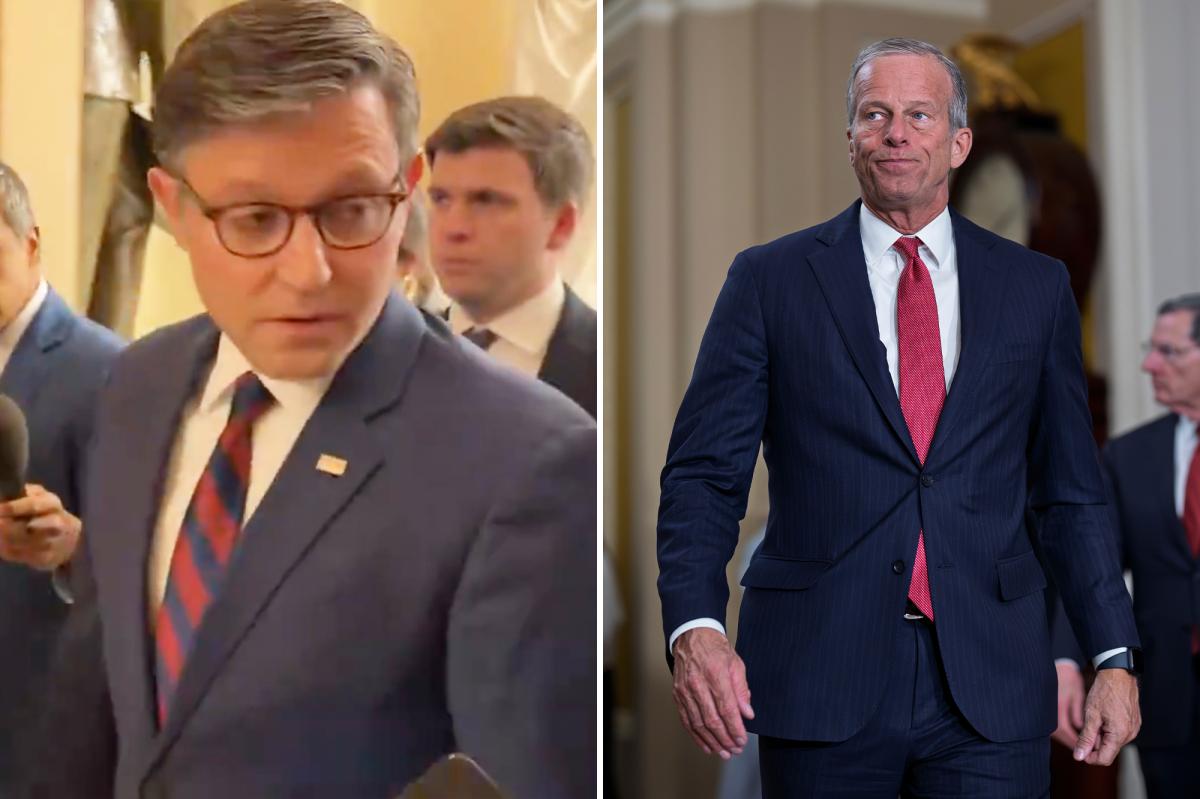
WASHINGTON — House Speaker Mike Johnson revealed that House Republicans will take up a brand-new funding bill for the Department of Homeland Security, 73 days into the partial government shutdown.
At the start of the month, Johnson (R-La.) reluctantly acquiesced to the Senate’s two-track approach to fully fund DHS, which has faced a partial lapse since Feb. 14 — the longest government shutdown ever.
But weeks after publicly indicating that the two chambers were on the same page, despite House Republicans raging against the deal, the lower chamber declined to move the Senate deal.
Now Johnson is blaming that on the deal’s “problematic language.”
“It was haphazardly drafted,” Johnson told reporters Monday. “We have a modified version that I think is going to be much better for both chambers. Doesn’t change most of the substance, but it makes sure that we’re not going to orphan two of the primary agencies of DHS.
“We have to make sure that immigration law is enforced and that the border is safe and secure. Democrats don’t want to have any part of that, so unfortunately, we have to do that on our own.”
Johnson was coy about the timing. But there has been a renewed urgency on Capitol Hill to fund DHS, which oversees the Secret Service, given the White House Correspondents’ Dinner shooting.
Much to the chagrin of House Republicans, the Senate passed a bill that would effectively fund all of DHS except Immigration and Customs Enforcement (ICE) and US Customs and Border Protection (CBP).
That’s because Democrats were refusing to fund ICE and CBP without sweeping reforms that crossed red lines for Republicans, such as barring agents from wearing masks and tighter judicial warrants.
From there, the GOP planned to use the cumbersome Senate reconciliation process to bypass the 60-vote filibuster and fund ICE and CBP. President Trump will then use his executive powers to shift money around across those agencies.
House GOP leadership had initially fussed over the language in the Senate deal, but Johnson publicly claimed that the main reason the lower chamber was dragging its feet was that it needed proof that Congress could pass the reconciliation bill.
“US Customs and Border Protection Act shall have no force or effect for purposes of this act,” House Republican Conference Chairwoman Lisa McClain (R-Mich.) told The Post last month, reading from the Senate deal’s text
“So that’s a big concern.”
Trump had taken executive action last month to shift funding from the One Big Beautiful Bill Act to temporarily fund Transportation Security Administration screeners and other DHS workers.
But those measures are expected to run dry in May.
“My payroll through DHS is just over $1.6 billion every two weeks, so the money is going extremely fast and once that happens, there is no emergency funds after that,” DHS Secretary Markwayne Mullin told “Fox & Friends” last week.
“I’ve got one payroll left and there is no more emergency funds, so the president can’t do another executive order because there’s no more money there.”
The Senate adopted a $70 billion budget resolution last week to kick off the reconciliation process, and the House is expected to consider that measure this week as Republicans scramble to meet Trump’s June 1 deadline to complete reconciliation.
Meanwhile, after the House goes through its so-called “hell week,” theoretically navigating tough votes on the farm bill and Foreign Intelligence Surveillance Act Section 702 extension, it is set to break for recess until May 12.
Read the full article here