




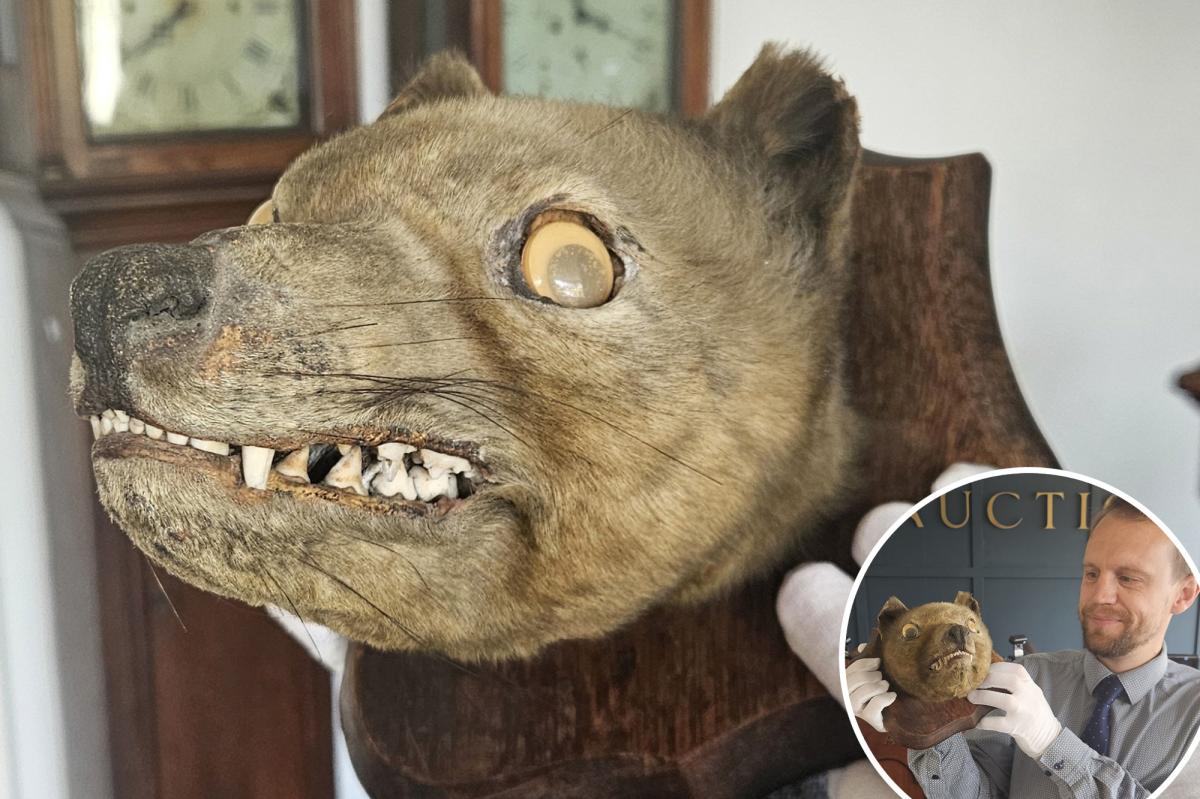
It was the Fantastic Mr. Faux.
A UK antique collector was shocked after realizing a taxidermied “fox head” was actually the supremely rare bust of an extinct predator called a Tasmanian Tiger.
“I will never find anything better,” the curious cranium’s owner James Cranfield, a natural history relics dealer, told the BBC of the once-in-a-lifetime find.
The incredible saga began innocuously enough when an anonymous seller bought the artifact for around $67 at a county fair because they were amused by its googly eyes and cartoonish smile, Science Alert reported.
So they were naturally quite surprised after putting it up for bidding at the Auctioneum in Bristol and seeing it go for 1,000 times that.
Cranfield, who specialized in collecting “weird and wonderful fox heads” to demonstrate diversity in taxidermy, had reportedly been intrigued after discovering the “19th century fox head” while scrolling an auction site.
Upon taking a closer look, he realized that it was something far more special. “When I clicked on it and it opened up to a bigger picture, it was like a bolt of lightning to my brain and eyes that it wasn’t a fox,” the 38-year-old exclaimed. “I immediately thought, ‘that looks like a thylacine.’”
The thylacine or Tasmanian Tiger was a carnivorous marsupial that resembled a large dog but with a distinctive striped pattern on its back. Once distributed across Australia and even as far north as Papua New Guinea, the predator had been confined to the island of Tasmania by the time European settlers arrived.
It was subsequently pushed to the brink by hunting, disease and habitat loss. The last thylacine died at the Tasmanian zoo in 1936.
Unfortunately, Cranfield could not identify it from pictures alone, so, on the day of the sale, he and his fiance got up at the crack of dawn and drove three and a half hours to the auction house to get a closer look.
Thankfully, the head, which was placed on a table among “all sorts of bric-a-brac and pottery,” told the eager collector exactly what he “wanted to know.”
He said the “giveaway” was that it boasted eight upper incisors as opposed to six like with a fox. “We went and sat in the car, I said ‘this is unbelievable, this is the holy grail, we’ve got to get it,’” Cranfield.
Thankfully, following a bidding war, the determined taxidermy buff secured the “priceless” tiger mount for $85,000, plus over $13,500 in fees, The Times Of London reported.
To ensure he hadn’t paid a fortune for a run-of-the-mill fox noggin, Cranfield gave the specimen a once-over with an X-ray and CT-scans, confirming that it was the bonafide artifact.
“Not only is it a genuine thylacine head, the X-rays have revealed the most perfect, pristine skull within the mount,” he exclaimed. “I’m very pleased that now that I haven’t got egg on my face for spending [so much] on a fox head. I could have never shown my face in the community or online or anywhere.”
Auctioneum’s Andrew Stowe was equally floored by the find.
“It was quite a shock to discover we were sitting on something so special,” he said. “It is unbelievably rare. Even replicas of skulls or bones sell for thousands of pounds. To find a complete item like this is almost unheard of, especially here in the UK.”
According to the International Thylacine Specimen Database, there are around 815 Thylacine fox specimens, ranging from slides to full mounts.
However, as far as they know, there is only one other head — and no one knows where it is.
Cranfield said he plans to keep the mount — not as a trophy — but as an educational took that scientists can use to glean more insight into its mysterious owner.
“I want everyone to know it exists so academics and scientists can contact me to study it,” he said. “It will be invaluable to science and I want to make it available to institutions.”
Read the full article here