




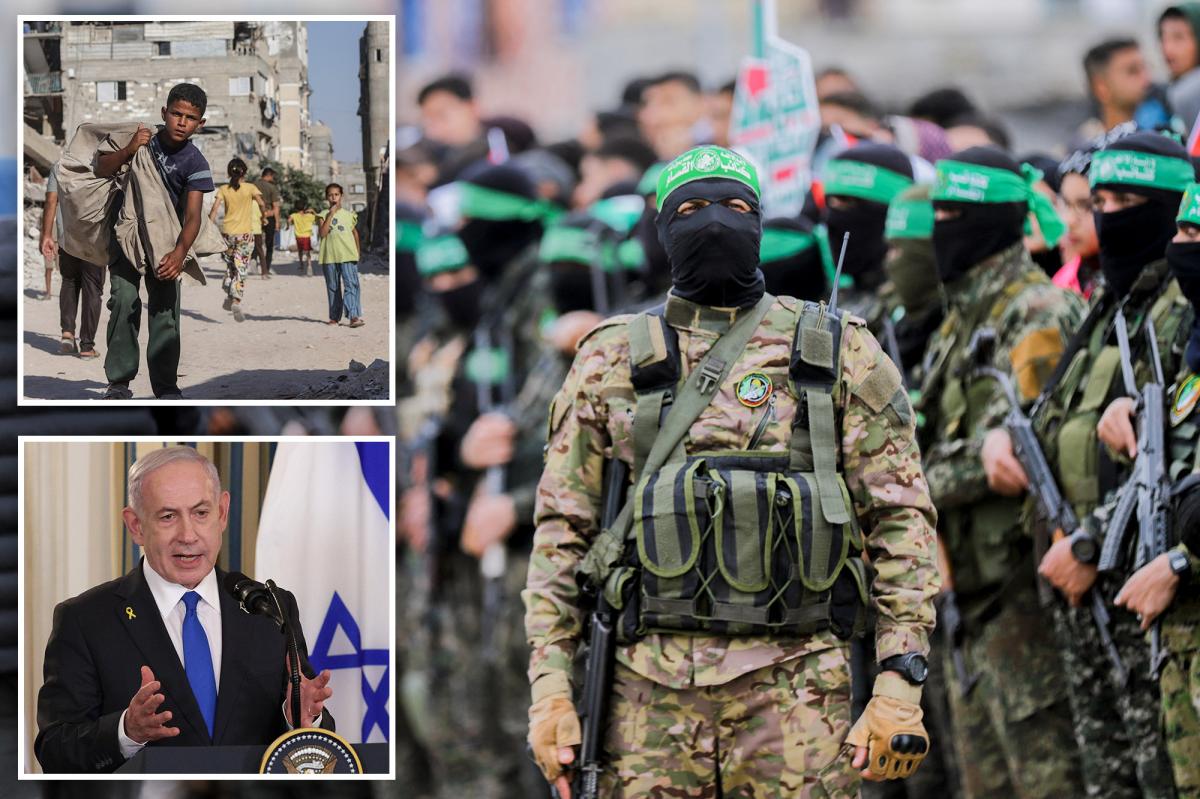
WASHINGTON — Hamas says it’s finally ready to lay down its weapons, a feat that could reshape the Middle East after nearly two decades of war and bloodshed — but even President Trump had questions over whether it will actually happen during a Cabinet meeting at Camp David on Friday.
If implemented, it would mark the first time Hamas has formally agreed to dismantle its military wing since seizing control of Gaza in 2007.
“Most people said that would be a deal that would be undoable,” he said. “Now, will it go through? It’s a very complex situation over there — the people are very complex and difficult. Many cases wonderful, and many cases not so wonderful. But that will be a — it’s a great breakthrough.”
The framework, released Friday, envisions Hamas disarming under international supervision as part of a broader deal to end the war in Gaza and hand control of the enclave to a new Palestinian governing body.
The president pointed out how the agreement — which would move Trump’s Gaza peace deal into its long-delayed second phase — is historic even before Hamas follows through with laying down its arms.
“Nobody thought that would be possible to disarm Hamas,” he said. “…It’s a big step for the Middle East, and people are really impressed by it, and they’re surprised by it.”
The first stage, which began in October, began a cease-fire between Hamas and Israel — which has mostly held but remains fragile.
As Phase 2 moves forward, here are the five questions likely to determine whether it’s a historic breakthrough — or just another false dawn.
1. Will Hamas really surrender all of its weapons?
This is the billion-dollar question. It’s one thing for Hamas to announce it’s willing to disarm — it’s another to actually do it.
The terror group is believed to possess thousands of assault rifles, rocket launchers, mortars, anti-tank weapons, explosives and an extensive network of underground tunnels built over nearly two decades of conflict, according to the Institute for National Security Studies at Tel Aviv University.
Analysts say the biggest unknown is whether Hamas intends to surrender its entire arsenal or only heavier weapons while allowing individual fighters to retain smaller arms.
For Israel, anything short of complete disarmament is unlikely to satisfy its longstanding demand that Hamas no longer pose a military threat.
“Hamas has a documented history of breaking every commitment it has ever made,” Israeli security analyst Yuval Davis told The Post. “Its own founding charter calls for Israel’s destruction — that has never been amended or renounced.”
“Notably, under this very agreement, Hamas has already said its heavy weapons won’t be surrendered until a Palestinian state is created and Israel is destroyed — a condition Israel rightly rejects,” he added.
2. Who makes sure Hamas isn’t hiding weapons?
Even if Hamas agrees to disarm, verifying it will be an enormous undertaking.
The proposal calls for international monitors to oversee the destruction or transfer of weapons, inspect military sites and verify that Hamas has dismantled its infrastructure.
But it remains unclear how, exactly, that will work, as Gaza is riddled with underground tunnels, hidden weapons caches and makeshift factories built over decades of conflict.
Finding every rifle, rocket launcher and explosive could prove nearly impossible, skeptics have said.
But some officials envision a phased approach to the disarmament, starting the process region by region, allowing forces to clear small communities of weapons before moving onto the next.
Asked Friday who would take custody of the weapons once they are abandoned, Trump asserted that his Board of Peace, which is working to implement the Gaza peace deal, would be responsible for that.
However, prior announcements have claimed new Palestinian authorities would take over much of the remaining weapons.
3. Will Israel trust the process enough to leave Gaza?
Israeli leaders have repeatedly vowed they won’t withdraw unless they’re convinced Hamas can never again launch an attack like the Oct. 7 massacre.
Any Israeli troop pullback would likely happen in phases tied to verified milestones in Hamas’ disarmament.
If Israeli officials conclude Hamas is dragging its feet or hiding weapons, the entire agreement could quickly unravel — as they have long argued that previous cease-fire agreements allowed Hamas to regroup, rebuild its tunnel network and replenish its weapons stockpiles.
But Trump on Friday said the Israelis have been supportive and helpful in bringing the agreement to fruition, noting that the Jewish State understands what it needs to do as part of the arrangement.
“We do have an understanding with Israel,” he said, referring to Israel’s promise to pull back in Gaza as Hamas disarms. “Israel helped us, and they’ve been very good.”
Privately, some Israeli sources have told The Post they are hesitant about forcing the next phase too soon, voicing skepticism after years of broken cease-fires and shattered promises.
“Will Hamas abandon its goal of destroying the State of Israel and murdering Jews?” one source in Jerusalem told The Post, calling it the “most important” question.
4. Who takes over Gaza?
Removing Hamas from power is only half the battle.
The bigger challenge may be determining who governs more than 2 million Palestinians once the terror group steps aside.
The proposed roadmap calls for a technocratic Palestinian administration backed by international support to oversee reconstruction, security and day-to-day governance.
That body, dubbed the National Committee for the Administration of Gaza, would serve as a transitional government and on Friday announced its “full readiness to assume its responsibilities” in a statement posted to X.
“As the implementation process advances, NCAG will focus on restoring the functioning of public administration institutions, restoring essential services, improving humanitarian conditions, enhancing public security, laying the necessary foundations for recovery and reconstruction and creating an environment that supports development and generates economic opportunities,” it said.
But whether that government body can ultimately establish authority — and keep rival militant groups from filling the vacuum — remains one of the biggest unanswered questions.
“Governance cannot be handed to any entity with ties to Hamas, its ideology or its personnel,” Davis said. “A legitimate transitional authority must be vetted, de-radicalized and free of Hamas influence — otherwise you’ve simply rebranded the same terror infrastructure under a new letterhead.”
5. Can Hamas survive without its guns?
For decades, Hamas’ military wing has been central to its identity, influence and power.
Giving up its weapons would fundamentally transform the organization from an armed militant movement into a political actor.
The risk is that hardline commanders or splinter factions reject the deal altogether, potentially creating new militant groups determined to keep fighting Israel even if Hamas’ leadership agrees to disarm.
But it could instead dissolve entirely, with some saying such a feat would transform the Middle East for years to come.
“I hope this agreement marks the beginning of a lasting peace,” Emirati foreign policy expert Khaled Omar said. “The experience of Hamas shows that extremism is never a solution and that even a small territory under extremist control can become a serious threat to regional security.”
“If this agreement succeeds, it could become an important step toward building a more sustainable and durable peace across the region,” he added.
Read the full article here