

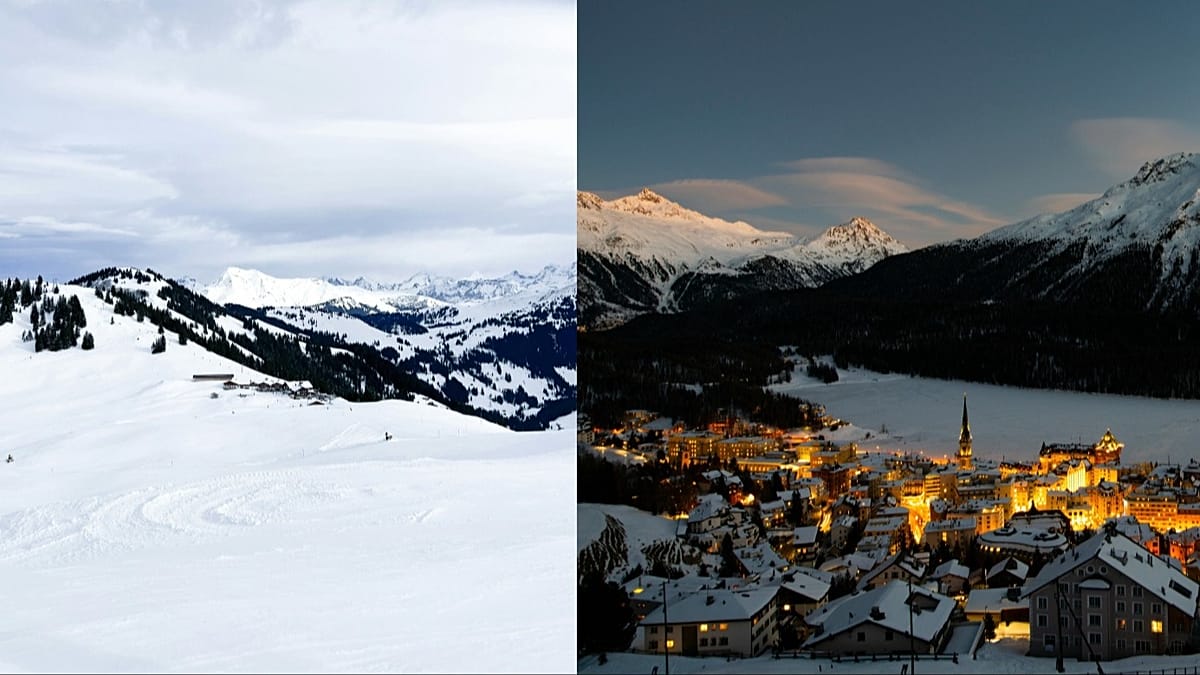
Few destinations do Alpine retreats quite like Switzerland. But when it comes to choosing where to spend a winter getaway, two names in particular tend to compete for travellers’ attention: Gstaad and St. Moritz.
Both promise snow-topped mountain peak landscapes, world-class skiing, luxury hotels and plenty of opportunities to indulge in après-ski dining and socialising. Although the destinations share a Swiss Alpine setting, the two resorts offer distinctly different experiences.
Although the two both receive an average snowfall of four metres per person, serious skiers should know St. Moritz’s piste network spans 350 kilometres, compared with 200 kilometres in Gstaad. St. Moritz also has a higher village altitude, highest point and longer season from late November to early May compared to its Swiss counterpart.
Beyond the slopes, Gstaad is perfect for snowshoeing, cultural experiences such as cheese making, and to top it off, Gstaad promenade features an array of artisanal shops with fashion, jewellery, crafts and other wares on offer.
So, which resort is best for you depends on whether you’re after unparalleled skiing, or have an eye for old-money vibes and non-skiing experiences.
St. Moritz
Located some 1,856 metres above sea level, St. Moritz is famed as the birthplace of Alpine winter tourism and enjoys more days of sunshine year-round than almost any other resort in the Alps by virtue of its location in Switzerland’s Engadin valley.
The sun-drenched resort town is home to four large ski areas, including Corviglia-Piz Nair, Corvatsch-Furtschellas, Diavolezza and Lagalb.
Corviglia, St. Moritz’s local mountain, which is directly accessible via Chantarella funicular or via chairlift or single cable car, features 155 kilometres of pistes prepared for winter sports enthusiasts.
From Corviglia, the cable car can take visitors to the Piz Nair mountain which has an elevation of 3,057 metres above sea level. At the summit, visitors can take in the views alongside the piping hot dishes at the Piz Nair 10’000 Feet eatery. Here, from the restaurant’s windows and terrace, guests are treated to panoramic views and local dishes, such as Güggeli – grilled or roasted chicken.
A day ski ticket to Corviglia in November ranges from 52.50 to 57.50 CHF (€55.75 to €61.06).
Staying in St. Moritz also journeys to the resort town’s past. The iconic Badrutt’s Palace Hotel has been open since 1896, when it set the tone for subsequent Alpine stays that followed. Today, the four-storied property features 163 keys, with lake-facing suites offering views of the shores of the frozen Lake St. Moritz.
Despite its tucked away location, St. Moritz’s maintained Alpine pass roads mean buses and cars from the rest of the country, as well as from Austria and Italy, can easily access the resort town. The drive from Zurich or Milan takes around three hours, while it takes four hours from Munich.
Train journeys, such as via the Glacier Express, Bernina Express or Rhaetian Railway offer a slower and more scenic way to reach St. Moritz.
While for international visitors, there’s an array of travel options, including via private jet, chartered flight or air taxi with Engadin Airport being in the nearby town of Samedan.
Gstaad
At 1,050 metres above sea level, Gstaad offers a different take on the Swiss Alpine escape.
Located in the southwest of Switzerland, the Alpine resort village is surrounded by 10 chalet villages – each with its own distinct personality and history.
While its competition edges ahead on altitude, highest point and overall piste network, Gstaad offers a greater vertical drop with slopes descending at 1,950 metres from the highest ski point of 3,000 metres down to the valley.
Gstaad’s season starts in mid-December and runs till early April, with a day ski ticket bought from Gsteig costing 45 CHF (€47.86) per person.
The longest slope in the holiday area measures at 7.5 kilometres and starts at La Videmanette mountain, with the latter featuring a large number of trails that can be used for snowshoeing.
In comparison to St. Moritz, according to Gstaad tourism, the focus is not on the number of slope kilometres between the Eggli and La Videmanette, but enjoying the “the peace and quiet and the impressive landscape with its perfectly groomed pistes”.
For a savoury taste of Swiss culture, the outdoor Fondueland experience in Gstaad is ideal for fondue fans. Set among Alpine pastures and herbs, eight supersized fondue pots, locally referred to as caquelons, each seat eight people. Visitors can pre-order “fondue backpacks,” stocked with either traditional or truffle-infused fondue from local dairies, crusty fondue bread from local bakeries and accompanying spices and enjoy the quintessential Swiss dish against a mountain backdrop.
The pedestrianised village centre is also ideal for dining, as well as strolling and shopping. Here, designer labels such as Ralph Lauren and Zadig & Voltaire stand alongside sports, jewellery and watch shops. While for the cultured traveller, Studio Naegeli, in the historic Chalet Naegeli area, is a contemporary art gallery focused on fine art and photography.
Travelling by train to Gstaad can be part of the trip experience in and of itself, with many of the trains featuring large windows to take in the views of the scenic route through Alpine valleys. From Swiss destinations like Interlaken and Montreux, the straightforward train ride takes around an hour and 40 minutes.
Further afield from London, a traveller would need to hop a Eurostar train to Paris and later alight a few more times to reach Gstaad over the course of at least nine hours.
For an intimate stay in Gstaad, the 57-key Le Grand Bellevue is set in the heart of the village with the property dating back to 1912. Built with country-style elegance in mind, its selection of nine suites features gardens, mountain views and transfers to and from Gstaad train station included as part of the stay.
Guests can also make use of the hotel’s vast Le Grand Spa. At 3,000 square metres, guests can choose from 17 different wellness zones, including steam baths, an ice fountain to saunas and a salt insulation grotto.
Read the full article here