




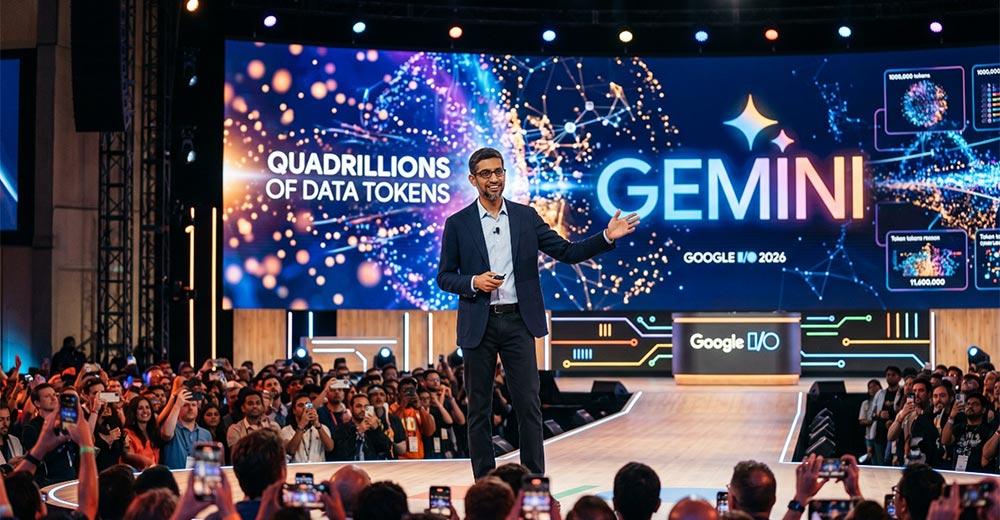
Google used I/O 2026 to demonstrate how deeply AI is being woven into nearly every layer of its ecosystem — from search and productivity tools to commerce, development platforms, and wearable computing.
CEO Sundar Pichai used the keynote to mark 10 years since the company declared itself an “AI-first” organization. Today, that strategy has evolved from a long-term vision into the foundation of nearly every major Google product initiative.
Google is no longer simply adding AI features to products; it is building a full-stack AI ecosystem spanning hardware, models, software, and services. From custom silicon to foundational models, the company is assembling one of the industry’s most formidable AI platforms.
The sheer scale is staggering. The company has moved from processing 9.2 tokens initially to quadrillions of tokens today. The developer community has swelled to 8.5 million users. Five of Google’s flagship products now boast over 3 billion users each, with Search alone bringing AI benefits to 3.5 billion people.
To power this, Google is aggressively expanding its infrastructure, scaling its capital expenditure from $31 billion to roughly $90 billion. A vast portion of this investment is poured directly into developing its proprietary TPU 8t and 8i silicon, enabling it to distribute training seamlessly across the largest cluster on the planet — over 1 million TPUs.
The result? Google says its latest infrastructure delivers 1,500 tokens per second with twice the performance per watt of the prior generation.
Here’s what mattered most at Google I/O 2026 — and why it signals a far more disruptive AI era than most companies appear prepared for. We’ll conclude with the modular Framework Laptop 16, a system whose upgrade-focused design may be better suited to the rapidly evolving AI landscape than offerings from many larger OEMs.
The Announcements: Making Life Easier, Better, and More Fun
Google’s barrage of announcements was fundamentally aimed at collapsing the distance between human thought and digital execution. Here are the monumental shifts that matter most:
Gemini Omni and Gemini 3.5 Flash
Google unveiled Gemini Omni, a foundational shift in multimodal capability. Omni can generate any output from any input, understanding the physical world — including kinetic energy and gravity — to translate a fleeting idea into an entertaining, highly accurate video.
Accompanying this is Gemini 3.5 Flash, which radically outperforms the previous 3.1 Pro model. It operates in a league of its own for speed and accuracy, becoming the default engine for the Gemini ecosystem.
Agentic AI and Gemini Spark
Gemini Spark is a personal AI agent running 24/7 on the new Antigravity framework. Spark connects seamlessly across Google Workspace and over 30 third-party apps to plan events, manage schedules, and execute complex logic even when your laptop is closed. Google has wisely reorganized its pricing, bringing the AI Ultra plan down to $100 a month to give power users priority access to these autonomous tools.
Docs Live & Notebook LM
Docs Live is a revelation for content creation. You can now simply initiate a “verbal brain dump.” For instance, a user who needs an alumni speech can dictate their life story and successes, and Gemini instantly turns it into a polished document. Meanwhile, Notebook LM has been redesigned inside the Gemini app to effortlessly turn complex, scattered information into cohesive knowledge.
Ask Maps and Ask YouTube
Search is becoming hyper-contextual. If your kid falls into a pond during a wedding, “Ask Maps” immediately maps out the nearest clothing stores that carry children’s formal wear. “Ask YouTube” leverages Gemini to instantly find the exact video snippet to solve a real-time dilemma.
Intelligent Search Box & Universal Cart
Google’s new AI search box features 24/7 background Search Agents that scour the web for you. In commerce, the Universal Commerce Protocol powers a new “Universal Cart” that automatically tracks vendors, prices, and availability across brands like Amazon, Walmart, and Shopify.
Creative Powerhouses
Google Pics is gaining aggressive, on-device AI editing. Google Stitch allows users to generate and iterate entirely new website designs using nothing but voice commands. For musicians, Flow Music turns a hummed tune into a fully orchestrated R&B track, fundamentally changing how we create and gift music.
Android XR and Intelligent Eyewear
Partnering with Samsung, Qualcomm, Warby Parker, and Gentle Monster, Google is launching two types of smart glasses this summer: an informational display model and an audio-only variant. Integrated directly with Gemini, they represent the next frontier of pervasive computing.
C2PA SenseID
To maintain trust, Google integrated SenseID into Chrome, allowing users to right-click any image to detect if it was AI-generated. Crucially, this digital watermark standard is supported by rivals like OpenAI and Nvidia.
AI Consolidation Threatens Standalone Apps
With these announcements, Google has inadvertently — or perhaps entirely by design — made a vast array of specialized companies and applications redundant.
Standalone AI Search Tools Like Perplexity and Jasper
Google’s introduction of 24/7 Search Agents and the newly overhauled Intelligent Search Box obliterate the need for niche AI search engines. When Google can continuously monitor real-time apartment listings or financial news in the background and deliver them natively to your device, paying for a separate AI research tool becomes unjustifiable.
Web Builders and Freelance Designers Like Wix and Squarespace
Google Stitch allows users to verbally command a website into existence. A local bakery owner no longer needs to navigate drag-and-drop interfaces or hire a junior web designer; they simply tell Stitch what they want, and generative UI builds a custom, responsive site instantly.
Transcription and Writing Tools Like Grammarly and Otter
Docs Live natively handles verbal brain dumps, turning them into beautifully structured prose. By integrating this directly at the OS and Workspace level, third-party transcription and grammar-checking subscriptions lose their primary value proposition.
Entry-Level Coding IDEs and Copilots
Google’s Antigravity 2.0 IDE is an agent-first platform that can create a fully functional operating system from scratch and port “Doom” to it in mere minutes. If enterprises migrate to Gemini 3.5 Flash via Antigravity, Google estimates they could save upwards of $1 billion per year. Basic coding assistants are vastly outgunned by this invisible framework that autonomously handles massive, complex architectural tasks.
Shopping and Deal Tracking Tools Like Honey
The Universal Commerce Protocol and Universal Cart fundamentally rewrite e-commerce. Why use a third-party extension to track price drops when Google natively monitors availability and dynamically routes your cart to the best vendor?
The Counter-Argument: Skeptics will argue that specialized tools will always survive because they offer deeper, niche features that a monolithic tech giant cannot replicate. They will claim that the human touch in web design, or the specific UI of a dedicated coding app, commands loyalty.
The Reality: History shows that when a platform seamlessly integrates a “good enough” or superior feature directly into the user’s daily workflow, fragmentation dies. Friction is the enemy of adoption. When Gemini Spark can execute tasks across 30 different applications while your laptop is closed, the convenience, integration, and zero-switching-cost environment will crush standalone alternatives.
Over time, that kind of deeply integrated workflow could place significant pressure on traditional productivity platforms, including Microsoft Office.
Google Moves Closer to AGI
During the keynote, Google leadership framed AGI as a near-term possibility rather than a distant sci-fi concept.
Gemini Omni is the clearest indicator of this trajectory. By moving beyond text prediction to generate and understand the physical world — how objects fall, how light bounces, how kinetic energy transfers — the model simulates reality.
When AI models begin to convincingly simulate physical interactions and environmental behavior, they move closer to the capabilities associated with broader general intelligence. Once AGI is fully realized, we will have systems capable of self-correction, novel scientific discovery (accelerated by the newly announced Gemini for Science), and autonomous economic participation.
Adapting to the Agentic Workforce
If the tools are doing the heavy lifting, what happens to the humans? To ensure employment and make this technology work for you rather than replace you, a fundamental paradigm shift is required in both the classroom and the boardroom.
In school, rote memorization and basic coding syntax are dead ends. Educational focus must pivot toward systems architecture, critical thinking, and complex problem-solving. Students should be taught how to act as “orchestrators,” managing autonomous agents to achieve a desired outcome.
In the workplace, professionals must aggressively adopt these tools to elevate their output. A software engineer should transition from writing boilerplate code to reviewing the architecture generated by Antigravity 2.0. A marketer must stop manually writing copy and instead focus on strategically deploying personalized campaigns generated by Gemini Spark.
The mantra is simple: You will not be replaced by AI; you will be replaced by a human seamlessly leveraging AI. Ascend the value chain by focusing on emotional intelligence, strategic alignment, and cross-disciplinary innovation — areas where even Omni currently falls short.
What’s Next for Google and the Competition
Looking forward, Google is likely to bridge the gap between its digital agents and physical robotics. With Gemini Omni already understanding kinetic energy and the physical world, the natural next step is to embed these models in autonomous hardware for manufacturing, logistics, and eldercare. Furthermore, its push into Android XR signals a future where spatial computing replaces the smartphone entirely.
For competitors — namely Apple, Microsoft, and Meta — the alarm bells are ringing. To avoid redundancy, they must pivot hard.
Apple must leverage its massive hardware footprint to offer hyper-private, on-device agentic AI that Google’s cloud-heavy approach cannot match.
Microsoft must aggressively defend its enterprise moat by embedding its AI capabilities more deeply into Office 365 before Google’s expanding agentic ecosystem erodes its productivity software advantage.
Meta will likely continue to open-source its Llama models to commoditize the foundational layer, in an attempt to counter Google’s massive hardware and training investments.
Wrapping Up
Google I/O 2026 wasn’t merely a showcase of new products; it was a masterclass in platform dominance. From the sheer processing power of the new TPU silicon to the sweeping capabilities of Gemini Omni, Docs Live, and the Universal Cart, Google has declared war on digital friction.
By giving users an ecosystem that thinks, anticipates, and creates autonomously, Google has drawn a line in the sand. The march toward AGI is accelerating rapidly. For the rest of the tech industry, the message is clear: adapt your value proposition immediately or prepare to become a relic of the pre-agentic era.
Framework Laptop 16
The Framework Laptop 16 represents a radical departure from the disposable computing culture of the past decade. It is a fully modular, endlessly customizable 16-inch laptop that empowers users to repair, upgrade, and completely reconfigure their machines.
The system features powerful AMD Ryzen AI 300 Series processors and a unique Expansion Bay that allows users to seamlessly swap in a discrete GPU — like the Nvidia RTX 5070 — without needing to buy an entirely new device. With support for up to 96GB of DDR5 RAM and massive storage capacities, it is designed to evolve alongside changing performance and AI workload demands.
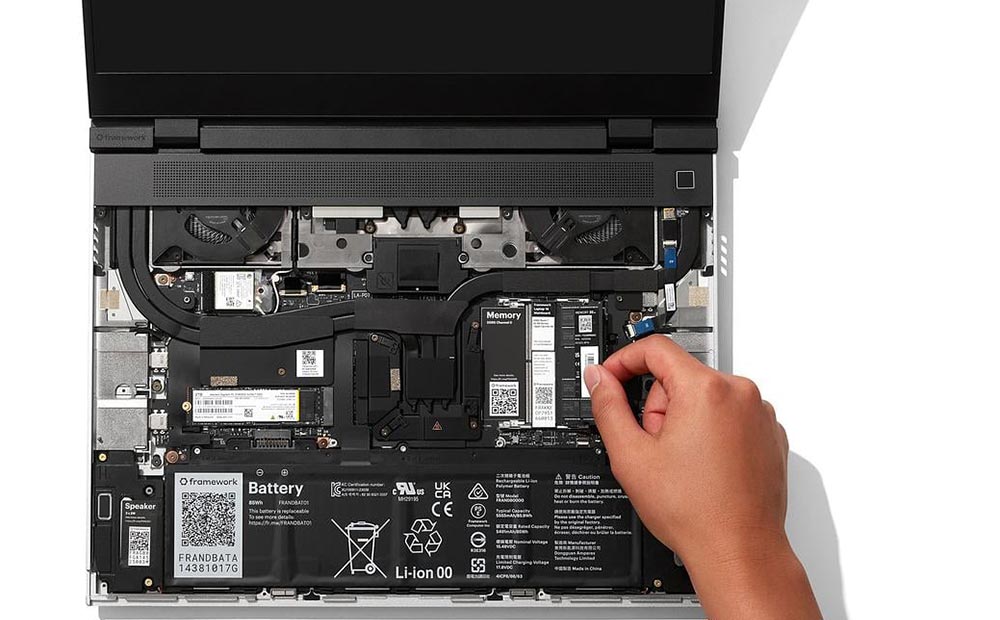

The Framework Laptop 16’s modular design allows users to upgrade and replace key components rather than replacing the entire system. (Image Credit: Framework Computer)
This machine connects perfectly to the themes of our Google I/O 2026 coverage. As Google and other AI vendors move developers toward more agent-driven workflows, the compute requirements for local testing, rapid compilation, and AI sandboxing are skyrocketing. Instead of replacing a laptop every time AI workloads become more demanding, the Framework Laptop 16 allows a developer to simply slot in a newer, more capable AI accelerator or GPU module.
Modular PC Advantages
I’ve been involved with modular PC efforts going back to the one IBM created around the start of this century. Back then, IBM’s push toward open architecture and standardized expansion slots was designed to reduce costs and foster a massive ecosystem of third-party innovation. Those early modular designs proved that when you give users the ability to upgrade and adapt their hardware, you dramatically extend the technology’s lifecycle while shifting power back to the consumer.
In an AI market that now changes every few months, modular hardware is becoming increasingly practical for users trying to keep pace with rising AI demands. The rapid advancement of NPUs, GPUs, and local LLM processing requirements means that a static, sealed laptop can become functionally obsolete long before its screen or keyboard fails.
Modular PCs like the Framework 16 should become the new industry standard because they decouple rapidly aging silicon from static hardware. This prevents massive e-waste and saves users from the relentless, expensive upgrade cycle driven by the AI arms race.
The Framework Laptop 16 is the most forward-looking laptop currently on the market. Given the pace of change coming from companies like Google, it represents what the future of all laptops should be. Following Google I/O 2026, it is an ideal choice for my Product of the Week.
Read the full article here