



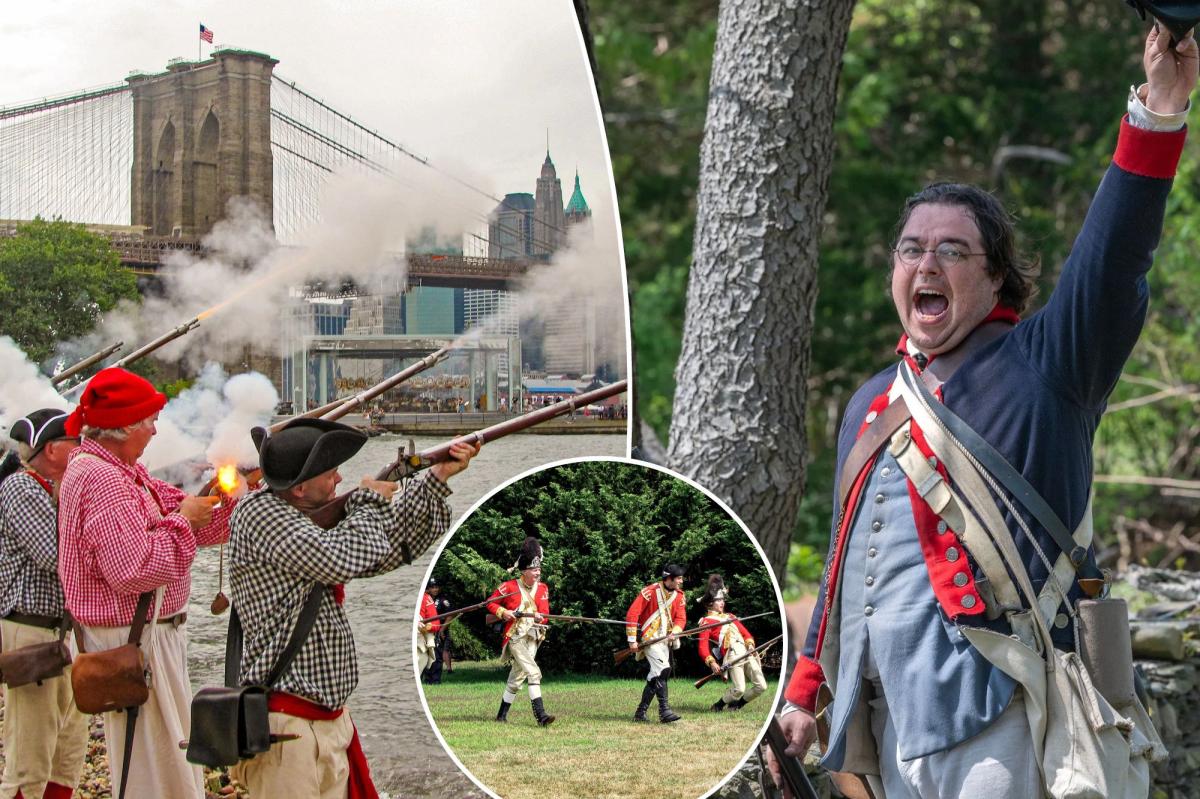
Once more into the breeches.
New Yorkers need not be alarmed by the sight of squadrons of Redcoats pouring out of the subway at Brooklyn’s Grand Army Plaza on Saturday morning — this isn’t the second coming of the Revolutionary War, and the British aren’t back.
No, these period costume-flaunting fighters are merely here to party — like it’s 1776. The occasion? The 250th anniversary of the Battle of Brooklyn — known as the largest skirmish by troop deployment during our nascent nation’s struggle for independence.
These raring-to-go re-enactors aren’t professionals, either — they’re doctors, accountants, and other working stiffs “who happen to have an ardent love of history,” said Kim Maier, an organizer of the event, which will kick off in Prospect Park at 10 a.m. and continue until the British win (the fight, not the war), around 12.
For the first large-scale reenactment of the battle since 2001, roughly 400 soldiers will assemble on Long Meadow, joined by thousands of spectators. The action will then proceed down Third Street, through Park Slope, to the Old Stone House — where the real conflict culminated on Aug. 27, 1776, explained Maier, executive director of that historic site just off of busy Fourth Avenue.
The first military conflict after the Declaration of Independence, the Battle of Brooklyn saw 20,000 British troops and Hessian Mercenaries rout roughly 10,000 continental soldiers led by George Washington — who ultimately led his army across the East River, avoiding total destruction.
“This is literally the Empire strikes back,” home team re-enactor Justin Costantino told the Post of the legendary skirmish. “They send the entire British army to invade and conquer the city of New York, capture and kill George Washington and put this silly little notion of the United States of America at last to rest.”
He added, “It’s also the closest the country ever came to not existing.”
Costantino is an adjutant of the Long Island Companies of the Third New York regiment of 1775 and a PhD candidate in history who studied the storied era at SUNY Stony Brook.
For him, re-enacting isn’t mere Continental cosplay — it’s a second career.
The self-described “historical interpreter” participates in 20-25 events a year — and told The Post that his “passion has crept in” as a “full-on part-time job.”
“It’s like, ‘Hey, you want to go watch the Knicks game?’” said the New Hyde Park resident. “It’s like, ‘Nah, I got a brigade meeting. Are you getting paid for this?” It’s like, ‘No.’”
His devotion to his reproduction firearm alone would make the soldiers of “Full Metal Jacket” blush.
“When I describe my Charleville 66 to people, I tell them I have neither pets nor children … my musket is the joy of my life,” he declared.
But zeal alone won’t be enough to replicate a clash of this scale in 2026 with a fraction of the people.
Just ask Ben Theis, a 25-year re-enactment veteran who will be fighting for the Crown — sorry, not sorry.
He leads the Grenadier Company of the Brigade of Guards 1776-83, a New Jersey-based British Revolutionary War reenactment unit he founded several years back.
“We can never truly recreate a hundred percent of what it was then,” Theis, a security industry marketing professional who helped plan Saturday’s revolutionary reboot, told The Post. “There were thousands of men on the field that day.”
To make matters more difficult, participants hail from from rag-tag volunteer units around the country, each supplying their own uniforms and equipment.
Serious quality control is required. That’s where umbrella organizations such as the British Brigade and the Brigade Of The American Revolution (BAR) step in, establishing authenticity standards — the latter holds annual schools featuring experts from various fields of 18th-century study. Individual units also do their part to prevent themselves from resembling a Rev War version of a Renaissance Fair.
“When you go to Party City and you get the Jack Sparrow costume and you decide to hang out with us with a plastic musket or something like that, we’re going to be like ‘you can’t sit with us,” laughed Costantino, who will bravely don an authentic wool coat Saturday — despite the late August heat and humidity.
And don’t call it a “costume” in front of the varsity LARPer — who politely but firmly informed a reporter that this was, indeed, a “uniform.”
Realism comes at a steep price, too — authentic regalia, complete with all the trimmings and a bonafide 1700s musket, will run enthusiasts between $2,000-$4,000 online.
“You can finance a Mercedes or become a Revolutionary War re-enactor,” quipped Costantino, adding they help recruits curb costs by letting them borrow “hand-me-down” uniforms and other articles from the regiment.
Theis told The Post he’s actually gone as far as making gear from scratch, becoming proficient in leather-working. His wife sews many of the uniforms herself, including her husband’s.
The method re-enactor even fashioned traditional bearskin caps worn by the British Grenadiers using pelts are sourced from “ethically harvested bears.” They’d set participants back $2,000 otherwise.
Looking the part is only half the battle. These colonial cover bands must master the drills, movements and weapons-handling of an 18th-century soldier — while wielding reproduction firearms with real gunpowder, albeit sans the projectile.
Instead of holding pickup battles before game day, tribute troopers can stay sharp by participating in smaller exhibitions through the year.
Aspiring rebs can hone their skills at immersive BAR events, from period-appropriate social gatherings to firelock shooting competitions.
In a single campaign season, Costantino said he’s seen recruiting go from not recognizing a flintlock to falling in line for inspection and “rolling their own cartridges.”
According to Theis, an army veteran who served in Operation Desert Storm, understanding the history behind these maneuvers is equally important.
“We wanted to break the Hollywoodisms and show how things really work to the best of our abilities,” he said.
One movie misconception this veteran re-enactor wants to bayonet is that the Crown’s troops “marched in straight lines and fired in unison while the Americans hid behind rocks and trees and so forth.”
“Yes, that’s true. But it’s also true that the Americans fought in straight lines and in the style of a European army,” Theis clarified. “And it’s also true that the British did fight behind trees and would go to ground and lay on their arms and not present themselves as a target.”
Despite his meticulous prepwork, some scenarios will inevitably end up backfiring. Theis recalled a re-enactment of the Battle of Guilford where the British were supposed to sustain “heavy casualties” despite ultimately emerging victorious.
However, through a miscommunication, a staggering “98% of the British line went down” following a Continental volley, leaving around three guys standing.
“Everybody had a good laugh,” he said. “Three quarters of us stood back up again to go finish the engagement.”
“None of this is choreographed beyond maybe moving markers on a map,” Theis explained. “We’re all volunteers at the end of the day.”
And, even die-hard interpreters don’t normally muster such an army for the Battle Of Brooklyn.
Costantino says that a typical commemoration draws about half a dozen or so re-enactors, but America’s 250th B-day has transformed the small-scale celebration into a “once in a lifetime” historical tribute.
“We wouldn’t be able to get the guys from Illinois and Virginia to come in if it was, ‘Oh, come celebrate the 248th,’” he said.
For Theis, success isn’t measured by enemy body count. “[I want to] encourage them to find out more, pick up a book and read about it. If that is what a few people do, then I consider [the event] highly successful.”
Read the full article here