




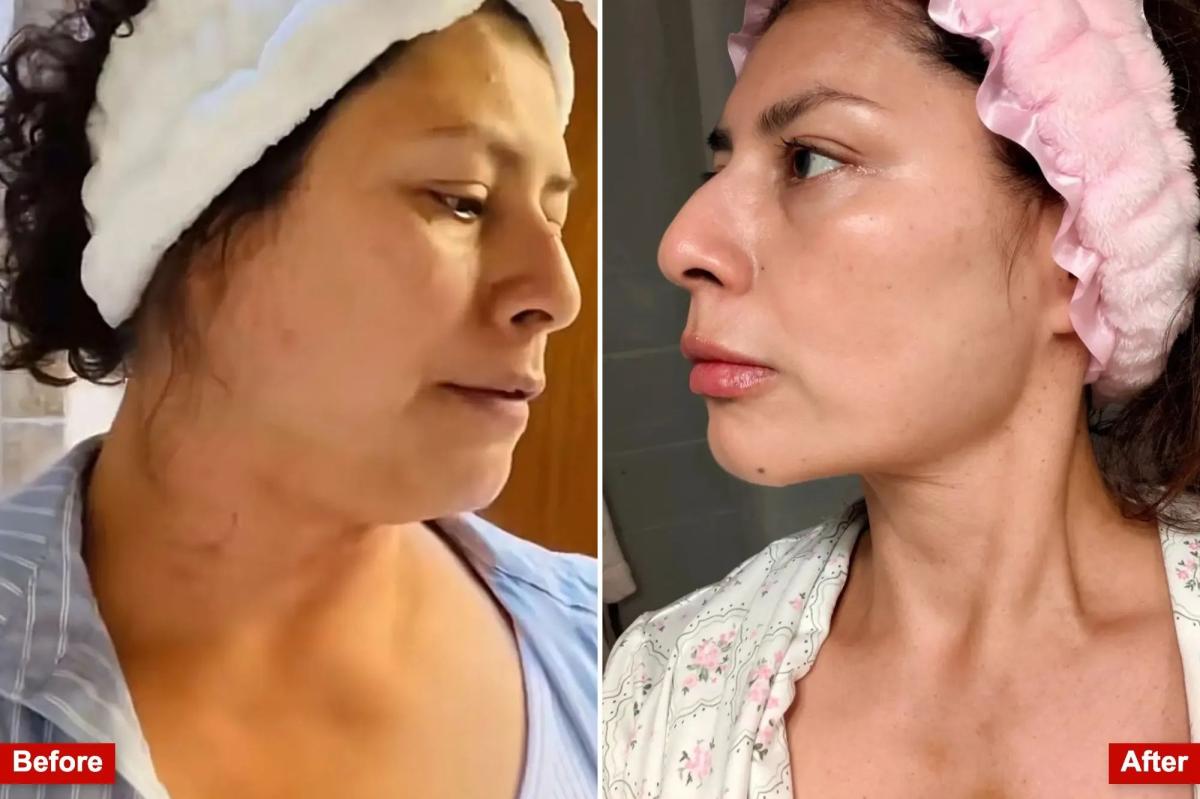
Ruth didn’t want to pay a plastic surgeon to give her the body of her dreams. She wanted to do it herself.
Rather than forking over nearly $100,000 on traditional liposuction, under the supervision of a medical expert, the 55-year-old instead purchased a $95 kit of Korean fat-dissolving fluids online, pumped the potion into a syringe and shot it into her lower belly, thighs and double chin.
She’d already lost 45 pounds with GLP-1 meds that she was self-administering at home. So why not, she thought, dissolve those additional “pockets of fat” that she still couldn’t erase herself — no matter the safety risks.
Ruth, a married mom of two, who chose to withhold her last name for privacy, is just one of a rising number of women choosing to bypass the safety of an operating room to, instead, perform a makeshift, shady version of liposuction on themselves, at home, as trailblazers of the “DIY Lipo” trend.
It’s a controversial cosmetic movement that touts do-it-yourself injectables as a nonsurgical answer to the prayers of folks fighting the battle of the bulge.
But, unlike Kybella, a popular FDA-approved, yet disputable jab administered by medical professionals to permanently destroy fat cells in targeted areas, which can cost roughly $500 to $1,500 per treatment in NYC, these black-market DIY dupes are unregulated and pose significant safety risks, such as permanent scarring, serious infections, skin deformities, cysts and painful knots.
As precarious self-administered GLP-1s have opened the door to even more dangerous at-home cosmetic procedures such as this one, despite the shocking risks, hundreds of women, like Ruth, are doing whatever it takes to get snatched without breaking the bank — and are encouraging others online to follow suit.
“I will never stop using this product. I love it. I want it on subscription,” Ruth told The Post of her cherished Dr. Lipo + V supply, which ultimately targets fat deposits in the face and neck area over the course of several sessions.
What the Massachusetts resident is referring to is a 10-pack of 5-milliliter vials filled with lipolytic, a combo of phosphatidylcholine (PPC), which reduces localized fat beneath the skin and sodium deoxycholate (DC) to physically dissolve the fat cell membranes.
Together, when properly injected into fatty tissue, the ingredients can effectively reduce fat volume and thickness by inducing adipocyte necrosis, or the death of fat tissue, per data.
Ruth first discovered the product online, where videos promoting similar fat-dissolving substances, such as Aqualyx, Lipodissolve, Lipo Lab, Kabelline and more, have garnered nearly 500,000 social media views.
After turning to Wegovy, a self-injection semaglutide, to drop the 50 pounds she’d gained during perimenopause, a phase during which women over 40 often pack on weight at a rapid rate, Ruth spent much of 2025 researching DIY lipo solutions until finding one she hoped would work wonders.
Upon receiving her shipment from Asia last fall, Ruth, per the package’s instructions, used a marker to draw a grid of 1-centimeter boxes under her chin, similar to how a surgeon would before operating on a patient.
The brunette then deposited the concoction into a separately purchased syringe and injected one shot into each box. She repeated that process once every two to three weeks for the next two months.
60 days later, her stubborn adipose pudge has totally disappeared.
“I couldn’t believe it,” she gushed.
“I was so impressed with the results of my chin that I did DIY lipo on my stomach, under my C-section incision, my thighs and those annoying little fat rolls women under my arms by my bra,” laughed Ruth, a former medical assistant in a level-1 trauma center emergency room.
“I have so much confidence. I can take selfies and feel good about myself. I can wear sundresses and maybe even a bikini for the first time in 15 years this summer,” the 55-year-old raved.
Owing to her experience in healthcare, the New Englander told The Post she’s comfortable self-inoculating, noting that the only adverse side effect she experienced was a bit of temporary swelling and tenderness.
“I’m so proud I did this on my own at a fraction of the cost of liposuction,” she raved.
But, according to the experts, she’s one of the lucky ones.
“I do not recommend people trying this at home,” Carter Boyd, a cosmetic plastic surgeon with NYU Langone Health, advised. “It is a procedure, you’re injecting chemical substances into your body, and there are risks associated with it.”
The authority warns that shopping for unverified, DIY meds on Facebook and TikTok marketplaces, or the dark web, could render deadly outcomes.
He adds that administering unprescribed shots can lead to nerve damage, bleeding, inflammation, ulcerations, necrosis and other severe complications, which trained physicians are often better equipped to address in emergencies.
“Patients can damage their internal organs if they [self-inject] too deep, hitting a muscle, blood vessel or obstructing an airway in their necks,” Boyd told The Post.
Brunilda Nazario, the Chief Physician Editor of Medical Affairs for WebMD, agrees.
The board-certified internist and obesity specialist said shooting up a GLP-1, such as Wegovy or Ozempic, is less hazardous than self-injecting unregulated fat dissolvers, and notes the vast differences between their functions.
“The GLP-1 class of medications helps manage hunger by balancing hormones that affect our appetite and sense of fullness. They work in the gut, brain, and other parts of the body to support healthier outcomes for those dealing with extra weight,” explained Nazario.
“You lose fat cells in and around the body and its organs; it doesn’t target just the skin like the fat dissolver injections,” the expert added.
“On the flip side,” she continued, “the goal of fat-dissolving products is to help you achieve a smoother, more contoured look. They do not work on weight loss or improvement in health.“
Consequences and concerns aside, DIY lipo influencers, such as Ana, have attained viral acclaim by lauding fat-dissolving injectables for obliterating her excess blubber.
“I used to weigh 260 pounds and wear a size 16 [in jeans],” said the siren while showing off her now slight, sleek physique to over 462,000 virtual fans.
“I’m currently wearing a size 4,” Ana added, flaunting her taut tummy. “I can [attribute it] to DIY lipo.“
The content creator emphasized that she recently lost more than 100 pounds with the help of peptides and GLP-1 drugs, but has used products from unregulated brands with buzzy names such as Dr. Lipo, Power Delete, Pine Bottle and Lipo Lab, to contour her abdomen.
Beki, a mom and nurse digitally documenting her “glow up” journey, too, praises goodies from Lipo Lab and Pine bottle for sculpting her distended midsection.
“It works y’all. Get it. Do it. You will not regret it,” she captioned before and after photos of her transformation. “Six sessions is where the magic happens. I’m halfway there with no intention to stop!”
Ruth, who, too, doesn’t intend to end her DIY lipo routine any time soon, claims the products have not only erased the flub that once plagued her face, legs and waist, but they’ve also tightened her skin, improved her circulation and aided her lymphatic drainage.
“I used to hate the way I looked. I even stopped taking pictures with my family because I was so unhappy with myself,” she groaned. “Now, I feel great.”
Read the full article here