




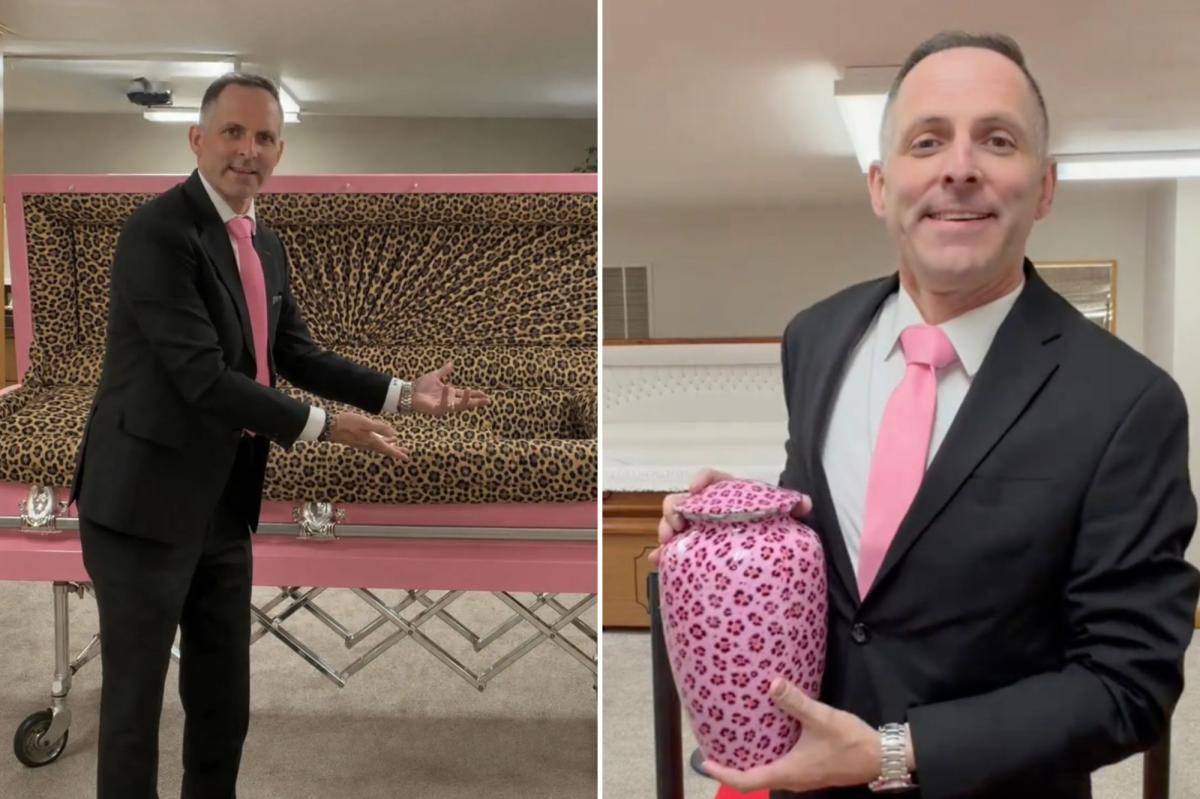
There’s nothing lighthearted, let alone fun or flashy, about death — but a flamingo-colored casket or a bowling pin-shaped urn suggests otherwise.
A doom-and-gloom, Addams Family-esque funeral service is not what Dan Madden, a funeral director of 23 years who owns Ohio-based Stark Memorial Funeral Home, strives for.
Instead, when mourners reluctantly step into his funeral parlor to plan their loved one’s services, they’re met with striking hot pink caskets, with, of course, the option to customize their interior — a stark contrast from the somber environment.
In an effort to “make death care [the planning of post-death services] less taboo” and more fun, Madden offers wild, pimped-out funeral goods, both in-house and on his FashUrns website, where the bereaved can buy everything from butterfly to Star Wars-themed vessels, and has garnered millions of social media views showcasing them.
When sharing his death-centered work online, the comments on Madden’s videos inspired him to offer mourners something less gloomy and more lively.
“People kept asking if there were different options out there, things that were more unique, more colorful, and not the same traditional choices they were used to seeing,” he told The Post.
“A lot of people are looking for something that feels less common and more personal — something bold, colorful, or different that reflects their personality or the personality of someone they love,” the mortician continued.
A quick scroll through Madden’s TikTok and Instagram pages, where he’s known as @danthefuneralman and has 80,000 followers and counting, shows the undertaker playfully strutting and posing with everything from hot pink cheetah-printed urns to biodegradable turtle-shaped ones, often next to a brightly colored coffin for his “FashUrn” show series.
Morbid? Maybe.
Ridiculous? Slightly.
Humorous? Most definitely.
“In my 23 years in funeral service, I have seen how sad and overwhelming this process can be for families. Funeral planning is emotional, and for a lot of people, death feels uncomfortable to even talk about,” the funeral expert pointed out to The Post.
“I started making this content because I wanted to make the subject a little lighter, more relatable, less taboo and maybe even put a smile on someone’s face.”
And that he did.
Soon after uploading a sassy video in his funeral home with none other than Fergie’s 2000’s hit “Glamorous” playing in the background, viewers flooded the comment section, jokingly writing, “I see my future and it’s bright!”
“I want a clear one so my family has to look at me,” another quipped.
Even “Jersey Shore” favorite Nicole “Snooki” Polizzi commented on the video, writing, “I’ll take it,” referencing the hot pink cheetah-printed urn.
Since building an online presence, the funeral expert said he’s been inundated with custom urn requests, like a “PlayStation controller full-size urn for somebody who was a gamer,” but stressed that they “are really not much more expensive than your traditional options,” which can range from the low hundreds to well into the tens of thousands.
Madden says the response to his eclectic offerings is just as positive in real life: “…they’re not used to seeing them when they visit funeral homes and they like the variety.”
“It’s opening up these conversations where people are going, ‘Man, you got me thinking about pre-planning (for death) — thank you for this,’” he added.
Madden isn’t alone in his quest to make death a tad less serious, as he’s part of a burgeoning movement of death-care workers who’ve taken to posting death-related content on social media.
Brad Sheppard, a funeral service program director and professor at the University of Arkansas Hope-Texarkana with 25 years of industry experience, pulled back the veil on post-death care, posting regularly under the moniker @funfuneralfacts.
Sheppard told The Post that he’d been inspired to establish an online presence by his young mortuary school students.
“I noticed that younger students have really short attention spans, and they don’t like listening to me lecture,” said Sheppard. “So I started doing these really simple, one-minute TikToks for them, like a short lesson, and they found them funny so I just kept doing them…I made them public and we ended up with @funfuneralfacts, my students’ name for it.”
Shepard’s shorts cover a wide range of death-aftercare-related topics, featuring titles such as “Casket Secrets” and “Do morticians cut clothes?” (the latter features Sheppard cheerfully holding up a pair of scissors next to a suited-up dummy in a coffin).
Sheppard admitted that he’s received some pushback from an older generation of funeral workers, who tend to feel “what happens behind the doors at a funeral home should stay there.”
Still, he emphasized that the response to his content — which he creates in an attempt to make funeral service “less intimidating and more understandable to the public” — has been overwhelmingly positive.
“I would guess most people only encounter funeral directors once or twice in their lives, and that’s at one of their hardest moments,” Sheppard said. “A lot of times they may have misinformation. I want it to be that when they do experience a loss, that’s one less thing they have to worry about.”
“Eric the Undertaker,” a 28-year funeral director veteran based in California who prefers to maintain anonymity when posting online to keep the focus on his message rather than his business, posts a selection of similarly educational death-related content.
Video titles on his @erictheundertaker social pages include “The Body’s Silent Conversation: What Happens After Death” (explaining how cells continue to communicate after death through a process called thanatotranscriptome) and “Why Aren’t New Cemeteries Being Built? The Truth Behind the Conspiracy Theory” (addressing how 63 to 64 percent of Americans are now choosing cremation over burial).
However, the majority of Eric’s content revolves around sharing the stories and lessons he’s learned from those grieving their dead — along with what they can teach the living about choosing to carry on with love, hope and gratitude.
“There’s a sanctity to (death) that needs to be preserved, and it can be difficult to just talk about that,” Eric told The Post, having lost his own son five years ago. “But when I gave myself permission to actually tell my stories…Not only have they taught me about death and dying, but really it’s about focusing on what the emphasis should be in life.”
Describing the love he has for his late son as a “huge” part of the evolution behind his own online presence, Eric emphasized that he sees the best after-death care-related content as a concrete way for those who are afraid of the inevitable to “take their focus off death and re-focus on their life.”
“It’s about (re-focusing) on the experiences they’ve had, maybe the experiences they got to share with someone that they lost,” said Eric. “Maybe re-connecting with someone — picking up the phone and saying, “Hello, I love you”…Once we re-focus on who we have in our life, which is what the content almost always teaches, then any anxiety or fear of death just so quickly diminishes.”
Read the full article here