




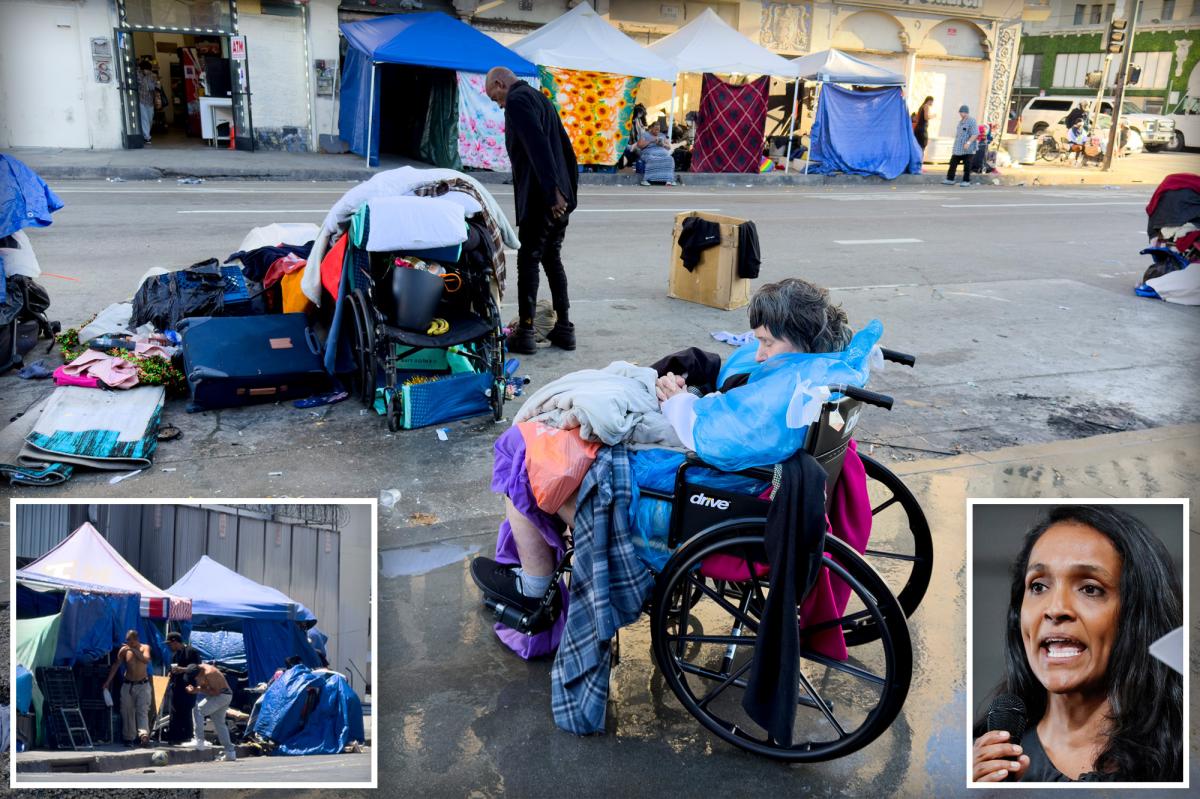
Just three out of a promised 2,000 apartments have been used to relocate the homeless in Nithya Raman’s failed $60 million project to get people off the streets.
Councilmember Raman, the chair of the Los Angeles City Council’s Housing and Homelessness Committee, introduced the Time Limited Subsidy program back in September as a cheaper alternative to Mayor Karen Bass’ Inside Safe Program — meant to get homeless people into an established residence.
Raman’s plan was to lease and move homeless people into 2,000 apartments and subsidize their rent, rather than pay for them to stay in motels or shelters.
However, nearly a year after that plan was launched — with $62.6 million in taxpayer funds behind it — only three apartments are occupied.
The City Council first approved investing in the subsidy model last September as part of its strategy for complying with a court settlement with the Los Angeles Alliance for Human Rights.
Four months later, on January 28, the council approved resources for a redesigned program targeting 2,000 households.
The full rollout began March 1.
However, only three units had occupants by June 25, according to a July 1 presentation to Raman’s powerful homeless committee — a damning result for a program Raman has campaigned to take citywide if elected Mayor.
“One household a month is not a solution,” councilwoman Monica Rodriguez told The Post. “I would say they’re having issues with the program. It’s not working. I think that’s what they discovered,” she continued.
Rodriguez says the $62.6 million subsidy rollout exposes the same gap between promises and results. “I think the big difference is talk versus action. [Raman] says a lot of words but doesn’t deliver,” she said.
The sluggish rollout follows another homelessness program tied to Raman that The Post revealed was stalled despite millions of dollars in government funding.
A $4,011,357 state grant Raman secured to address dangerous encampments along a 19-mile stretch of the Los Angeles River remained unspent nearly two years after it was awarded, The Post reported.
The money came from California’s Encampment Resolution Fund, designed to move people out of encampments and into housing and supportive services.
Raman’s office blamed administrative and contracting delays, calling it “deeply frustrating when critical resources get caught in administrative and contracting processes.”
In adopting Raman’s Time Limited Subsidy program, the council is trying to move away from the expensive model of using motel rooms, which can cost roughly $85,000 per person per year.
“This is par for the course for Los Angeles’ response to homelessness: too little, too late, and not enough attention to making sure the most vulnerable are removed from the streets as quickly as possible,” Paul Webster, executive director of the Los Angeles Alliance for Human Rights, told The Post.
“Nithya Raman and the mayor have been talking about time-limited subsidies for years now. This is the whole reason we insisted on metrics and milestones. If we rely on the city, we know it’s going to be underwhelming at best,” he added.
Raman’s office pushed back on the latest figures, claiming they were just an “early snapshot of the redesigned TLS program.”
“Since contracts with service providers only began this spring, the City will be monitoring the program closely to make sure it moves forward successfully. That’s exactly why we had the public presentation: to catch issues early,” Raman said.
Raman wants LA to scale back its reliance on Mayor Karen Bass’ marquee Inside Safe motel program and steer more homelessness dollars toward cheaper options, including time-limited subsidies and shared housing.
Inside Safe carries a far higher price tag, but has produced far more housing placements. The program has cost approximately $391 million and served 5,932 people since its 2022 launch, according to city figures.
1,571 participants were in permanent housing, while 1,752 remained in temporary interim housing and 2,866 had exited as of early 2026.
“Based on $62 million and three households, Inside Safe has now been made a freaking rock-bottom bargain. My advice to Ms. Raman is: She’s supposed to make it more cost-effective, not less so — if you’re going to be critical of Inside Safe,” Rodriguez said.
Download The California Post App, follow us on social, and subscribe to our newsletters
California Post News: Facebook, Instagram, TikTok, X, YouTube, WhatsApp, LinkedIn
California Post Sports Facebook, Instagram, TikTok, YouTube, X
California Post Opinion
California Post Newsletters: Sign up here!
California Post App: Download here!
Home delivery: Sign up here!
Page Six Hollywood: Sign up here!
Read the full article here