


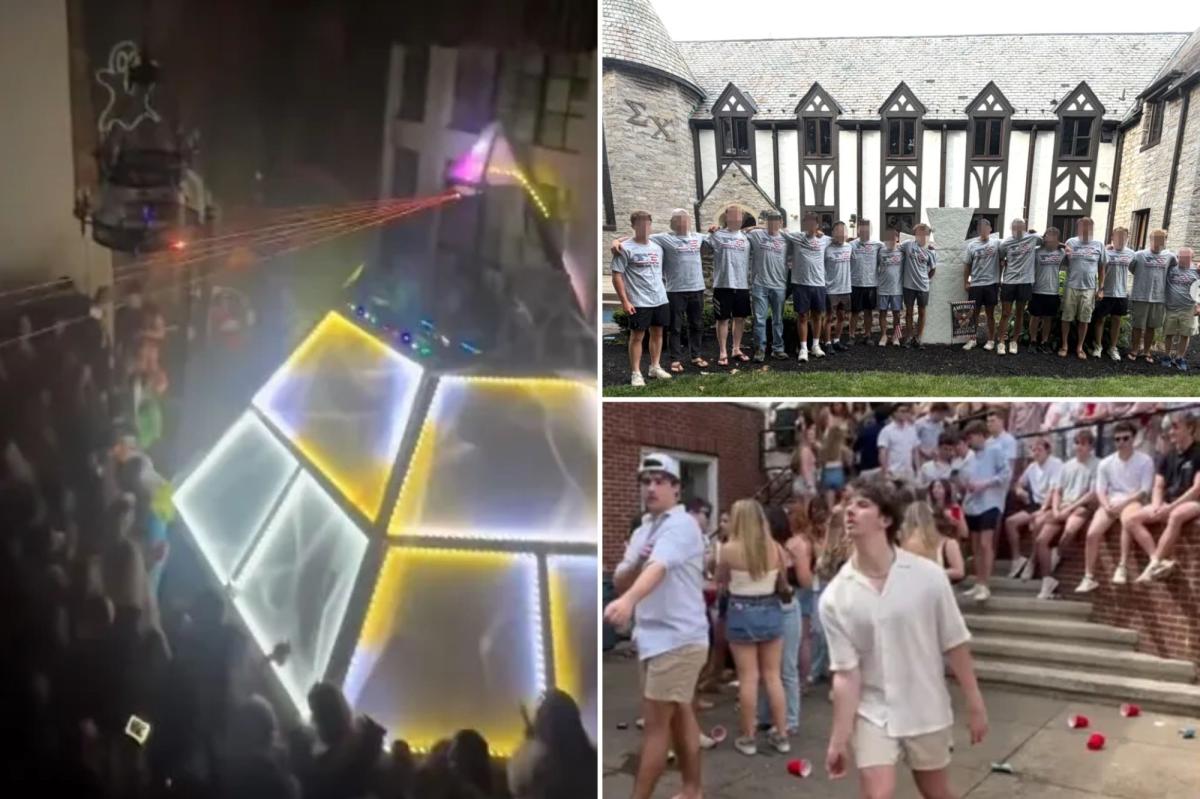
STATE COLLEGE, Pennsylvania — The frats busted for cocaine at Penn State University last week dealt out of “drug rooms” at parties and hazed freshmen even worse than making them bag up narcotics, campus sources claimed to The Post.
Thirteen members of Sigma Chi and Delta Upsilon fraternities were arrested last week over alleged wide-scale dealing and distribution of drugs by federal authorities.
However, those who studied with them said cocaine use and MDMA-fueled end-of-semester parties were well known at the $21,000-a-year school, where the fall semester started Monday.
“It barely scratches the surface of what’s going on. It’s a part of the culture at Penn State. It was normal to take cocaine at these parties, especially with freshman boys who wanted to impress their brothers and talk to girls,” one sorority sister told The Post.
“To me it felt like they were offering it to everyone at the party. You’d look around, and there would be people snorting lines of cocaine around you. It was so normalized.”
The two accused fraternity chapters were described as being at the top of the school’s social scene.
Students pledging in 2023 were made to “package the drugs into half gram bags for sale,” according to court documents. One of the young men forced to take part had a relative who had graduated but was part of Sigma Chi, The Post has learned.
That freshman was then “hazed extra hard” as a result of his connection, one of around 15 boys allegedly forced to take part.
“He knew the hazing process for fraternities was tough and intimidating, but never in a million years did he think it would involve bagging up and selling drugs,” a source close to him said.
“He didn’t want to say no and risk being seen as weak, especially because of his family connection inside the frat.”
The pledges were also allegedly forced into personal servitude for the seniors, made to run errands, act as designated drivers and subject to sexual-themed challenges too graphic to describe.
“Honestly, it was almost a break from some of the disgusting and degrading things they were being made to do,” the source added.
The Post reached out to the individual allegedly at the center of the hazing but he declined to comment.
The Pennsylvania Attorney General named New York-born accounting graduate Agostino Abbatiello as the “top of food chain” when arrests were made last week. Alongside him, Thomas Robinson, Mohammed Huraibi and Lars Zeepvat were also named other key players in the alleged scheme, which took place between 2023 and 2024 — although feds tracked cocaine sales by Abbatiello into Feb. 2026.
A second sorority girl, who wished to remain anonymous, was a frequent guest at their frat parties.
“I was a freshman, and I was so excited because they were famous [on campus] and getting in felt like a huge deal,” the now-senior told The Post. “You didn’t have to look hard to know they were selling drugs. I am honestly surprised they weren’t caught sooner.
“I never had to pay for any cocaine but you would have to go into a specific room to Venmo one of the guys, and they’d hand you a little bag.
“It was done away from the rest of the house where the others were just drinking, dancing and being stupid college kids.”
On-campus sources claimed parties fueled by MDMA — more commonly known as Molly — were thrown at Delta Upsilon and served as enormous blowouts at the end of each semester.
Invitations were sent through the messaging app GroupMe, disguised as innocent-sounding “paint parties,” according to a third senior belonging to a different sorority.
“The Molly parties were really intense,” she said. “Everyone would show up dressed in white and you would have neon paint put on you.
“I guess the ultraviolet lights would then make everything look ‘trippy.’”
“Then people who were friends with the frat boys or could be vouched for were taken into a designated room to pick up Molly.
“They would Venmo one of the brothers there and were given the drugs and a giant lollipop to use to stop lockjaw. It was so obvious who was high because of their giant pupils.”
Penn State, Sigma Chi, Delta Upsilon and State College IFC did not respond to The Post’s request for comment for this story.
The frat boys weren’t great at covering their tracks, according to authorities, who allege Robinson was accepting payment through a Venmo account with the username “Tom-Robinson,” while Abbatiello “would boast about how much money he was making from selling cocaine,” according to court papers.
The scandal reflects badly on other fraternities at Penn State.
Xander Dempster, 21, who is a part of the Chi Pi fraternity, said: “It puts all fraternities here in a bad light and it is just not fair on the rest of us.
“We do a lot of charity work and are heavily involved in the community. Last year we helped raise $18 million at Thon,” a dance marathon organized by the students.
In total, 14 fraternities at Penn State have been banned, suspended, or are currently operating unrecognized following investigations into misconduct, which include allegations of hazing, forced alcohol and drug consumption, physical and mental abuse and forced servitude.
Five of those frats — including Sigma Chi, at the heart of the alleged drugs ring — created their own governing body, the State College Interfraternity Council in March 2025. That was formed in response to reforms installed by Penn State after Timothy Piazza, 19, died when he was pledging for Beta Theta Pi in 2017.
His parents, Evelyn and Jim Piazza, say reform is desperately needed.
“Sigma Chi is part of the independent coalition away from the College and we have been publicly saying it is a dangerous model, and this is just proof that we were right,” Evelyn told The Post.
“Lessons have not been learned following our son’s death, because everyone wants to think they are invincible and it won’t happen again.
Jim added: “The state antihazing law in our son’s name was passed in 2018 and there has not been a single situation where the district attorney has assessed a hazing charge.”
The campus is abuzz with talk about the cocaine scandal, and freshmen say it’s reinforced their view of frats.
Billy Kiray, a 21-year-old freshman from Pittsburgh, told The Post: “I was never going to join a fraternity, I think I am a little too old for that now.
“This whole situation shows that even more. I will just be focusing on my studies and making my family proud.”
Freshman Cole Falin, 18, from Royersford, Pennsylvania, studying political science, said: “My mom is actually a Penn State alum but she says it has changed a lot since she’s been here because there was not any of this going on.
“I was kind of surprised … but it is college so there will be drugs around somewhere. I will definitely not be joining a fraternity, I want to stay away from all that.”
Ahead of the new year, Penn State Vice President for Student Affairs Andrea Dowhower said the university “continues to be appalled by these allegations” and added: “Hazing is against University policy, as well as state and federal law, and we strongly encourage anyone who is aware of such dangerous behavior to report it to the University and law enforcement.
“We strongly discourage any student from affiliating with unrecognized organizations or engaging with these organizations. With no University oversight, they have a greater potential to threaten the well-being of those who participate in their events.”
Read the full article here