


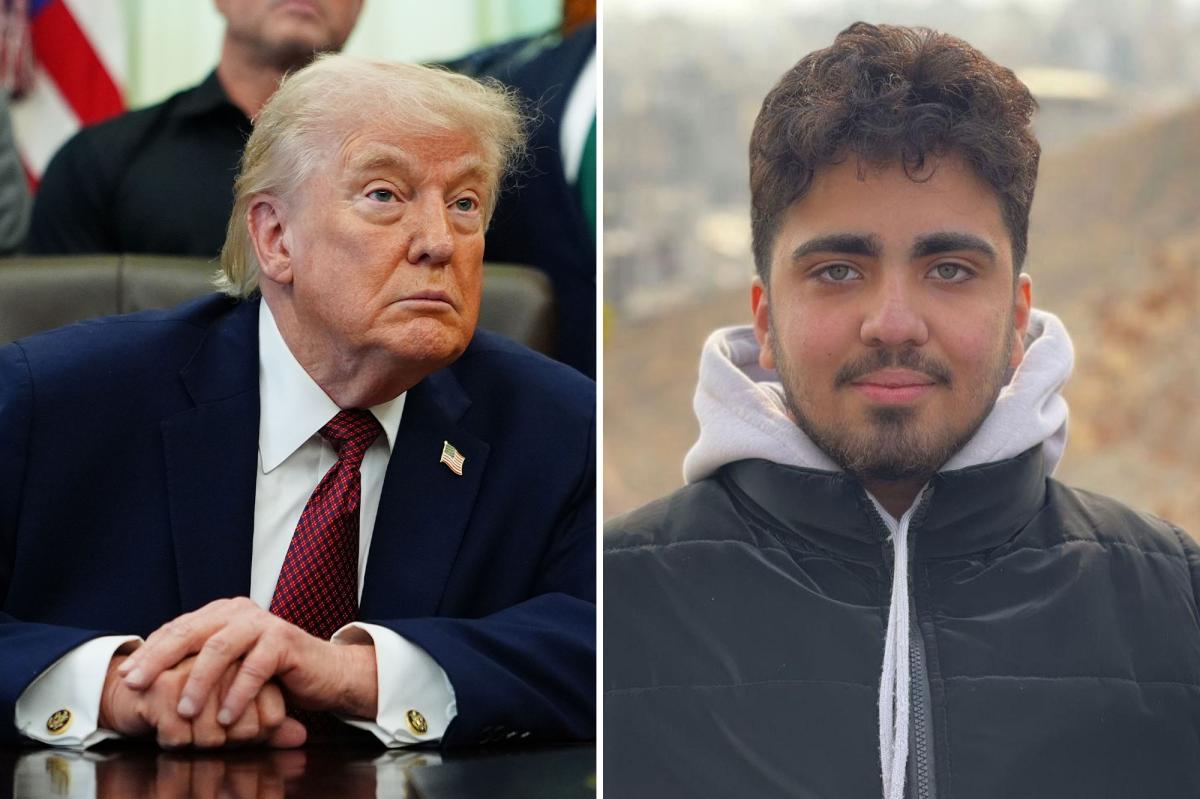
A Los Angeles dad grieving the death of his teenage nephew in Iran says he received a personal letter from President Donald Trump offering condolences — and a promise to stand with the Iranian people.
Majid Moghadasi, an Iranian American living in Woodland Hills, told The Post his nephew, Erfan Faraji, was killed on Jan. 8 during anti-government protests that rocked the Islamic Republic.
His death, just two days after his 18th birthday, came as the regime killed up to 36,500 in a January crackdown.
Estimates vary from 7,000 to 36,000 killed in the regime’s January crackdown on the unrest.
Two days after learning of the teen’s death, Moghadasi said he reached out directly to the White House, pleading for help.
Moghadasi’s deeply personal plea described how his nephew was fatally shot in the streets of Shahr-e Rey, south of Tehran, just for taking part in protests.
“He was an innocent teenager with dreams and a future ahead of him. His only act was standing up against injustice,” Moghadasi wrote, adding that Iranian authorities had responded to demonstrations “not with dialogue, but with live ammunition.”
He urged Trump to continue taking a firm stand against the Iran.
Just days later on Jan. 13. Trump wrote back that he and First Lady were “devastated” by the loss.
“Erfan will be held in my heart, and I promise never to forget or forgive the terrible events that took him from us,” the letter reads.
“Please know that my Administration will always stand with the Iranian people in their quest for freedom and democracy.”
The president also vowed then that efforts were underway then to hold Iran’s leadership accountable, writing that his administration was “working diligently to ensure that the Ayatollah and his murderous regime are brought to justice.”
Moghadasi said the family was grateful for the president’s kind words and said he trusted the president’s m decision making. As for the letter, he was overjoyed to read it.
“Receiving the letter from President Trump was very emotional for me,” Moghadasi said. “When I first read his response, I felt that my voice — and more importantly, the voice of my late nephew, Erfan Faraji, and many others—had finally been heard. It gave me a sense of acknowledgment and a bit of relief during a very difficult time.”
He continued: “Of course, along with that feeling came a sense of hope—that justice for Erfan and other innocent young people who lost their lives will not be forgotten. At the same time, it also reminded me of the responsibility to continue speaking up and keeping their memory alive.”
Despite the geopolitical uncertainty, his message to the president was one of gratitude, emotion — and hope.
“I would like to thank Donald Trump for his attention to these matters,” Moghadasi said. “I hope that the decisions being made will ultimately lead to peace, security, and a better future for the people of Iran.”
Erfan’s death came amid a wave of protests that erupted across Iran in late December 2025 and January 2026, fueled by economic turmoil and long-standing political grievances.
According to Amnesty International, demonstrations that began with strikes in Tehran’s bazaars quickly spread nationwide and were met with a violent response from security forces.
Human Rights Watch reported that authorities escalated their crackdown around Jan. 8 – the same day Faraji was killed — with forces allegedly using live ammunition against protesters, often targeting the head and torso.
Death toll estimates have reached into the thousands, with some reports suggesting as many as 5,000 fatalities by mid-January, alongside mass arrests and widespread internet shutdowns that obscured the full scale of the violence.
For Moghadasi, the emotional toll has been compounded by uncertainty about his family’s safety.
“Given the current situation in Iran, part of what has happened has been emotionally significant for us, but mentally we are not in a good place,” he told the Post. “Due to internet shutdowns and communication disruptions, we have no direct contact with our family in Iran. We truly don’t know their condition or whether they are safe.”
“This uncertainty is extremely stressful,” he added. “What I do know is that many people close to us are deeply upset and are hoping for justice for Erfan.”
In the weeks following his nephew’s death, Moghadasi also posted a video tribute online titled in Farsi: “In memory of Erfan Faraji and all the brave who sacrificed their lives for freedom.”
On 28 February 2026, Ali Khamenei, the supreme leader of Iran, was assassinated in Tehran as part of a series of Israeli airstrikes aimed at high-ranking Iranian officials. Khamenei’s death was confirmed by the Iranian government on 1 March.
“When I first heard the news, I had a strong emotional reaction,” Moghadasi said. “However, after sharing something online, I realized it could put my family at risk, so I removed it.”
Download The California Post App, follow us on social, and subscribe to our newsletters
California Post News: Facebook, Instagram, TikTok, X, YouTube, WhatsApp, LinkedIn
California Post Sports Facebook, Instagram, TikTok, YouTube, X
California Post Opinion
California Post Newsletters: Sign up here!
California Post App: Download here!
Home delivery: Sign up here!
Page Six Hollywood: Sign up here!
Read the full article here