


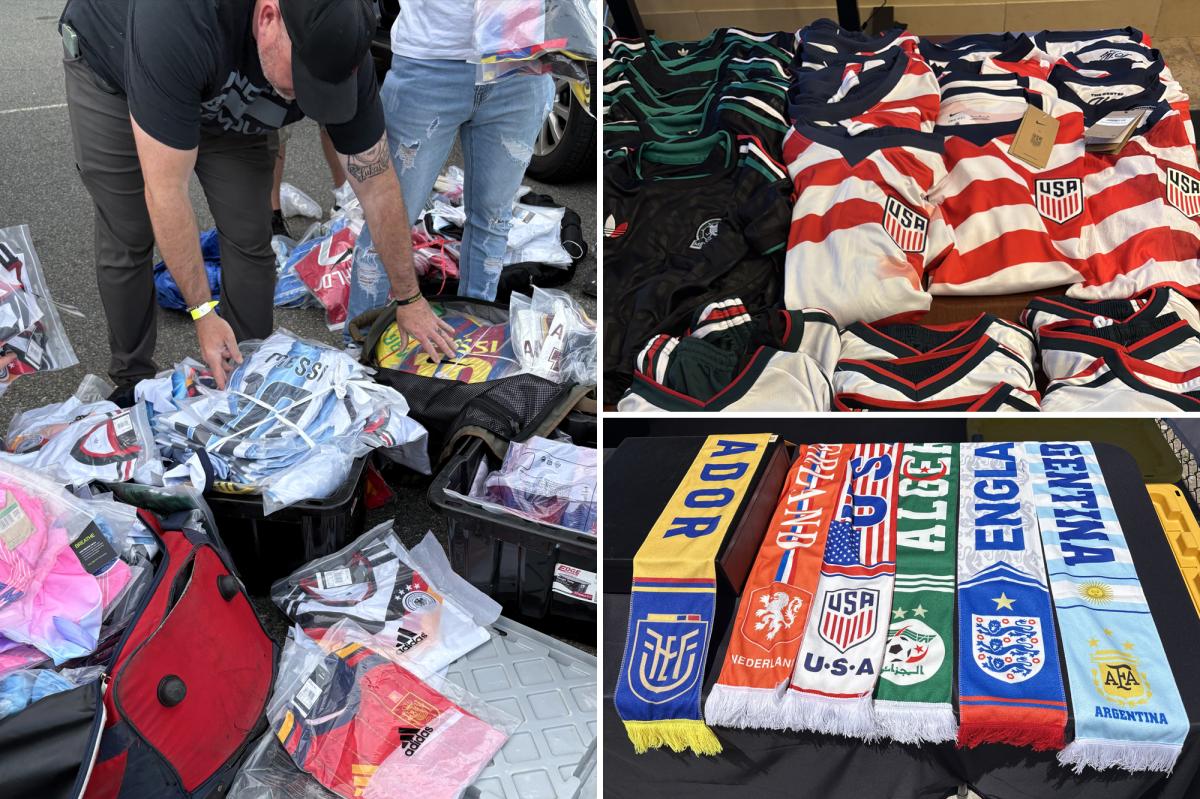
Department of Homeland Security agents aren’t just guarding the crowds at the World Cup final in New Jersey — they’re also on the hunt for a flood of fake Messi and Mbappé jerseys.
The agency’s investigators in Newark have seized 3,323 counterfeit jerseys worth an estimated $49,450 during the 39-day tourney and expect more before Sunday’s finale, which is expected to draw roughly 80,000 fans — including President Trump — into MetLife Stadium.
Officials tracking the phony goods expect those numbers to skyrocket in the final frenzied hours before Argentina takes on Spain.
“They’re shipping these jerseys where the teams are playing. They want to get the jerseys closest to the stadium,” Customs and Border Protection spokesman Michael Scappechio told The Post.
“We’ve got the finals here in our backyard here at MetLife (stadium). “We’re going to see a pickup.”
One recent Newark Liberty International Airport raid uncovered 1,100 fake kits packed inside an air cargo shipment.
Smugglers often conceal the knockoffs — typically manufactured in Asian countries — among unrelated cargo.
“Sometimes they just completely mischaracterize their shipments,” Scappechio said.
The agency made similar busts in Kansas City, where 4,000 counterfeits kits, valued at $550,000, were confiscated.
But that’s a drop in the bucket for a multi-billion market where official team jerseys complete with Nike or Puma labels and the latest wicking technology go for up to $185 apiece.
Photos reviewed by The Post show stacks of knockoff Lionel Messi jerseys after Argentina’s thrilling semifinal victory Wednesday over England, along with Mexico’s signature green kits.
Other snaps show suitcases packed with Cristiano Ronaldo jerseys prior to Spain eliminating Portugal on July 6.
The countries shipping the phony kits are the same ones, federal officials say, that flood US retail stores with name brand clothing: China, Hong Kong, Pakistan, India and Thailand.
Every fake jersey sold is money out of the pockets of manufacturers, teams, brands and player associations who split the revenue from legit sales.
Last year, ICE said authorities seized more than 276,000 counterfeit sports-related items worth over $33 million.
Officials say the biggest challenge remains stopping counterfeit merchandise before it reaches the thousands of street vendors who typically horde major sporting events.
Customs agents have been pursuing counterfeit and intellectual property crimes since CBP was created in 2003. They have been joined by ICE agents as well as Homeland Security Investigations agents. ICE and CBP received $75 billion in the One Big Beautiful Bill Act.
Read the full article here