




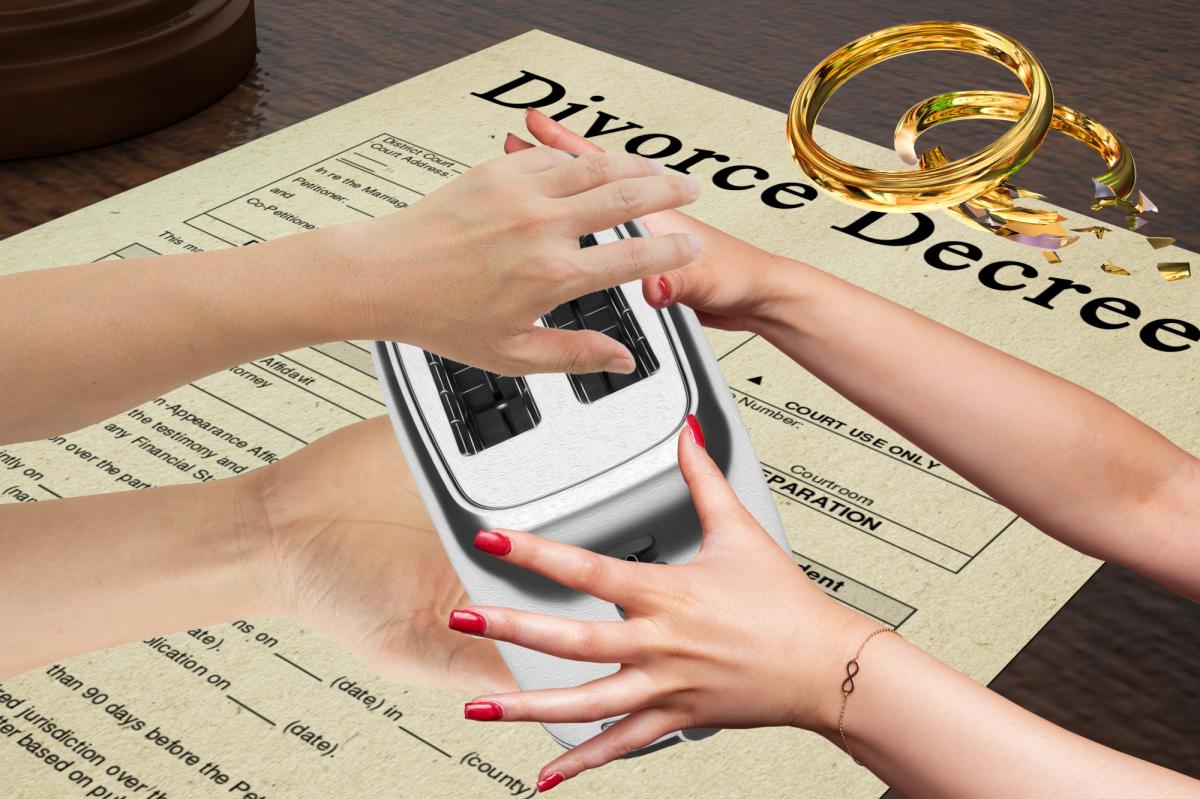
A $20 million divorce unraveled over a paltry $49 toaster oven.
In another case, a woman had a tanning bed moved out of her marital home and into her hotel room mid-divorce — to keep up appearances, obviously.
Then there was the man who tried to claim a couch. Not for comfort, but because it was where his wife had caught him cheating with his mistress.
These requests are not outliers; they are quite common. And divorce lawyers say the more insignificant and strange the ask, usually, the more emotional and contentious the split.
“The most common fights I see are over stupid, inexpensive items,” divorce attorney Paul Talbert told The Post. “Spouses will get into these knock-down, drag-out arguments over old mugs, pots and pans, cheap dining room tables, and couches worth next to nothing.”
While divorce remains a defining force in American life, more than 1.8 million people split in 2023 alone — attorneys say that many settlements become something else entirely.
A final battle for control, resentment, manipulation or revenge.
Hanging framed in the conference room of his New York office, a sign reminds divorce lawyer James Sexton’s clients, “It’s not about the pasta,” a reference to one of the most iconic lines in the Bravo-verse. In his practice, Sexton says that’s what divorce settlements boil down to.
“It’s very often not about pasta,” Sexton told The Post. “It’s about the thing under the thing.”
Trivial treasures
A yellowed sixth-grade yearbook that had been collecting dust in a filing cabinet became the focal point of heated letter exchanges after it “disappeared,” Sarah Jacobs, a New Jersey-based divorce attorney, told The Post.
Jacobs even recalled a client’s dispute over a “beloved wooden spoon,” allegedly a family heirloom — that no one used.
For some, the justification is practical — why buy something again? But, in reality, attorneys say, the disputes rarely involve money.
“At one point, we were debating the value of a half-full bottle of dish soap that was left under the kitchen sink,” divorce attorney Nicole Sodoma told The Post of a memorable case.
“I often find it’s not about the object — it’s about what it represents, or the outsized importance it takes on when your sense of fairness is being challenged.”
Lifestyle clashes
Sometimes the requests are about preserving a lifestyle that the marriage enabled.
Attorneys describe clients fighting to retain access to private jet memberships, airline points, or even country club bonds — perks tied to a lifestyle that, by definition, is ending.
In some cases, the fight becomes about shared spaces instead.
“I’ve had people include provisions that their ex can’t go to a certain restaurant ever again,” Sexton said. “It’s a place they used to go together — and the thinking is, ‘I don’t want to see you there if I still go.’”
Pets as pawns
In many divorces, pets become the central point of emotional warfare.
“I once had a multi-millionaire guy worth about $400 million in my conference room, look me in the eye, and he said, ‘The dog is the ball,’” said Sexton.
Other attorneys have seen similar dynamics play out. In one case, a couple spent more time testifying over the ownership of a small box turtle they found while camping than they did dividing the assets of their horses, which were worth over $1 million.
Brian Mayer, a family law attorney in California, told The Post of a settlement in which both parties would rather have custody of the golden retriever than their children.
That emotional weight has led to a rise in so-called “petnups” — agreements that determine animal custody arrangements before conflict escalates.
“Pets are no longer considered mere property,” said Debra Hamilton, a mediator and principal at Hamilton Law and Mediation PLLC. “They are family members, companions and emotional anchors.”
Control freakouts
Lawyers agree that most of these asks, albeit extreme, usually boil down to control. Or the last opportunity to inflict pain on a former partner, with requests ranging from banning an ex from certain social spaces to dictating future relationships.
“I’ve seen people try to impose restrictions on new dating partners, even requiring approval after a certain period of proving monogamous dating with that new partner,” said Sodoma.
Sexton has seen similarly extreme provisions.
“You’re never allowed to discuss me with your cousin, or you have to take down every photo of us from social media,” he said.
At times, the goal isn’t resolution — it’s disruption.
Duane Cocker, a family attorney in Washington, told The Post of a couple who fought over a $40 shelf from Walmart. It became the final sticking point in the divorce — not because of its value, but because, as he put it, one spouse “wasn’t done fighting.”
The other wanted it for a different reason: to burn it.
Why does it happen?
For people going through a split, sometimes the intention is simply to throw a grenade and watch what happens, and sometimes it’s simply about delaying the inevitable.
The behavior is actually not that surprising, some experts say. Divorce, particularly contentious ones, can be the last opportunity to exert leverage over someone who once mattered deeply.
“Relationships often end with the same passion they began,” said Sexton. “If you don’t have children together, then as soon as the papers are signed, this is over,” he adds.
‘Chump factor’
“I often see divorce negotiations become intensely focused on relatively small items or accounts that don’t materially affect the outcome,” said Katherine Miller, lawyer and author of “The Emotionally Savvy Divorce: Smart Negotiations for a Clean Break.”
She describes the phenomenon as the “chump factor” — the fear of looking like the one who got taken advantage of. Once that’s in play, people fixate on a specific item, not because of its value, but because of what giving it up seems to say.
From the outside, it looks irrational. In reality, it’s about recognition, identity, and not wanting to feel like the “one who lost.”
Read the full article here