




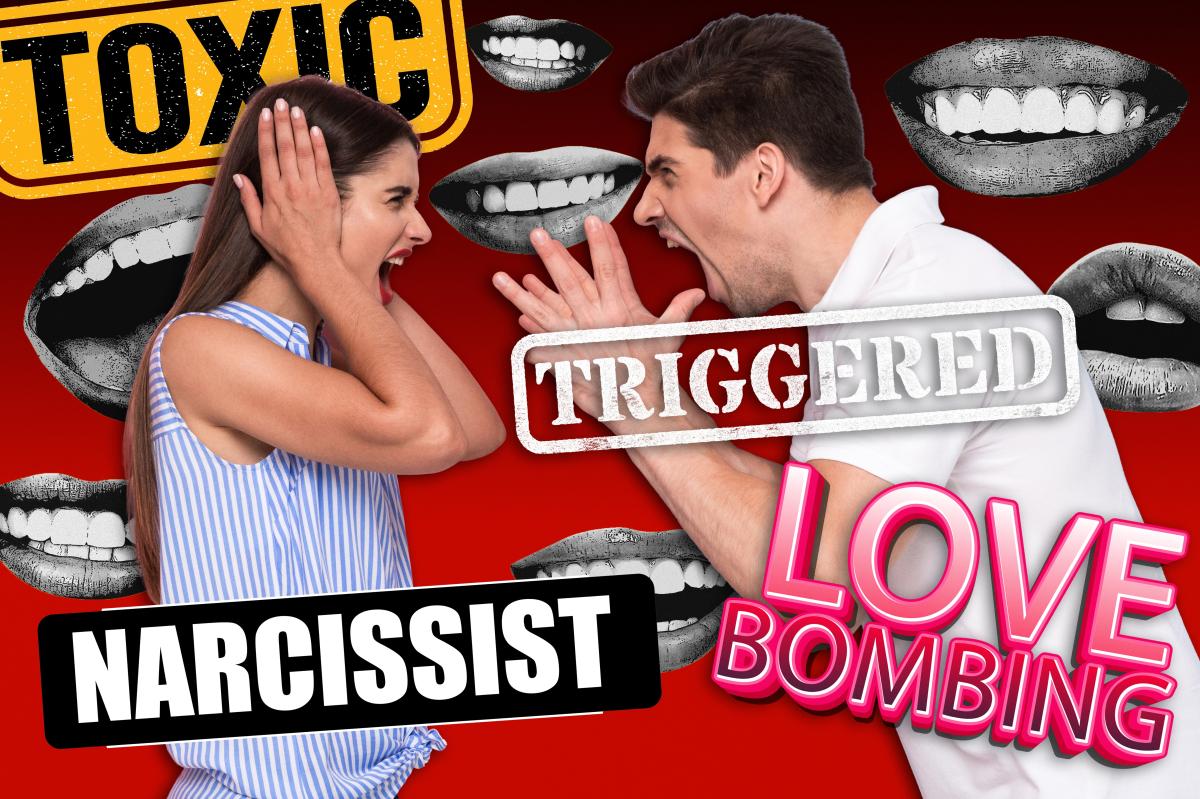
Going to therapy for your mental health is a great idea.
Using therapy talk in everyday conversations? Not so much.
Terms like “narcissist,” “love bomber,” “trigger,” and “gaslighting” that were once only used among the four walls of a shrink’s office have increasingly made their way into everyday conversation, flipping clinically-recognized diagnoses and concepts into catch-alls for unwarranted behavior.
Just because someone might show some signs of narcissistic behavior or turn something on the other person in conversation, doesn’t necessarily mean they’ve been diagnosed as a narcissist or are gaslighting.
The incorrect use, or even weaponization, of such terms in everyday life can be particularly harmful, especially in romantic relationships — a hurt that Curtis T., 24, knows all too well.
The Gen Z Brooklynite told The Post that he experienced “weaponized therapy-speak” when an ex branded him a sociopath, an informal term for someone with an antisocial personality disorder, for quickly moving on after the relationship ended.
He reassured The Post that he is the farthest thing from that.
Another former partner accused him of utilizing “the silent treatment,” a destructive form of emotional abuse, which the commerce writer explained was his attempt at processing the news that he had been cheated on. “It was two hours of me not responding, by the way,” he clarified to The Post.
Having been in therapy for years, Curtis finds the use of these watered-down terms “extremely infuriating,” as he sees it as a cop-out from taking actual accountability for one’s own actions.
Still, he admitted that he’s been guilty of misusing the phrases — citing an incident in which he wrongly blamed a friend for “gaslighting” him. He views the primary culprit behind this hyperbolic verbiage as its skyrocketing presence on social media.
“I 1000% see weaponizing therapy-speak as a trend on social media,” said Curtis. “By definition, the word ‘gaslighting’ means to invalidate someone’s experiences or feelings. However, now the word has morphed into meaning someone is wrong for simply disagreeing with you.”
Indeed, #gaslighting is latched onto almost 500,000 videos on TikTok, featuring posts with text overlay such as “Narcissists trying to gaslight you be like” and “GRWM: Gaslighting.” #Narcissist is associated with 2 million; #boundaries, 1.2 million; and #trigger with 317,000.
Dr. Isabelle Morley, a NYC clinical psychologist and couples therapist, told The Post that she sees the misuse and weaponization of therapeutic buzz-phrases “absolutely everywhere,” while carefully distinguishing between the two, as she sees the first as “people trying their best, but just getting the words wrong.”
Weaponization is a more serious, destructive matter — especially in romantic relationships.
“I see it all the time — where one partner blames the other for all of the relationship’s problems, thus not seeing or taking responsibility for their part,” said Morley, who authored the relationship guidebook “They’re Not Gaslighting You: Ditch the Therapy Speak and Stop Hunting for Red Flags.”
Morley explained that by pathologizing the other person, whether through amateur diagnosis or by putting up walls with misinformed talk of boundaries or triggers, one absolves oneself of responsibility in the relationship and gets to be the “wronged partner,” which she describes as “a position we’d all rather be in.”
“(This partner) is attempting to communicate something, and they think this word captures it,” Morley explained. “The problem is that the words themselves tend to push other people away because they feel accused and blamed, as opposed to being brought into empathy or understanding.”
Diana Burdette-Garcia, a California-based therapist, added that in her own sessions with clients — particularly couples’ sessions — it can be difficult to use these terms in their proper therapeutic context as pop culture continues to dilute their meaning.
To combat the issue, she told The Post that she makes it a priority to “get curious” as to why her client feels the urge to use these phrases towards their partners in the first place — and encourages them to do the same.
“I use it as a signal to pull on a thread — to dig deeper and find out where that defense started,” Burdette-Garcia said. “(As therapists), we get past the obstacles that are created by society, social media and people who are going out there using ‘therapy speak’ without really knowing what they’re doing or saying.”
To recognize when someone is using therapy speak, particularly in a lovers’ quarrel, Burdette-Garcia recommended using the phrase in a self-directed way first, as a temperature check for how well you actually understand and intend to use it.
“Before throwing out a term like ‘narcissist’, stop and say, ‘OK — this person is bringing up ‘narcissist’ for me,” said Burdette-Garcia. “‘What are the characteristics that fall under that term that I don’t resonate with?’ (You’re learning), ‘I don’t like when someone speaks over me,’ or “I don’t like when someone makes me feel like I’m attacking.’ You’re practicing self-awareness when you turn it inward.”
She also explained that a good rule of thumb is to be honest about intent when using therapy-speak, both in and outside a relationship.
“If you’re using therapy-talk, stop and evaluate to see how you’re using it,” she continued. “Is it against someone else? Is it to defend yourself? Because if it is, then you’re probably not using it right.”
Read the full article here