




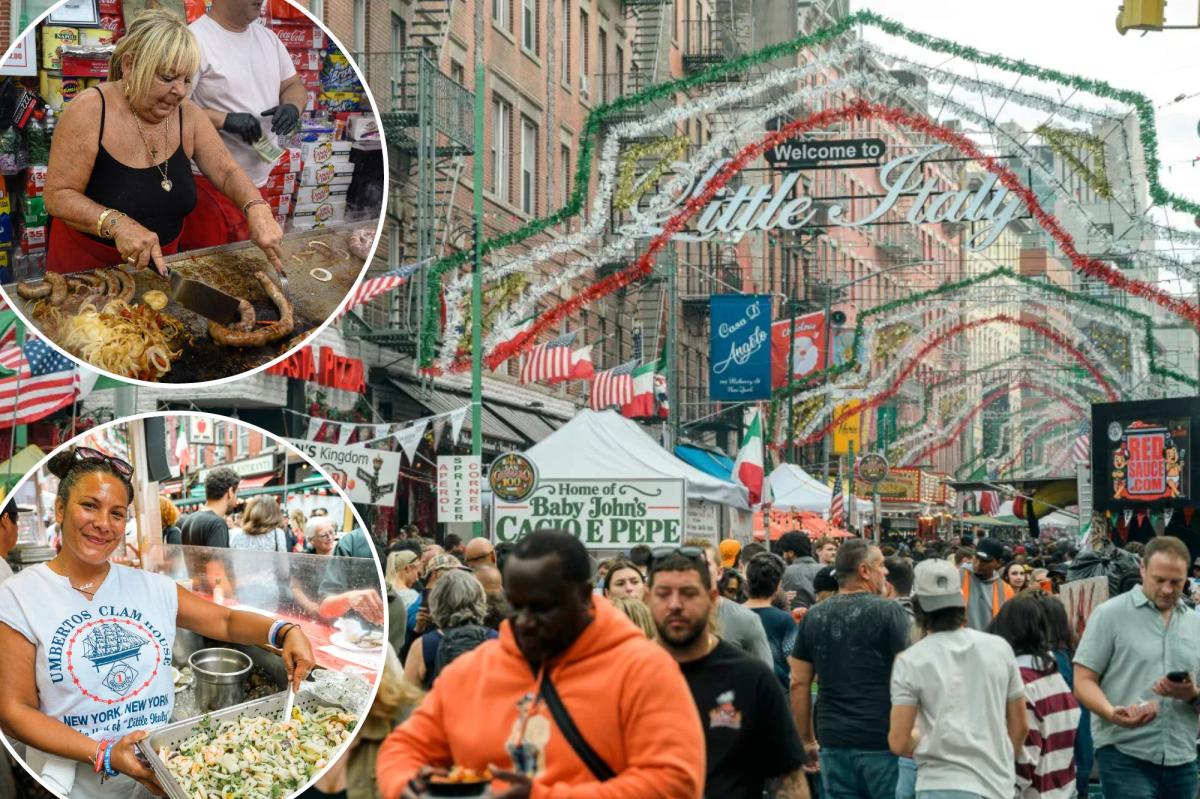
People wait all year for the Feast of San Gennaro. Vendors pay thousands of dollars for the chance to be there.
And then, almost overnight, Little Italy comes alive. Food stands spring up along 11 blocks, the smell of sausage and peppers fills the air, music spills into the streets and an estimated million people descend on the neighborhood.
That transformation can look effortless. It isn’t.
Months before the first cannoli is sold, organizers and vendors are already spending money, securing permits, arranging trucks and running power — building the beloved festival, which celebrates its 100th anniversary this year, one piece at a time.
“We start planning in November, and I can’t tell you how many meetings we’ve had with various agencies,” John Fratta, vice president of the Figli di San Gennaro organizers, told The Post.
The festival, which runs through Sunday, must comply with a web of regulations governing everything from gas and water to public safety.
“It’s absolutely nonstop,” said Fratta, whose great-grandfather, Luigi Vitale, was the first president of the organizing committee.
A large part of Fratta’s job is corralling and placing vendors, with applications pouring in for the festival’s milestone year. This year, 220 vendors make up the festival, including 75 cooking up everything from classic Italian dishes to sweet treats.
The rest hawk everything from crucifixes to T-shirts.
“This year we have a lot of new vendors, but many of them have been with us for decades,” said Fratta, who grants approvals as long as there’s space.
The aforementioned organizing committee institutes a seniority system, with some of the most veteran vendors getting prime spots on Mulberry Street near its intersection with Grand. The farther away from that corner, the less desirable the spot, or so the thinking goes.
The committee also spaces out similar vendors so they don’t cannibalize one another’s business. Vendors guard their turf, after all, especially when they’re trying to win customers and recoup what they shelled out to be there.
“People are still calling even though the festival has already started, but we only have so many slots,” explained Fratta. This year’s vendor count has already reached the maximum the Feast can accommodate, with some vendors traveling from as far as Boston and Philadelphia.
Setting up shop doesn’t come cheap: a 10-by-10-foot booth costs $2,350, while vendors shell out $4,000 for a 10-by-25-foot space.
And the costs keep piling up: vendors pay $400 for sanitation, plus a one-time electricity fee ranging from $460 to $700.
“It’s only gotten bigger and busier over the years,” Vinny Patuto, 81, the mastermind behind the longtime stand Cuzzin’ Vinny’s, told The Post.
“You are totally burnt out by the end of it,” he said of the intense process. “It really takes a toll on your body, diet and everything else.”
Patuto has been involved with the Feast since childhood, following in the footsteps of his father, who participated in the first Feast in 1926 shortly after immigrating from Foggia, Italy.
Preparation for this year’s revelry began in mid-July, when Patuto began sourcing everything from cuts of meat to peppers.
By the time the festival kicks off, Patuto’s days are as packed as his succulent sandwiches. It all starts at 4 a.m., when fresh bread is delivered to his home in Long Island City, Queens.
“I then load it onto my van at 4:30 a.m. and drive over to Little Italy to drop it off,” the 81-year-old explained.
From there, Patuto heads back to Long Island City to pick up his crew for the day — a multigenerational family affair, from sons and cousins to nephews and granddaughters, plus the boyfriends and girlfriends of the fam.
By 8 a.m., the head back to the Feast, which can be an adventure in itself. “Transportation and parking are always a pain in the neck.”
By 11 a.m., the group is in place and ready to sling signature items like juicy $21-a-pop braciole and $18 sausage-and-peppers sandwiches — two Cuzzin’ Vinny’s specialties.
Patuto can’t put a number on how many sandwiches his stand serves, but estimates it’s in the hundreds — enough to cover the stand’s costs and turn a bit of a profit.
The festival closes at midnight on weekends (and 11 p.m. on weekdays), but cleanup starts an hour earlier.
“We take inventory, soap everything down, scrape the grills, restock the sodas, and we’re out of here by 1 a.m.,” he explained.
By 1:30 a.m., Patuto and his clan are back home with barely any time to process the intensity of the day, only to do it all again mere hours later.
“By the end of the festival, we’re licking our wounds and apologizing to each other,” he said with a laugh. “‘Sorry I stepped on your toe,’ or, ‘Sorry I called you a so-and-so.’ Your conscience finally catches up with your intelligence.”
Chris Rianniello of Umberto’s Clam House, a Little Italy seafood staple since 1972, knows that hustle all too well.
“I’ve been working this festival since I was 13 years old and I’m 27 now,” he pointed out. “It means everything for me to be here, even though it’s a lot of work.”
While the Clam House’s physical restaurant on Mulberry Street does an ocean’s worth of business during the Feast, it also operates two festival stands just feet from its front door.
Rianniello, whose grandfather opened the Clam House, helps dole out $20 stuffed clams and $23 tender calamari — two of the stand’s biggest sellers.
“We flour and pre-fry the fish up the block, then bring it all here, chill it and fry it for another couple of minutes. Obviously, it’s all more difficult doing it all outside,” he explained.
That sentiment is shared by other local restaurateurs.
“We’re used to it, and we make it work,” said Nicky Criscitelli, owner of Da Nico’s Restaurant, which does a booming business during the festival while also selling pastries at a nearby stand.
“There’s no way I’m saying it’s easy, because it’s difficult. But I give my workers, servers and chefs a lot of credit. In this business, you’re not anything without them,” he said.
Visit Sicily NYC, a bakery and cafe located at 86 East 7th Street run by Sicily native and internet personality Nicolas Calia, is one of Gennaro’s newer stands on the block.
Calia applied earlier this year — and made the cut.
“As Italians from Italy, we knew we wanted to participate in its 100th anniversary and bring some authentic food we know from back home,” Calia told The Post. That food includes $15 panelle sandwiches, a classic Sicilian dish consisting of fried chickpea fritters and potato croquettes served on Italian bread.
“I’m the delivery guy, too, so I bring everything over by bike,” said Calia, who estimates he’ll sell around 300 sandwiches and 800 cannoli per day.
For Italians, the Feast is about more than what’s on the plate. It’s about tradition.
“What’s so unique about America is that you don’t have to give up your traditions and your faith when you immigrate here,” said Monsignor Jamie Gigantiello, who, alongside Monsignor David Cassato, serves as one of the Feast’s spiritual advisers, conducting the centerpiece Mass honoring the event’s namesake saint.
“You can assimilate into this country and still keep your traditions, which is what the Neapolitans did one hundred years ago.”
It’s that tradition that helps energize Little Italy, which is simultaneously undergoing a generational sea change.
“San Gennaro is part of what helps keep Little Italy alive,” said Andrew Cotto of the Italian F&B publication Appetito Magazine.
“Let’s not kid ourselves, it’s the feasts of all feasts,” actor and former Grand Marshal Steve Schirripa agreed. “There’s nothing like it in the country.”
Read the full article here