

One morning in October 2024, the writer Julie Summers received a call at her home in Oxford conveying astonishing news.
A boot containing the remains of a human foot had been found on the north flank of Mount Everest. A woolen sock tucked into the boot bore a white name tape, with red letters spelling out: A.C. IRVINE.
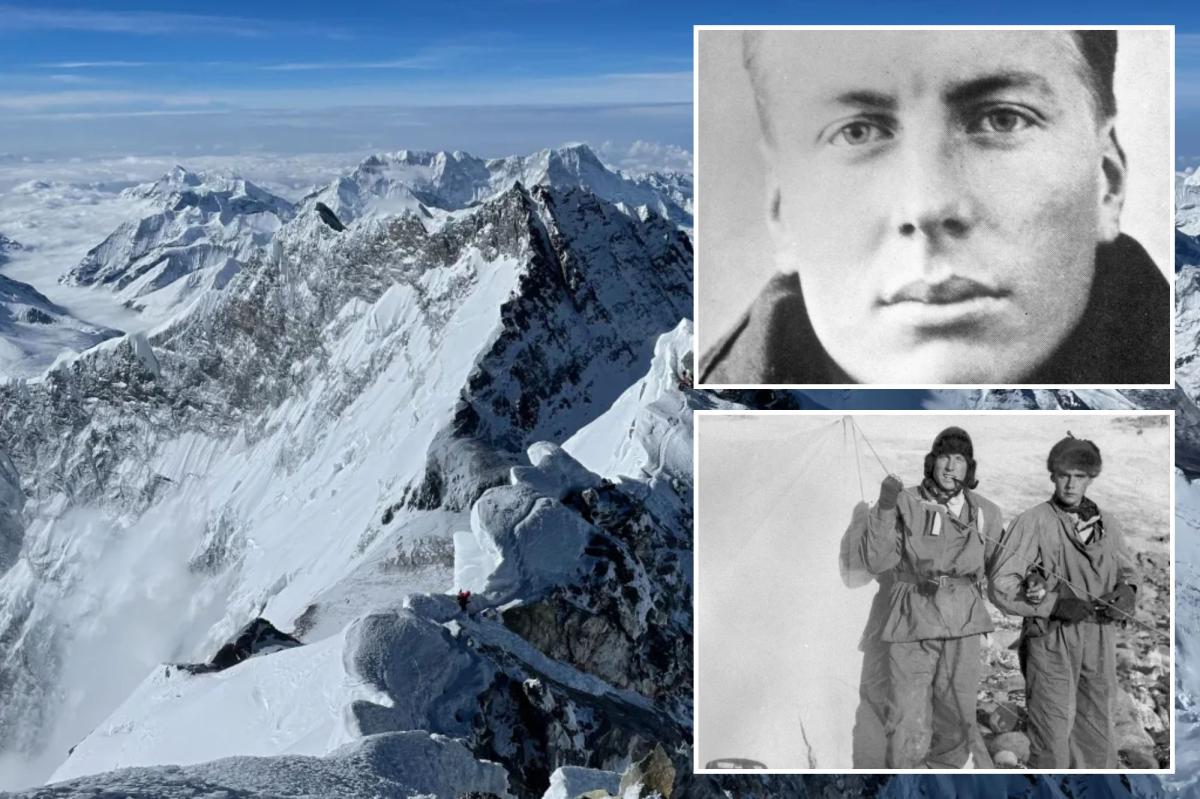
Andrew Comyn “Sandy” Irvine, a 22-year-old college student who accompanied British mountaineer George Mallory on his ill-fated attempt to summit Everest, had been lost for more than a century. Noel Odell, a fellow Everest expedition member, was the last person to glimpse him and Mallory — as two black spots far in the distance “going strongly for the top” along the mountain’s crenulated ridgeline on June 8, 1924.
When mist moved in, engulfing the pair, they vanished, never to be seen alive again. Only in 1999, when Mallory’s mummified body was located in Everest’s high-altitude “death zone,” 2,000 vertical feet below the peak, did investigators begin to piece together the valiant climbers’ fate.
No trace of Irvine had been found — until now.
For Summers, the grandniece of Irvine, and his biographer, (“Fearless on Everest: The Quest for Sandy Irvine” was published in 2000) learning of the find was “a shocking, extraordinary moment,” she told The Post. She soon felt the desire to revisit her great-uncle’s life story, and embed it in all that had been learned in recent years about the 1924 venture and its aftermath. She asked her friend Jochen Hemmleb — the author, climber, and mountaineering historian who had been part of the research expedition that located Mallory’s body — to collaborate with her. As befits its dual authorship, “The Everest Mystery: Sandy Irvine, George Mallory, and the Truth Still Buried on Everest” (St. Martin’s Press, Aug. 25) is two books in one.
In the first half, the writers draw a engaging portrait of Irvine, traditionally regarded as somewhat of an “also-ran” on the mission to be first to conquer the mountain. While Oxford undergraduate Irvine had scant climbing experience, Mallory, 16 years older, was already famous as an explorer and alpinist, a veteran of two previous trips to Everest.
Why did Mallory choose to make the final push to the summit with Irvine as his partner? By delving into Irvine’s short life and especially the impressions he made on his contemporaries, the authors of “The Everest Mystery” offer a compelling explanation. Not only was the younger man daring, intent, and vigorous — a star oarsman on the Oxford rowing team thanks to his physical stamina — Irvine could boast, too, of keen mechanical aptitude, crucial for coping with the expedition’s rickety oxygen apparatus.
While Mallory had initially regarded using supplemental oxygen while climbing as unsportsmanlike, after he failed to reach the top of Everest without it in 1922, he changed his mind. Still, the breathing system available in that era was cumbersome and heavy.
Landing in India in March 1924, the team of nine British mountaineers took a month to travel from Darjeeling to the base of Everest. The account of their trip is the most magical part of the book: The group trekked and rode ponies through spectacular scenery, with yaks to carry the equipment, and porters hired locally to guide them. During downtime on the road, Irvine managed to reconfigure the oxygen apparatus to be lighter and more reliable.
But for Irvine’s technical handiness, Odell, a geologist and seasoned climber might have been chosen to accompany Mallory for the climb’s final leg. Instead, he led the back-up team, and twice ventured high up the mountain looking for the pair after they disappeared. At their final camp he found evidence that Irvine continued to tinker with the oxygen equipment until the last minute. “Nothing would have amused him more — as it ever had . . . with such good results,” Odell commented.
No lack of oxygen doomed the pair. But likely a fall did. Mallory’s body was found face down on a slope of scree and ice with a badly broken leg, and a snapped rope tied around his rib cage, leading experts to believe he slipped or tripped, perhaps while traversing the mountain’s treacherous “Second Step,” a vertical rock wall just below the summit. As he fell, the rope tethering him to Irvine certainly broke, and the younger man, the authors write, likely ended up alone on the mountaintop “traumatized, exhausted and perhaps also injured,” eventually succumbing to the brutal cold.
In the second half of “The Everest Mystery” the authors explore this theory and alternatives, drawing upon Hemmleb’s years of detailed study of the 1924 expedition. The vital question remains: did the pair reach the top before they died? Were they, rather than Edmund Hillary and Tenzin Norgay in 1953, the first men to survey the world from the summit? It’s possible. Artifacts from their climb including an ice axe and an old crampon have been discovered near 28,000 feet. (The peak is 29,031 feet high.) A definitive answer would require photographic evidence — and both Mallory and Irvine planned to carry Vest Pocket Kodak cameras. But no camera was found on Mallory’s body.
The authors are also obligated to face the far more vexing questions of what Chinese climbers saw — and did — in the decades after Mallory and Irvine’s attempt. The Englishmen ascended Everest on the northern, Tibetan side of mountain, controlled by China since 1950 and mostly off limits to foreigners. Several Chinese teams have followed that same route to Everest’s peak, and the deputy leader of the first successful expedition, in 1960, allegedly saw the body of a Caucasian wearing vintage clothes high on the northeastern ridge. Members of a 1975 trip also reported spotting a corpse, this time laying on a snow terrace below where the ice axe was found, suggesting, later, when news of the sighting spread in the West, that Irvine had fallen to his death from that spot.
Official sources in China always denied these reports, and rumors spread that the Chinese had whisked Irvine’s body off the mountain, so as to secret away his camera and cover up the possibility that Irvine and Mallory, rather than Chinese climbers, were the first to summit on the northern side of the mountain. According to another rumor, the body was discarded, thrown down the mountain to remove it from the climbing route, which might explain why Irvine’s foot was found on the mountain’s Central Rongbuk Glacier more than 7,000 feet below Mallory’s body, and 1 ½ miles down from where Odell last spotted the pair ascending.
But nature could account for the boot’s positioning so low on Everest. When the rope tethering him to Mallory snapped Irvine may have been sent tumbling down to the glacier below, and time and the movement of the ice has carried his remains further down over the years. “We just don’t know if he was on the glacier the whole time, since 1924, or whether he was pushed or moved,” Summers told The Post. “I prefer to believe the first.”
A century on, Summers also prefers to celebrate what the gallant pair accomplished while alive, not fixate on the circumstances of their death. “It’s an extraordinary achievement to get as far as they did then,” she said.
Summers and Hemmleb, by allowing readers to follow along on what was a thrilling and audacious journey, do succeed with “The Everest Mystery” in bringing Mallory, and especially Irvine, to vivid life.
Read the full article here