



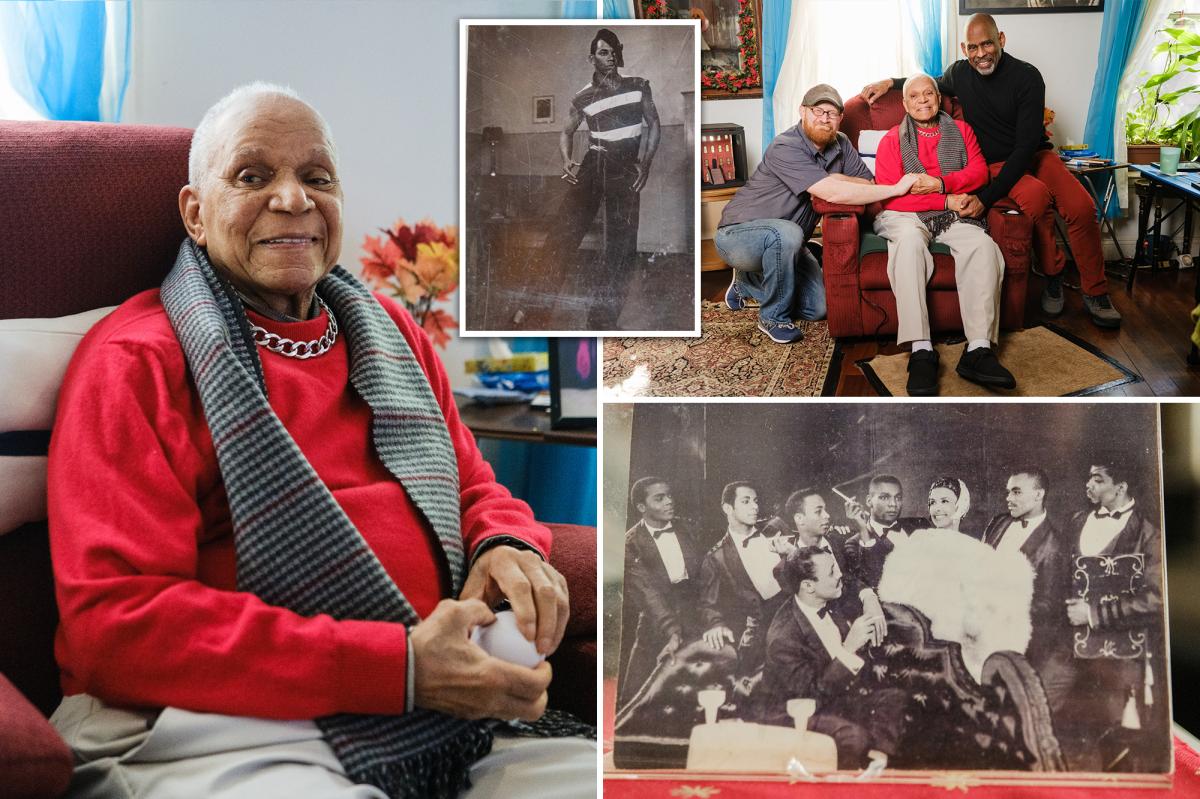
The local community is rallying around a Broadway icon and 95-year-old trailblazer who is at risk of losing the Hell’s Kitchen home he’s called his “sanctuary” for more than half a century.
Thousands of neighbors, former dance students and even strangers are rallying around Nat Horne — an original member of the Alvin Ailey American Dance Theater — who fears he won’t survive leaving his long-time Manhattan abode for a nursing home.
“I’ll probably die if they take me out,” Horne, who is celebrating his 96th birthday in December, told The Post.
“It’s my home.”
Horne has depleted most of his funds to pay for in-home care and has nothing left to continue paying for the care and his rent.
He has slowly been losing his memory since he was diagnosed with dementia in the spring of 2023, but needs to look no further than the walls of his living room to be reminded of the vibrant life he led.
His third-floor walk-up unit on 47th Street is covered in movie posters, souvenirs and awards, but mostly photographs of the stars he worked with and coached, including Laura BaCall, Lena Horne and Martin Sheen.
Despite the dementia, being legally blind and having recently undergone a hip replacement, Horne is vibrant and lucid, according to his former student and longtime friend Stanley Harrison, who visits the legendary dancer almost daily.
Horne even performs as a frequent guest on the Erin Lee and Friends channel — a YouTube show run by his neighbor and former student — and typically sings songs from the 12 Broadway shows he was crucial in bringing to life.
But even so, a fall in the middle of the night last spring made it clear Horne needs round-the-clock care, an exorbitant cost that has completely depleted the retirement savings he carefully built after decades of dancing and teaching.
By August, Harrison realized that Horne only had enough money to make it through December.
Luckily for Horne, his friends, neighbors, former students and even strangers are pouring in to help him bridge the gap, all unwilling to let the neighborhood staple lose the home that has served as his refuge since 1968.
“It’s his demeanor, his generosity, spirit and what he gave us,” said Harrison.
“When we were in class, he would say, ‘You are gods and goddesses. Hold your head high and lift your chest. You deserve to be special’ … That generosity is infectious.’”
They say it is their duty to give back to Horne, who they’ve dubbed “Mayor of 47th Street” for being a constant and friendly presence on his stoop in his later years.
Horne’s legacy in Big Apple show business is long and storied — and came on the heels of his groundbreaking stint as the first black member of the US Army’s entertainment branch, the Special Services.
After spending years lifting troops’ spirits abroad during fighting in the Korean War, Horne landed in New York City to pursue a career in entertainment.
He appeared in a host of Broadway shows over the years, was an original member of the Alvin Ailey American Dance Theater, worked on the “Sammy Davis Jr Show” and more.
In the 1970s, Horne established The Nat Horne School for Musical Theatre on 42nd Street — though his company shuttered after about a decade.
He even opened his Hell’s Kitchen home to students, whether they needed a place to lay their head or an extra hour of dance practice.
Harrison was one of them, paying just $100 per month in 1977 for a warm bed — roughly $555 in 2025 money.
Benjamin Magnuson, Horne’s archivist, credits the dancer for the life he leads today after receiving a scholarship for the Muse Machine, an arts education program for youth in Dayton, Ohio, that Horne established.
“He did that for many students every year. It’s not that I owe him a debt, it’s that I respect the idea of: it’s not a handout, it’s a handup,” said Magnuson, a Broadway star who has appeared in shows like Sweeney Todd.
While moving Horne into a nursing home or assisted living facility might seem like an option for other aging New Yorkers, Harrison and Magnuson fear it would usher in his death.
“This constant presence of humanity in space gives him energy and the willingness to continue. If he were in a home — Nat can’t see people’s facial expressions — he isolates himself from social situations,” Harrison explained.
“I think he would probably live a very isolated existence or a very lonely existence, and probably would die a lot sooner.”
The movement — taking donations through a GoFundMe campaign — has so far raised more than an incredible $30,000, a number his loved ones hope will grow to $100,00 — a price they say would account for a full year of rent, at-home care and medical costs.
Horne is aware of the GoFundMe and, while he is surprised that so many people are willing to contribute to his cause, he’s excited for what it could mean.
“This is my home. I love it. I think it’s a wonderful place to be. And I don’t want to leave, I’ll tell you that right now!” Horne said.
Read the full article here