



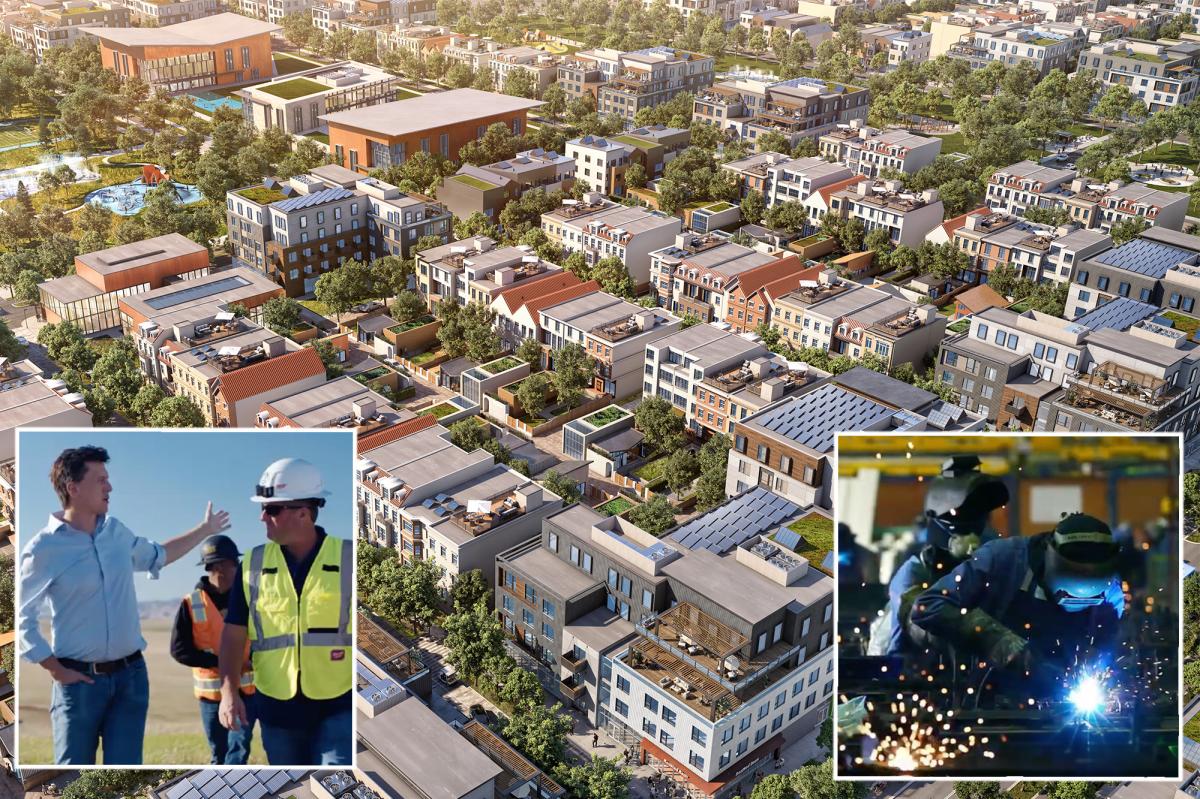
California Forever — a futuristic mega-project aimed at reviving American heavy industry — has tantalized its billionaire-backers while stirring questions over its ability to cut through the state’s notorious bureaucracy to deliver on the lofty vision.
The goal is to transform more than 50,000 acres in eastern Solano County into a sprawling economic hub between Sacramento and the Bay Area, bringing advanced manufacturing, defense jobs and hundreds of thousands of homes to a region long squeezed by California’s affordability crisis.
Supporters say the project is about far more than building another subdivision.
“I’ve dedicated the last decade of my life to the idea that Solano County can be the bridge between California’s past and its future and one of the most important places in America,” California Forever Founder and CEO Jan Sramek said.
“Manufacturing for the 21st century, shipbuilding to secure America’s freedom, home building and homeownership for the next generation of Californians, it can all happen right here in the next great American city,” Sramek said.
But despite the sky-high ambitions and land purchases of $1 billion, the project has yet to break ground and has been beset by classic California issues like mountains of bureaucracy, plodding legislation, political infighting as well as lawsuits and surly locals who are skeptical of the project.
Those hurdles took center stage Friday after defense contractor Saronic Technologies announced it would build its $3.2 billion “Port Alpha” autonomous shipyard in Brownsville, Texas, instead of Solano County — a project expected to create 10,000 jobs.
“Solano County was one of the great shipbuilding regions. This is the time when the United States is ready to invest in a new era of producing naval vessels and commercial vessels at scale and if we don’t move quickly, we’re gonna miss the opportunity,” Jim Wunderman, Head of Public Affairs, California Forever said.
California governor candidate Steve Hilton slammed state leaders over the news — calling Saronic’s departure a massive blow and called on the state to fix its anti-business stance before even more companies leave the Golden State.
“The project was driven out of California because of the same old story – the impossibility for businesses to deal with the bloat, bureaucracy, regulations and the anti-business attitude,” Hilton said.
The stakes are high for the state to help usher in the city being built from scratch – the project is backed by Flannery Associates, a company funded by a group of prominent Silicon Valley investors, including philanthropist Laurene Powell Jobs, former Sequoia Capital partner Michael Moritz, LinkedIn co-founder Reid Hoffman, venture-capital titan Marc Andreessen and the billionaire Collison brothers.
“I believe there is great opportunity here. There’s a lot of promise with our young people. There’s a lot of space and land that would be beautiful to build on and build a future on,” Jermaine Dowdell, NorCal Carpenters Union said about the project.
In an interview with The California Post, two of the project’s legislative allies said losing Saronic has supercharged their efforts to craft a bill that could streamline the bureaucratic and policy hurdles that led to Saronic’s departure.
“The Saronic decision was a disappointment, but it’s just the beginning of the opportunity, not the end,” said Darrell Steinberg, a former mayor of Sacramento and former Democratic state senator. “Their decision to go to Texas instead of California is a cautionary tale.”
Robert Hertzberg, a former Democratic majority leader in the state senate, said he has fielded calls from other shipbuilders interested in filling the void left by Saronic – provided the state can cut the red tape.
“We’ve talked to them and we’ve told them what we’re doing and they said ‘if you get this done, we’re coming’” Hertzberg said, referencing the bill he said is in the works.
California Forever first made headlines after the billionaire-backed effort quietly purchasing more than 50,000 acres of farmland surrounding Travis Air Force Base through Flannery Associates.
The clandestine buying spree stirred controversy before it was revealed that Jan Sramek, a Czech-born former Goldman Sachs trader, had spent years signing on investors and orchestrating the land buying campaign and intended to erect a new city.
The scope of the proposed city is enormous. Early concepts tout a community that could have 400,000 residents and hundreds of thousands of homes built over several decades alongside over 100 million square feet of commercial and industrial areas, planning documents show.
Proponents say the proposed city will help revive the Golden State’s hollowed out manufacturing sector and in the process create thousands of jobs. Those workers, California Forever says, will be able to live close to their jobs in an area where little urban development exists today.
“We believe that California can build great things once again,” the California Forever’s website states.
California Forever has sought to attract advanced manufacturing companies to create thousands of construction and permanent industrial jobs in sectors like chip manufacturing. It has proposed building a shipbuilding facility along the Sacramento River – restoring the region’s former glory days as a center for maritime manufacturing and defense-related industry.
Opponents like Former Fairfield Mayor Catherine “Cat” Moy, who for years was at the forefront of efforts to build the city, have argued California Forever is asking for special treatment from Sacramento for its development.
Moy said in an interview with The Post that California Forever has struggled to win support from local agricultural communities that worry about the project’s impact on farmers’ access to water.
Read the full article here