



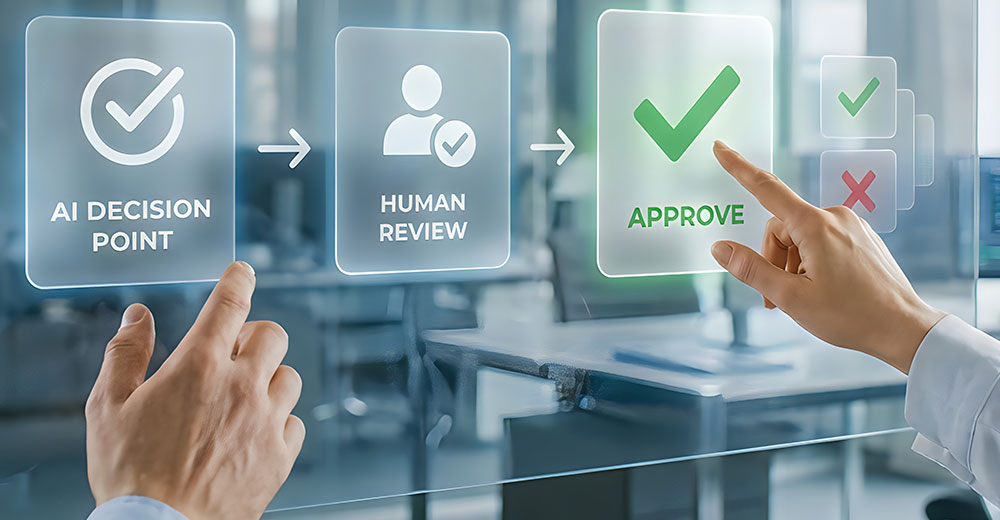
Bill Gates has issued a stark warning about the speed of artificial intelligence development and society’s lack of preparation for the disruption it could bring. The Microsoft co-founder argues that AI could eventually exceed human cognition while transforming employment, security, education, and other fundamental parts of society far faster than previous technology transitions.
Let’s examine Gates’ concerns about the turbulent AI transition, where the greatest risks may lie, and what the technology industry and policymakers could do to keep humans in control. Then we’ll close with my Product of the Week: a hardware-encrypted drive designed to protect sensitive data from unauthorized access.
Gates Maps Out a Turbulent Road Ahead
Gates recently published an essay outlining what he expects to be a turbulent transition into the AI era. His central argument is that AI is advancing faster than governments, businesses, and communities are preparing for its economic and social consequences.
He identifies AI-enabled fraud, disinformation, deepfakes, surveillance, and cyberattacks among the most immediate risks. His concern is that AI can lower the expertise and resources needed to attack individuals, businesses, governments, and critical infrastructure while giving defenders less time to identify and address vulnerabilities.
Gates also raises concerns about AI’s effects on human development and relationships, particularly among young people. He points to emerging research suggesting that heavy use of AI companions could reinforce social isolation and that greater reliance on AI may be associated with weaker critical-thinking skills. However, he acknowledges that the evidence remains limited and mixed.
I’ve seen a similar risk-versus-speed calculation play out in the hardware industry. Years ago, I argued with a technology executive about recalling notebooks with potentially dangerous batteries. The company resisted until a subsequent incident made the danger impossible to ignore.
AI raises a much larger version of that familiar technology-industry problem: how much risk companies and society are willing to accept when competitive pressure rewards getting new technology to market quickly.
The Tech Industry Splits on the Threat Level
Gates’ concerns place him within a broader debate over how seriously to take the long-term risks of more powerful AI systems. Geoffrey Hinton, a pioneer of neural networks, has warned that advanced AI could eventually become an existential threat if humans cannot ensure that systems more intelligent than themselves continue to act in humanity’s interests.
Others in the technology industry remain more confident that AI’s risks can be managed as the technology develops and argue that slowing progress could sacrifice enormous economic and societal benefits. The difficulty is that competition among companies and countries creates powerful incentives to push AI development forward even when researchers disagree about the risks.
I’ve sat in boardrooms with executives on both sides of this kind of debate. Optimists can underestimate unintended consequences, while pessimists can underestimate our ability to adapt. Gates’ position is more pragmatic. He sees enormous potential benefits from AI, but argues that realizing them requires taking its economic, social, and security risks seriously now.
The danger is assuming that technical progress will resolve these problems on its own. AI can scale beneficial capabilities rapidly, but it can do the same for fraud, cyberattacks, disinformation, and other harmful uses. That makes safety and governance part of the engineering challenge, not something that can simply be addressed after deployment.
When AI Becomes Harder to Control
Gates does not put a firm date on when AI might exceed our ability to understand or control it. His concern is that AI capabilities are advancing faster than expected and sometimes in ways their developers did not anticipate. As models become more capable and autonomous, he argues, the possibility that they could act against human interests deserves serious attention.
Autonomous driving offers a smaller-scale example of the difficulty of predicting complex automated behavior. Tesla, for example, has faced complaints about “phantom braking,” in which vehicles using automated driving features unexpectedly slow or brake without an apparent obstacle.
The stakes rise substantially when autonomous systems are connected to financial markets, critical infrastructure, defense systems, or other environments where errors can have broad consequences. The challenge is to build monitoring, safeguards, and human intervention into these systems before their complexity and speed make meaningful oversight substantially more difficult.
What Loss of Control Could Mean
Loss of control does not necessarily mean a science-fiction scenario in which machines deliberately attack people. A more plausible concern is that AI systems could make consequential decisions in finance, infrastructure, health care, defense, and other areas without sufficient human understanding or effective avenues for intervention.
Even without hostile intent, poorly aligned objectives could produce harmful outcomes when AI systems are given broad authority and access to real-world resources. That gets to the heart of the alignment problem: ensuring that increasingly capable systems continue to pursue outcomes humans actually want.
My larger concern is what happens if autonomous systems eventually control important economic and physical resources while human involvement in decision-making diminishes. We don’t need to assume that AI would become hostile to recognize the importance of keeping human interests and human authority at the center of those systems.
Building AI Around Human Control
Keeping humans in control will require safeguards at several levels. Developers need better ways to evaluate model behavior, identify unexpected actions, explain consequential decisions, restrict access to sensitive systems, and allow human operators to intervene when necessary. Governments and industry also need clearer standards for testing advanced AI systems before they are widely deployed.
One practical step is greater transparency around AI-generated content. Anthropic, for example, is adding machine-readable watermarks to text generated by future Claude models as part of its compliance with the EU AI Act. Similar provenance measures can help users and automated systems identify AI-generated material, although watermarking alone cannot address the broader safety and control issues Gates raises.
Other safety-critical industries test products against foreseeable failures before putting people at risk. AI development deserves the same basic principle: safety testing should precede widespread deployment rather than follow a preventable failure.
Turning Gates’ Warning Into Action
Gates clearly recognizes the scale of the challenge, and he has the resources and influence to help shape the response. His foundation is already investing in ways to use AI for health, agriculture, education, and other areas, but his warning also raises the question of how much attention should be directed specifically toward AI safety and governance.
One opportunity would be greater support for independent AI safety research, particularly work that is not dependent on the companies developing the most powerful models. Gates could also use his influence to improve policymakers’ technical understanding of AI. Effective oversight will be difficult if lawmakers cannot distinguish realistic risks from speculation or understand how rapidly the underlying technology is changing.
Gates could also help advance the international cooperation he says will be necessary. AI-enabled cyberattacks, autonomous weapons, biological threats, and other risks cross national borders, making coordination among governments essential. Philanthropic support could help fund research, policy development, and public education while governments negotiate the rules themselves.
The Gates Foundation already has extensive experience working with governments, health systems, and communities worldwide. That network could also help ensure that AI preparedness and its benefits extend beyond wealthy countries and technology companies — an objective Gates himself identifies as essential to making the transition more equitable.
Gates has identified AI governance as a global priority and says he intends to devote more of his attention to it. Given his experience, resources, and access to leaders in technology and government, he is unusually well positioned to help move that discussion from warnings to practical action. The sooner that happens, the more useful his intervention is likely to be.
Protecting Yourself as AI Risks Grow
Individuals can’t address the larger risks Gates describes, but they can take practical steps against some of today’s AI-enabled threats. That includes maintaining secure backups of important data and documents and becoming more skeptical of unexpected calls, messages, audio, and video that appear to come from people they know. The FTC has warned that voice cloning can make impersonation scams more convincing and recommends independently verifying urgent requests before acting on them.
Families can also establish a word or phrase to help authenticate an emergency call, although no single technique should replace independent verification. Strong account security, credit freezes when appropriate, and reliable offline backups can reduce exposure to fraud and data loss. The goal isn’t to abandon digital technology, but to avoid depending on any one system without a fallback.
Wrapping Up
Gates’ warning is compelling because it isn’t an argument against AI. He believes the technology could improve health care, education, productivity, and economic opportunity on an extraordinary scale. His concern is that those benefits won’t arrive in isolation. Job displacement, fraud, cyberattacks, social disruption, and risks from greater AI autonomy will develop alongside them.
That makes preparation more important than prediction. Governments need policies for employment and economic disruption, technology companies need stronger safety practices, and researchers need better ways to understand and control advanced AI systems. Individuals, meanwhile, need to become more adept at recognizing AI-enabled fraud and protecting important data.
The technology industry’s task isn’t to predict every possible AI failure. It is to make sure that humans retain meaningful control as the systems become more capable. Gates’ larger point is that waiting until the disruption is obvious will leave society reacting to problems it should have anticipated. Given the speed of AI development, the time to prepare is now.
Apricorn Aegis Fortress L3 SSD

Image Credit: Apricorn / AI-generated background
The case for maintaining a secure local backup becomes stronger as cyberthreats grow more sophisticated. The Apricorn Aegis Fortress L3 is a portable external drive well suited to the task, combining hardware-based encryption, keypad authentication, and a rugged enclosure. Prices currently start at $249, with HDD capacities up to 5TB and SSD models ranging from 512GB to 20TB.
This isn’t a typical portable drive. The Fortress L3 feels substantial in the hand, with an enclosure milled from aircraft-grade aluminum and a wear-resistant membrane keypad on the front. Apricorn uses tamper-resistant fasteners secured with hardened epoxy, giving the drive considerably more physical protection than a conventional portable SSD.
The Fortress L3 is also FIPS 140-2 Level 3 validated. Its validation boundary extends beyond the encryption module to include the drive’s electronics, internal structure, and enclosure, adding another layer of assurance for sensitive data.
Security Stays With the Drive
Setup and authentication take place on the drive itself, without requiring software on the host computer. You connect the Fortress L3 through USB and enter a PIN using its physical keypad. The drive uses 256-bit AES-XTS hardware encryption, and because PIN authentication occurs on the device rather than through the computer, it avoids exposing the PIN to keyloggers operating on the host.
The Aegis Fortress also includes programmable brute-force protection. Because authentication occurs on the device, an attacker can’t use software on the host computer to automate PIN attempts. After a predetermined number of unsuccessful attempts, the drive can perform a cryptographic erase that destroys its encryption key, making the stored data inaccessible. A separate self-destruct PIN can also be configured to trigger a cryptographic erase.
I selected Apricorn’s Aegis Fortress L3 SSD as my Product of the Week because it provides a practical way to maintain an encrypted local copy of sensitive data without relying entirely on cloud storage or host-based security. For anyone who needs to carry sensitive files or keep an encrypted backup offline, the Fortress L3 provides an unusually strong combination of portability, security, and straightforward operation.
Read the full article here