



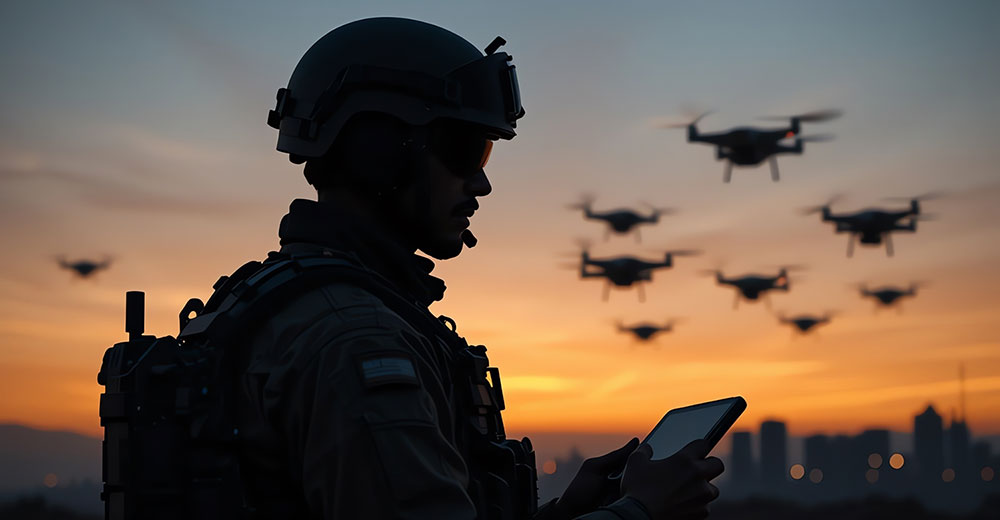
As pervasive computing and specialized hardware become commonplace, the intersection of military technology and artificial intelligence has become a critical issue.
This is no longer science fiction but an engineering reality that threatens to fundamentally alter warfare. Recently, there has been an international push to regulate and prohibit lethal autonomous weapons. The United Nations Secretary-General has advocated for an international law prohibiting machines capable of selecting and engaging targets without human control.
While the moral imperative behind this initiative is entirely understandable, the realities of modern warfare and the nature of software development suggest otherwise. Banning technology that consists largely of algorithmic code and standard microprocessors is an exercise in futility.
Instead of attempting to outlaw the inevitable, the global defense community must focus on building stronger AI defenses to protect against rogue autonomous threats.
Let’s talk about killer robots (I swear too many people watched Terminator and said, “That looks fun, let’s make a killer robot!”). As always, we’ll close with my Product of the Week, the Google Pixel Watch 4, which I just picked up and love.
The Fear of Autonomous Killing Machines
There is a sound, terrifying basis for why human rights organizations, AI safety advocates, and global leaders want to ban these weapons. When we talk about “killer robots,” we are not discussing humanoid terminators wandering a battlefield; we’re talking about autonomous soldiers, main battle tanks, deep-sea submarines, stealth warships, and hypersonic aircraft that operate without humans in the decision loop.
The core problem with granting a machine the authority to take a human life is the lack of human empathy, ethical context, and situational judgment.
An autonomous tank programmed to eliminate enemy combatants cannot reliably distinguish between a heavily armed insurgent and a civilian carrying a harmless piece of agricultural equipment that resembles a weapon.
Autonomous submarines operating in contested waters could interpret a civilian research vessel’s sonar ping as a hostile act and deploy torpedoes automatically, escalating localized conflicts into major international incidents.
Autonomous aircraft and drone swarms operate at processing speeds far beyond human cognitive limits. If an AI system misidentifies a target, it executes the strike before any human overseer can intervene. The cascading errors of flawed neural networks, biased training data, or enemy sensor spoofing could lead to indiscriminate slaughter.
The UN’s concerns are justified; releasing unthinking, feelingless machines to hunt and kill removes the final, crucial barrier to the horrors of war: human conscience.
Battlefield Reality and the Ukraine-Russia Proving Ground
Despite the valid moral objections, the military incentives to deploy autonomous weapons are too great for warring nations to ignore. We are already seeing these systems prove themselves in the brutal conflict between Ukraine and Russia, which has transformed into a real-time proving ground for next-generation combat technology.
In this war, electronic warfare and signal jamming are ubiquitous. Traditional remotely piloted drones often lose contact with their operators, resulting in high attrition rates.
To counter this, both sides have increasingly turned to autonomous targeting systems. Drones are now being programmed with machine vision algorithms that allow them to identify a Russian tank or a Ukrainian artillery piece, lock onto it, and execute a strike autonomously, even in a jammed electronic environment where radio control is severed.
The tactical advantages are undeniable. Autonomous drone swarms can overwhelm traditional air defense systems through coordinated maneuvers that human pilots could never replicate. They do not sleep, experience fear, or suffer from the fatigue that plagues human soldiers.
For military commanders facing heavily fortified positions and staggering troop losses, the allure of deploying an autonomous warship or a robotic infantry unit is irresistible. They save the lives of their own personnel while maximizing lethality against the enemy. This proven effectiveness makes it highly likely that major military powers will continue to refine and scale this technology, regardless of what treaties are signed in Geneva.
The Mixed History of Global Weapons Bans
To understand why a ban on killer robots will fail, we must examine the history of global weapons ban treaties. History shows us that bans only succeed under very specific conditions, and they fail miserably when those conditions are unmet.
The most successful disarmament effort in recent history is arguably the 1997 Mine Ban Treaty. This initiative successfully prohibited the use, stockpiling, and production of anti-personnel landmines. It worked because landmines are physical, easily identifiable objects that are universally reviled for killing civilians long after a conflict ends.
The global stigma was immense, the humanitarian disaster was highly visible, and most advanced militaries had already determined that stationary landmines were of limited tactical use in modern, highly mobile warfare. It is easy to ban a weapon you no longer need.
Conversely, efforts to ban technologies that offer a decisive strategic advantage have consistently faltered. Treaties attempting to curb the proliferation of nuclear weapons have only been partially successful; rogue states continually flout them because the strategic deterrent of a nuclear arsenal outweighs the diplomatic penalties.
Similarly, early 20th-century attempts to ban aerial bombardment or submarine warfare collapsed the moment major global conflicts erupted, because the warring parties could not afford to abandon the tactical high ground. Autonomous weapons fall squarely into this latter category. They offer far too much of an advantage for any nation to genuinely abandon them on the battlefield.
Why an AI Weapons Ban Can’t Be Enforced
Even if every nation publicly agreed to the UN’s proposed ban tomorrow, enforcing it would be a logistical impossibility. Unlike biological weapons, chemical gas, or nuclear warheads — which require massive, highly visible industrial infrastructure to produce — autonomous weapons rely on two hard-to-detect components: data and processing power.
The very same neural processing units and edge-computing chips that power enterprise data centers, self-driving cars, and localized large language models can be repurposed to guide a lethal drone swarm. The code required to make a weapon autonomous is just software. It can be developed on standard laptops, stored on encrypted flash drives, and uploaded to a drone seconds before deployment.
Furthermore, the line between a “smart weapon” and an “autonomous weapon” is blurred, and processing power is already required for conventional smart weapons. Modern militaries rely heavily on smart missiles that use radar and infrared sensors to track and destroy targets after being fired.
Defining exactly where human control ends and AI autonomy begins in these systems is a legal nightmare. A country could easily claim its advanced combat drone has a “human in the loop,” while the software is designed to make lethal decisions independently if the command link drops.
Because this technology is easily hidden and inherently dual-use, rogue nations and superpowers alike will violate the ban in secret, creating a dangerous asymmetry where rule-followers are left defenseless against those who cheat.
The Case for AI Defenses
Because an international ban is unenforceable and nations will inevitably develop these weapons in the shadows, advocating for prohibition is a dangerous distraction. Instead, the global community — specifically the technology and defense sectors — must engage in a well-funded effort to develop better AI-enabled defensive weapons.
If we accept that autonomous killer robots are an inescapable reality in future warfare, our only logical recourse is to build faster, smarter, and more capable AI systems to neutralize them. We need:
- Defensive drone swarms that can autonomously intercept and destroy offensive swarms before they reach civilian populations.
- Advanced cybersecurity platforms capable of hacking, disabling, or misdirecting enemy autonomous tanks and submarines in real time.
- Sophisticated electromagnetic warfare systems controlled by neural networks that can instantly adapt to and disable incoming autonomous aircraft.
Relying on a piece of paper to protect the world from the most significant leap in military technology since the splitting of the atom is naive. Countries will publicly agree to the ban to save face and project morality, while privately funneling billions into black-budget autonomous programs. The only true deterrent to a devastating autonomous strike is a demonstrably superior autonomous defense.
Wrapping Up
The United Nations Secretary-General is right to be horrified by the prospect of killer robots. The ethical implications of removing humanity from the kill chain are staggering and mark a dark new chapter in human history.
However, technology cannot be uninvented, and the decisive battlefield advantages demonstrated in conflicts such as the war in Ukraine ensure that autonomous weapons are here to stay. Because the underlying technology — computing power and AI software — is easily concealed and built on the same hardware and software found in consumer devices, any ban will be impossible to enforce.
Rather than wasting precious time on a doomed prohibition effort, we must focus our resources on building robust, AI-driven defensive networks to ensure that when these autonomous weapons are unleashed, we have the technological supremacy to stop them.
Google Pixel Watch 4

Image Credit: Google
I am constantly evaluating the latest wearable hardware, and recently decided it was time to upgrade my smartwatch. I was so sick of the battery life in the Pixel Watch 2 that I felt I needed to swap early, so I officially retired it and moved to the new Google Pixel Watch 4. Let me tell you, the jump is substantial and represents the maturity this platform desperately needed.
Right out of the box, the benefits of the Pixel Watch 4 were glaringly obvious. The most critical improvement is the battery endurance. The 45mm model now boasts up to 40 hours of battery life with the always-on display enabled, finally freeing me from the anxiety of the watch dying during an evening event or a long travel day. When it does need juice, the faster charging — thanks to a redesigned side-mounted charging dock — is fantastic, delivering 50% in just 15 minutes.
This watch features a much more complete sensor suite, including advanced skin temperature tracking and continuous electrodermal activity (cEDA) sensors for precise stress and health monitoring.
Another welcome upgrade for me is the size options. Going from a 41mm case on my old watch to the new 45mm option on the Pixel Watch 4 was incredibly helpful given my aging eyes. The new domed Actua 360 display on the 45mm watch delivers significantly more active screen area with 15% smaller bezels. For the first time, notifications, texts, and fitness stats are instantly readable without having to squint or bring the watch uncomfortably close to my face.
Beyond battery life, charging speed, and display size, the Pixel Watch 4 runs on an efficient Snapdragon W5 Gen 2 chip, making the UI incredibly snappy. While the Watch 2 was a solid effort, it felt like a stepping stone. The Watch 4 feels like a finished, premium device.
Should You Upgrade?
When comparing the Pixel Watch 4 to its main competitors — like the Apple Watch Series 10 or the Samsung Galaxy Watch 7 — Google has finally closed the gap. It matches Apple’s fluid software integration and beats it on rapid charging, while offering a more elegant circular aesthetic than Samsung’s current lineup.
With the Pixel Watch 5 likely less than a year away, some buyers may wonder whether to wait. Rumors point to a micro-LED display and possibly non-invasive blood glucose monitoring.
Should you wait?
If your current smartwatch is getting you through a full 24 hours without a sweat, you can safely hold off. But if you are constantly fighting a dead battery and squinting at a tiny screen on an older-generation device, the upgrade is entirely justified right now.
Because it transforms a frustrating smartwatch experience into a reliable, highly readable daily companion, the Google Pixel Watch 4 is my Product of the Week.
Read the full article here