




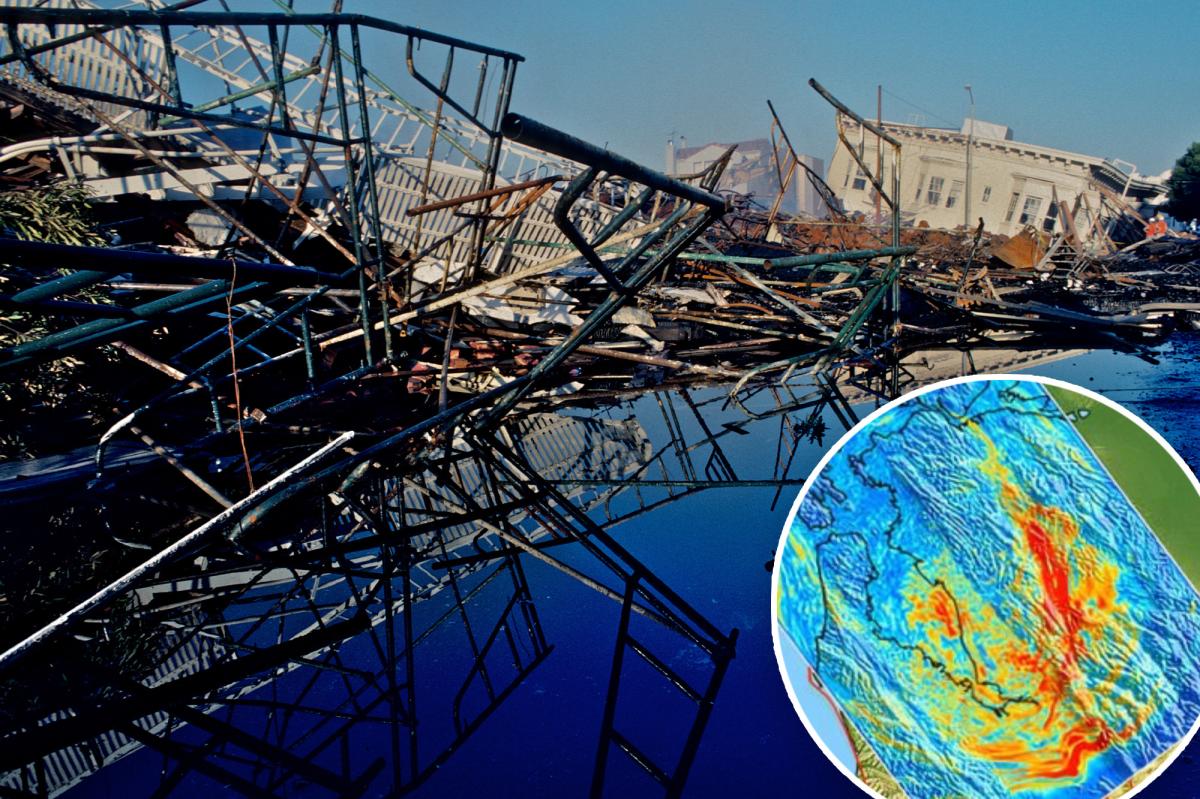
This has scientists quaking in their boots.
Researchers have found that one of the US’s most dangerous fault lines is overdue for an earthquake, potentially threatening millions of people across California, per an alarming study in the journal Seismological Research Letters.
This terrifying tremor could “cause extensive damage to such a dense population zone,” wrote the team from the Lawrence Livermore National Laboratory (LLNL) and Lawrence Berkeley National Laboratory (LBNL), in a statement.
Part of the massive San Andreas Fault Line, the Hayward Fault Line extends 74 miles through major Bay Area hubs, including Berkeley, Oakland and Fremont, an area that’s collectively home to around 8 million people.
This fault is of particular concern as it regularly generates magnitude 7 Earthquakes — more powerful than the 1989 Loma Prieta quake that killed 63 people and injured 3,757 in the Bay Area.
If one of these earthquakes were to occur today, it could potentially kill 800 people and injure up to 18,000, per a previous US Geological Survey report called the “HayWired Scenario.”
While the last event to occur was in 1868, scientists have calculated that Hayward ruptures every 95 to 183 years, meaning we’re overdue for a seismic event.
According to the U.S. Geological Survey, Hayward has a 14.3% chance of a 6.7 magnitude or larger seismic event by 2034 and a 33% chance before 2043, making Hayward one of the most hazardous fault lines in the region.
“This fault is what we sort of call a tectonic time bomb,” USGS earthquake geologist emeritus David Schwartz told the Los Angeles Times in 2018. “It’s just waiting to go off.”
To analyze just how dangerous this tremor factory is, the researchers used 3D simulations to examine 50 magnitude-7 simulations along the Hayward Fault, providing Californians insight into how they should prepare.
“We are interested in learning what the ground motion for a typical magnitude-7 earthquake in the Bay Area could be, so that we can work with engineers to make sure that the infrastructure and buildings in the Bay Area can withstand this motion,” said author and LLNL scientist Arben Pitarka.
The team, which was helming the project for the Department of Energy, focused on two key models: a simulation of how seismic waves are created during the earthquake rupture and broadcast seismic vibrations through the Earth.
“These large-scale simulations allow us to reduce the uncertainty in ground motion estimates” that are associated with the oft-unpredictable earthquake rupture phenomenon, per Pitarka. The models also allowed the team to pinpoint areas vulnerable to “very strong shaking” in the San Francisco Bay Area.
These models revealed that the shaking generated during of these simulated tremors could be up to 50 percent more powerful than prior forecasts for nearby population centers. Affected hubs included Livermore, Oakland, Berkeley, Hayward, San Leandro, Emeryville and Alameda.
Caused by the pulse-like nature of the ground motion, which concentrates the seismic energy like a lens, this preternaturally violent shaking poses an outsized threat to tall or flexible buildings.
Per the current would also potentially impact the deep “basin” areas in California, which would likely trap and magnify an Earthquakes waves, upping the length and power of the reverberations.
Affected areas include Livermore Basin, the East Bay Hills, and Bay Mud, a low-lying area situated on the shore of San Francisco Bay.
The USGS predicted in 2018 that the disaster could potentially also cause 400 fires that could destroy 50,000 homes and displace nearly half a million people.
Thankfully, by painting a picture of the threat, these simulations allow city officials to plan accordingly.
“With that information, we can also start preparations for retrofitting some of the vulnerable structures,” said Pitarka.
The team plans to use the same simulations to analyze the neighboring San Andreas, the epicenter for some of California’s most devastating earthquakes, such as the 1906 San Francisco event that killed more than 3,000 people.
Read the full article here