


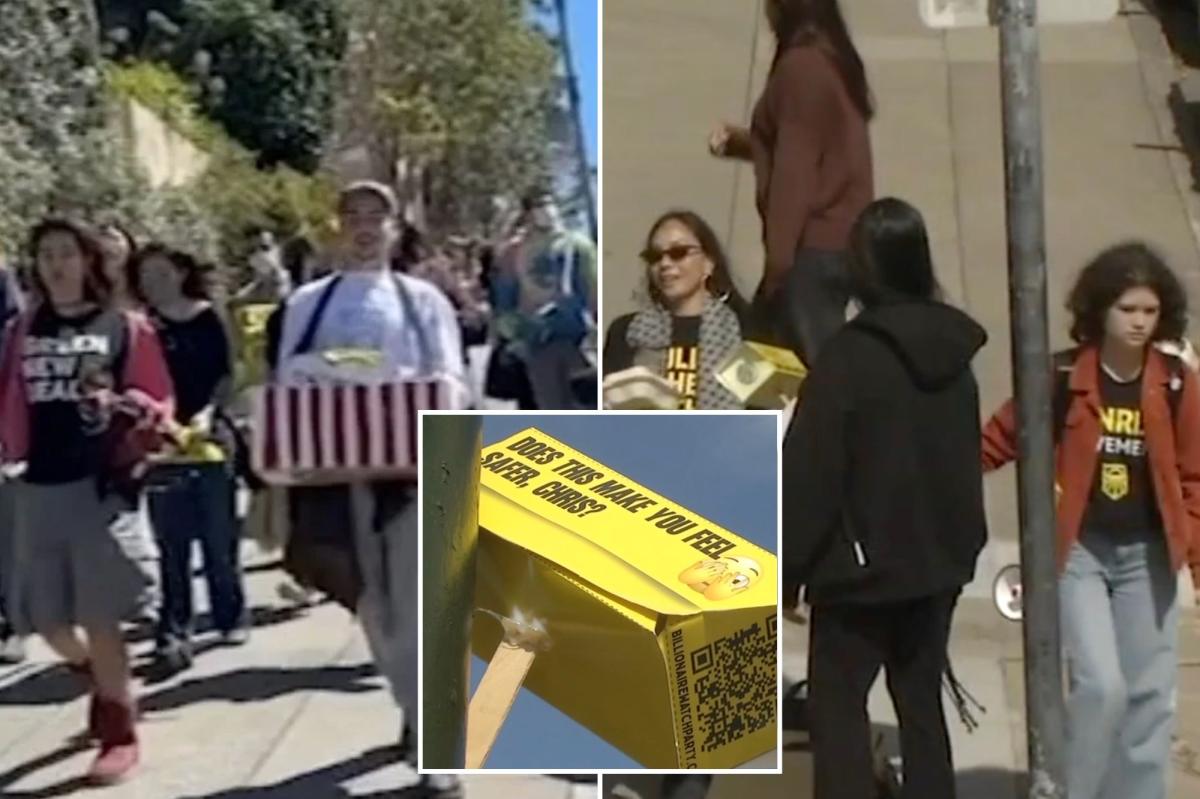
Activists showed up at cryptocurrency billionaire Chris Larsen’s San Francisco mansion to protest his support of Flock cameras.
A coalition of over 20 immigrant rights groups, climate organizers and others are demonstrating as part of the “National Week of Action Against Automated License Plate Readers.”
On Friday they erected dummy yellow cardboard cameras outside Larsen’s Bay Area home with signs on them saying “does this make you feel safer Chris?”
They also pasted bright pink posters with the image of a shocked doll’s face and arrows pointing towards the installed Flock cameras. “There is a Flock camera on this pole. Do something,” read the poster.
“There’s not much evidence that flock cameras significantly impact crime rates,” Luc Bouchard, an organizer with Sunrise Movement Bay Area, claimed to ABC News.
Bouchard also accused Larsen of investing “more than any tech billionaire in the tech surveillance system in San Francisco.”
“He feels that he’s entitled to watch us, we came to his house to watch him,” Bouchard said.
The series of protests comes on the heels of rising mass surveillance concerns among residents in California and across the nation.
More than 117,000 automated license plate readers from Flock Safety are located across the country, including more than 16,000 in California alone, according to a DeFlock map. Flock’s cameras account for about 83% of the map’s total.
Most of the cameras the Golden State are in LA or the Bay Area. San Francisco County ranked third in the nation for cameras per road mile with 1,196 per 1,000 miles, according to the data.
Online tool DeFlock.org had also revealed earlier this month that controversial Flock cameras were installed across 6 locations in Yosemite National Park despite mass surveillance concerns.
However, park officials claimed that the cameras are not designed to read license plates but to help control traffic.
Amid mounting scrutiny from privacy advocates and politicians, Flock Safety had announced earlier this month that it will reduce the duration of data stored by the license-plate cameras from 30 days to just seven.
The company had also assured that cops would have to justify every search.
CEO Garrett Langley told the California Post the overhaul amounts to the toughest license-plate-reader policy in the country.
About 90% of investigative searches on Flock’s system already occur within seven days, according to Langley.
Mounted on streetlights, these cameras capture images of passing vehicles and log their license plates. Authorized users can reconstruct a vehicle’s route by mapping these photos and locations.
The system automatically converts the imagery into searchable database records by indexing license plates, model, color, unique features and timestamps.
The LAPD has already suspended its contract with the company over privacy and data security fears.
Read the full article here